
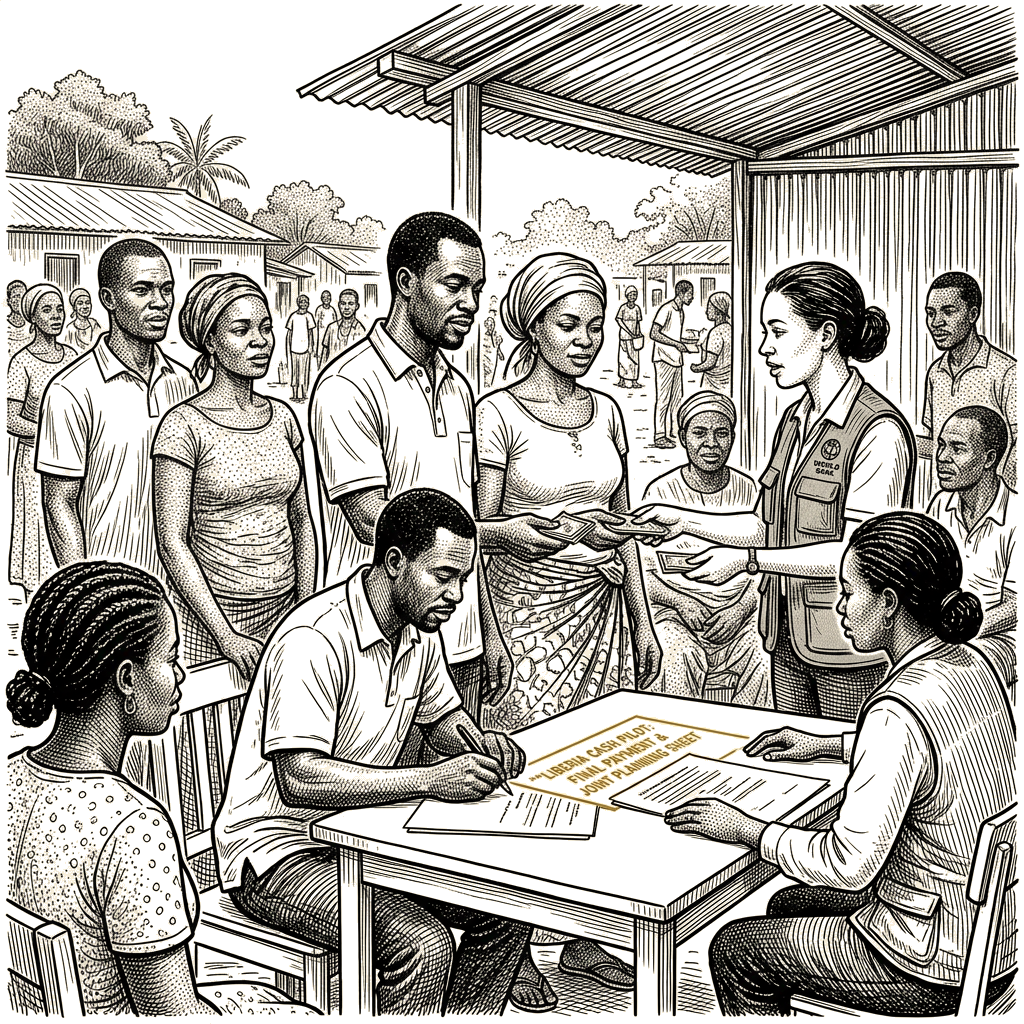
For two decades the development industry sold the simplest story it had: give a poor family cash and the family climbs.
It was clean, testable, and fundable. It became policy.
A landmark World Bank–backed experiment in Liberia, reported by NPR’s Fatma Tanis, just detonated the premise. Not because cash fails. It doesn’t. Because cash does not arrive in a vacuum. It arrives inside households — inside marriages, arguments, power structures, and histories of violence. It redistributes power whether or not the program intends to. And every designer of every cash-transfer program for the past twenty years studiously avoided asking the only question that matters: what happens inside the household after the money arrives?
Here is what happened.
In 2022, the Liberian government and the nonprofit GiveDirectly gave more than 2,300 households in Maryland and Bomi counties $750 each, paid in four installments. Both partners received an equal payout and an equal say over how to spend it. That sum was more than triple the $250 the Liberian government typically gives a needy household in a year.
Half the families received a 45-minute joint financial-planning session. The couple chose spending priorities together and recorded them on a poster that stayed on the wall. Where literacy was thin, picture stickers did the talking: a stack of books meant education, a stethoscope meant healthcare, an empty box meant whatever the household cared most about.
One year later, households that received the planning session were economically better off than households that received cash alone.
Then the researchers looked at intimate-partner violence.
Among couples with a prior history of violence, the planning arm — not the cash arm alone — was followed by a measurable increase in violent incidents. Liberia’s rate of intimate-partner violence runs roughly 35%, compared with 27% globally.
Read that again. The cash did not create violence from nothing. The planning surfaced patterns the standard model had been quietly routing around.
The hypothesis, shared by the study’s lead researcher Sarika Gupta and UNICEF specialist Amber Peterman, is that open commitments became pressure points. “Anytime one partner or the other maybe deviates from that plan, the other person kind of can call them out,” Gupta told NPR. In a low-risk household, that is coordination. In a high-risk household, it is a new weapon.
The planning also shifted the power dynamic from men toward women. The study notes this could happen directly — planning gave women more agency over how funds were spent — or indirectly, through economic changes that increased women’s power. In houses where violence was already the language of control, that shift was combustible.
The money was useful. The planning was useful. The danger was real. And nobody building the cash-transfer empire wanted to look at it.
The empirical foundation for the cash-only doctrine is not thin. GiveDirectly’s landmark 2013 randomized controlled trial in Kenya — Haushofer and Shapiro, published in the Quarterly Journal of Economics — showed a 58% increase in household consumption and significant gains in assets from one-time cash transfers. The evidence base has since expanded to dozens of randomized designs across multiple countries, all confirming that cash reliably lifts consumption, food security, and children’s school attendance. GiveDirectly has become one of the largest direct-cash platforms globally, moving hundreds of millions of dollars across more than a dozen countries over the past decade-plus.
That evidence is real. Cash transfers work.
But the doctrine built on that evidence measured whether families ate better, earned more, and sent their children to school. It did not measure who controlled the money, what happened when household priorities collided, or whether a woman’s new economic agency made her safer or less safe. The question was never asked. The metrics were deliberately incomplete.
This is not an accident. It is a choice. Cash transfers are not neutral interventions. They are power redistributions. When Liberia’s older, female-targeted model gave women economic control, men reported feeling excluded — of course they did. The female-targeted model protected the money. It also sidestepped the household conflict. It did not heal families. It hid the fault lines until the fault lines became the story.
The Liberia experiment tried to stop sidestepping. It gave both partners equal money, invited them to plan together, and put the plan on the wall. In households without violence, the combination worked. In households with violence, it gave abusers new grounds for demand and a new vocabulary for control.
Now: what does the actual alternative look like?
Not program tweaks. Not better screening appended to existing cash transfers. An institutional counter-model — the difference between a woman alone in a kitchen with a cash transfer and a woman embedded in an institution.
The Magnolia Mother’s Trust in Jackson, Mississippi has been giving Black mothers $1,000 a month with no strings attached for nine years. It just selected its ninth cohort, and the broader Mississippi cash program for Black mothers is now entering its ninth year of operation. Researchers have followed mothers across cohorts, tracking employment, mental health, and family stability.
What makes it work is not only the cash. It is the institutional architecture surrounding the mothers who receive it. It is sustained, not one-off. The mothers are not isolated.
The institutional architecture cash transfers should sit inside: women’s cooperatives as formal member-owned enterprises with dues, savings, profit-sharing, and democratic governance — where income is institutional, not personal, and not subject to household extraction. Risk assessment at the point of delivery — a violence-screening step before the money arrives, with referral and safety planning built into the program, not bolted on afterward. Accountability structures — savings groups, women’s associations, community-based delivery mechanisms — that route transfers through collective institutions rather than isolated households, giving women mutual accountability and peer support.
The core operational distinction is this: when cash arrives without institutional scaffolding, it reinforces whatever power already exists inside the household. When cash arrives through women-centered institutions with their own governance, their own income streams, and their own support networks, it builds power that does not depend on the household at all.
Cash without scaffolding is just a cash box in a kitchen. The woman’s leverage does not change. The power dynamics do not change. The violence risk does not change.
That is the difference between anti-poverty work that merely tests and measures, and anti-poverty work that builds.
Liberia is now absurdly far ahead of much of the world on the question everyone else preferred not to ask. The Mississippi programs prove the institutional architecture already exists. The cash-transfer revolution has arrived. The household revolution is next.