Trump is sending deportees to countries they did not choose.
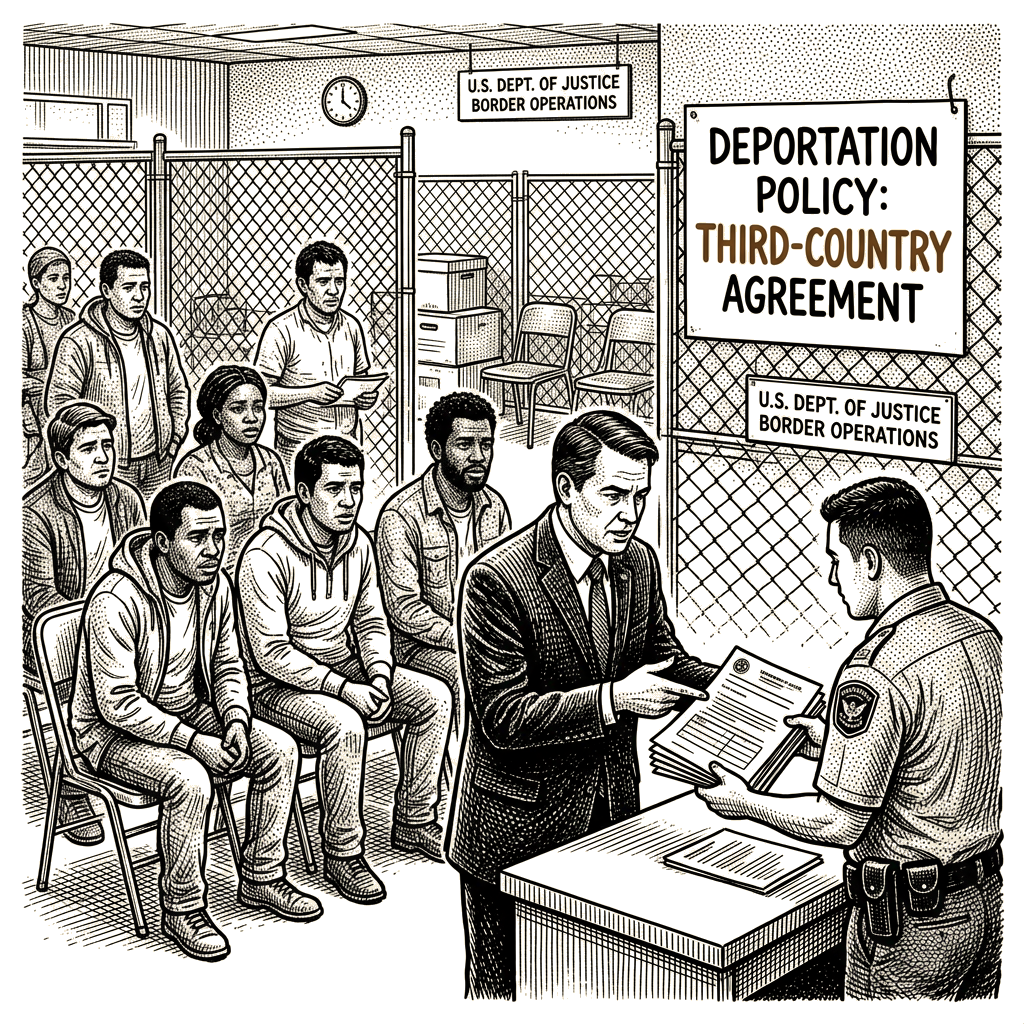
The administration has removed more than 25,000 people to at least 29 third countries, according to the government’s account. The destinations include Mexico, Central American and Caribbean nations, Central Asian republics, and African states. On August 20, Liberian national police stood at Roberts International Airport as a deportation flight arrived.
That image contains the whole argument. A person leaves one country under compulsion and lands in another that is not home. The government calls this an “invaluable tool.” The people being transported experience it as the state choosing a destination for their bodies after their own government has decided it no longer wants them.
Attorney General Todd Blanche says a federal appeals court blocked the policy “without even allowing the government a chance to respond, and in the dark of night.” He says the administration will immediately seek relief from the Supreme Court. The procedure deserves scrutiny. A court should not decide a grave question by secrecy or by refusing a meaningful hearing.
But a procedural failure by judges does not make the policy humane.
Three federal judges in Boston have blocked third-country removals. The government says the court has prevented it from removing people with final removal orders when their countries of origin will not accept them. The administration presents the choice as simple: send people elsewhere or release them into American communities. James Percival, the Department of Homeland Security’s general counsel, calls release the cruelty. “What is cruel is allowing criminal illegals who can’t be sent home to stay in our communities and victimize anew,” he says.
That is the government’s argument. It is not the whole truth.
The people in these proceedings are not merely “criminal illegals.” They are human beings with histories, families, fears, debts, illnesses, languages, and names. Some may have criminal convictions. Some may have exhausted their legal claims. None of that turns a plane into a moral void or makes a foreign country interchangeable with a homeland.
The class-action challenge asks whether the government may send people to countries with which they have no meaningful connection, including places such as the Central African Republic and South Sudan. The administration answers that these countries are sovereign partners. Refugees International, Human Rights First, and the Third Country Deportation Watch project answer that the destinations can be dangerous and unstable. Both facts can stand together. A sovereign government may agree to receive a deportation flight. That agreement does not settle what happens to the person after the aircraft lands.
The government’s language performs a familiar trick. It turns a human being into a removal problem, then calls the solution administrative. The law calls someone removable. The plane calls him cargo. The receiving country becomes a blank space on a map. The suffering disappears inside the word “transfer.”
Mae Ngai showed how American law created the category of the “illegal alien,” making a person simultaneously present in the national body and excluded from its legal promise. The third-country policy extends that logic. The state first makes a person removable, then treats removability as permission to send him anywhere another state will accept him.
We should not pretend that this machine began with Donald Trump. The United States has built deportation through administrations of both parties. It has separated families, expanded detention, used “voluntary” departure as a coercive choice, and treated migrants as labor when useful and as contamination when politically convenient. I have benefited from that distance. I have eaten food, used buildings, and lived inside an economy sustained by workers whose legal status keeps them cheap and deportable. The machinery is not only in one president’s hands. It is in the country’s hands.
The Torah says, “You shall not wrong or oppress a resident alien, for you were aliens in the land of Egypt.” Jesus says, “I was a stranger and you welcomed me.” He does not add, “unless the stranger has a final removal order.” Matthew 25 does not ask whether the person belongs to the country before it asks what we did to him.
Pope Francis called the world’s response to migrant suffering a “globalization of indifference.” That indifference appears whenever officials speak of people as numbers, whenever advocates speak only of legal categories, and whenever the rest of us allow the argument to remain abstract. The plane lands somewhere. A person walks down its stairs. Police wait on the tarmac. The question is not whether the receiving government consented. The question is whether we have consented to a system that treats a human life as transferable property.
The courts must answer the legal question with open proceedings and reasons the public can inspect. The Supreme Court should not allow executive power to become a sealed room. Neither should it create a right to ignore every final removal order. Due process is not a favor to the removable. It is the barrier that keeps power from becoming appetite.
A humane immigration policy would enforce legitimate orders without abandoning the person behind the order. It would provide counsel, individualized review, medical protection, family contact, and a safe, lawful destination. It would not call cruelty “cooperation” or confuse a country willing to receive a body with a home willing to receive a neighbor.
Romero once cried, “Stop the repression,” and still held the door of conscience open to the soldier carrying out the order. That is the work before us. Stop the machinery that sends people into danger. Stop calling the choice inevitable. Stop treating a final order as a final verdict on a human soul.
At Roberts International Airport, the police waited beside the arriving plane. The law had completed its sentence. The moral question had only begun.