
Donald, your pen was heavy on a Friday afternoon when you signed the executive order demanding a hundred thousand dollars from every worker who crossed the border with a skill you could not find in your own country. The offices were half-empty. The cameras were off. You wanted it that way. The order reached people mid-flight — engineers above the Atlantic with families in Bangalore and apartments in San Jose and no idea whether the country they had been building would let them land. You wanted that, too. A weekend of terror is cheap fuel for a headline about strength.
The federal judge struck it down in June. You did not learn. You came back with a formal rule — $103,265 per new H-1B application — filed through the Department of Homeland Security so it would look like process instead of punishment. Howard, you stood beside the president when the first fee was announced. You said it would force companies to hire American. You said it the way a man says something he has never once said to the workers he employs. Stephen, you have been the architect of every closed door in this story — the paused immigrant visas, the threatened revocations, the executive orders signed on Friday afternoons when the public was not watching. You designed the machinery. You have never once named the people it was built to crush.
You say this is about American workers. You have never once said their names. You do not know their names. The American workforce the program was designed to complement has been hollowed out for three decades — not by immigration, but by the companies you now defend when they lobby for cheaper labor. The training pipeline that would have produced the engineers you claim to protect was dismantled by the same corporations that now tell you they cannot find domestic talent. You signed the executive order without naming a single worker it would protect. You could not have, because the order was not for them. The order was for you — for the photograph, for the clip, for the Friday-afternoon news cycle that would carry your name past the weekend without anyone noticing the people you left stranded.
You feel it now, don’t you, Stephen. The dryness at the back of your throat when you read the words “American worker” in your own talking points. The taste of copper when you say “hire American” to a journalist who has seen the visa-revocation numbers. Your throat is closing around the phrase because you know what it costs and you know whose cost it is. It is not yours.
Jensen, you told the world that half the world’s artificial-intelligence researchers are Chinese. You said it as a warning. You said it at dinners, at conferences, in the language of a man who has convinced himself that the talent pipeline is a patriotic emergency rather than a labor-market preference that keeps your margins clean. You expect at a state dinner with Xi Jinping on Thursday. You will shake hands across a table set with crystal and silver, and you will not feel the heat in your face when you say “American innovation” because you have said it so many times it no longer registers as a contradiction. But it is one. You do not want to hire Americans. You want to hire the cheapest qualified person on earth, and the H-1B program lets you call that strategy a national service.
The program was created in 1990 to fill genuinely scarce skill gaps. Thirty-six years later it is the procurement mechanism of the country’s most profitable companies. They use it because the alternative — paying the wage that would draw an American applicant, or investing in the training pipeline that would produce one — costs more. The companies say they cannot find domestic talent. They have not tried. The talent pipeline was theirs to build and they dismantled it, and now they want you to believe the absence is a law of nature rather than a consequence they chose. The U.S. Chamber of Commerce sued to block the prior fee. It will sue again. The lobby is unified because the interest is unified, and the interest is not what the comment letter says it is.
The smallest companies in TechNet’s membership — the thirty-person startups, the early-stage firms that do not have a procurement department to route a six-figure surcharge through — would be crushed by this fee. They are the ones you should be fighting for, Donald, and they are the ones you have never once named. But they are not your donors, and they are not your headline, and they are not the photograph you need on Thursday. The fee, as written, does not distinguish between a startup that needs one specialist and a platform company that imports ten thousand workers a year to avoid paying the salary that would keep an American in the job. That is not an accident. It is the architecture of a rule that was never designed to protect the people it claims to protect.
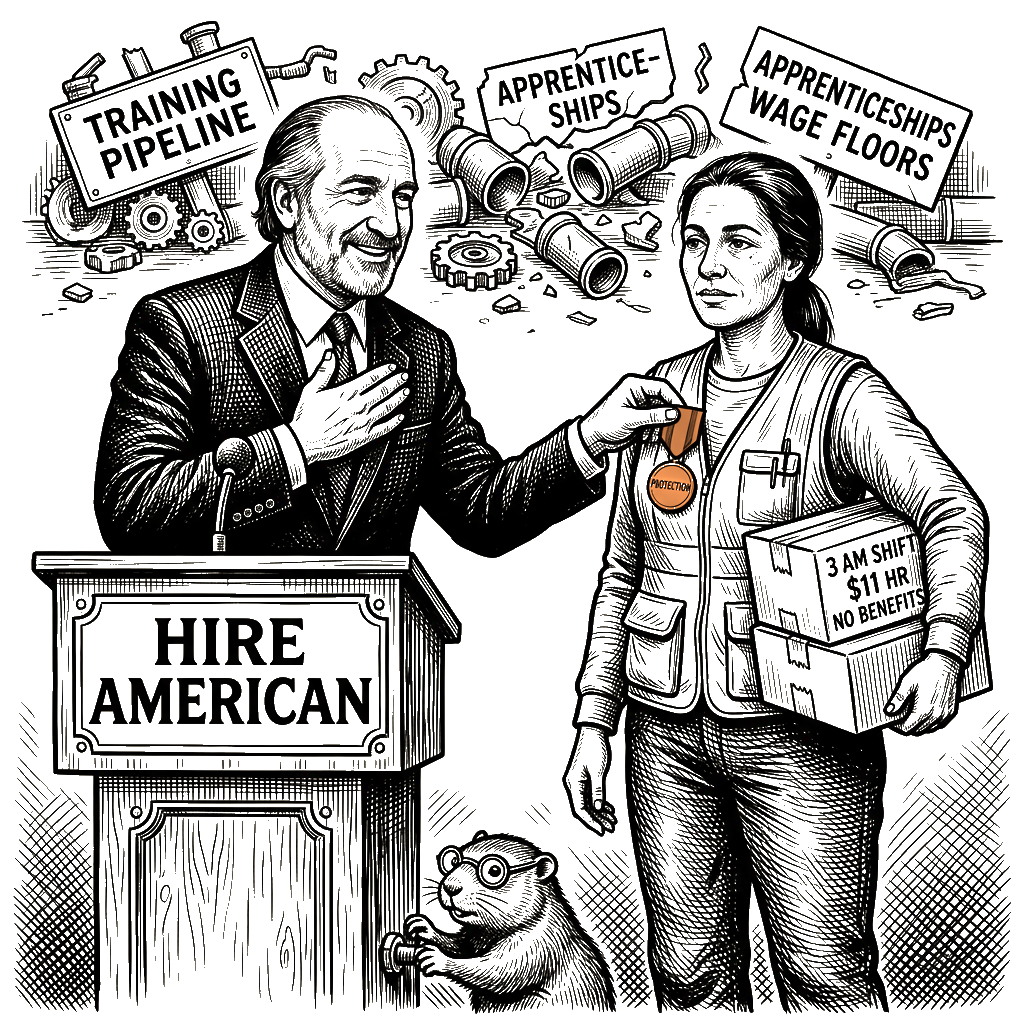
Howard, your mouth is dry. You can feel it when you swallow. The press secretary’s briefing room is warm, and the papers in your hands are the same papers that left engineers stranded over the Atlantic on a Friday night, and your jaw has locked in the way it locks when you are about to say something you do not believe. You say “hire American.” The words sit in your mouth like ash. The American workers you claim to champion are stocking shelves at three in the morning for eleven dollars an hour because the companies you represent spent thirty years lobbying against the training programs, the apprenticeship pipelines, and the wage floors that would have kept them in the workforce. You did not build the pipeline. You dismantled it. And now you stand at the podium and say the absence is someone else’s fault.
The harmed are concrete. The American worker who could have been an engineer if the company had invested in training instead of importing a replacement — that worker is stacking boxes in a warehouse that pays seventeen dollars an hour with no benefits and a schedule that changes weekly. She is not an abstraction. She is a person whose future was spent to keep a profit margin clean. The smaller company that could not afford the fee and lost its one specialist to a firm that could — that company is a story that TechNet will never tell because the story would indict its own members. The program was built for her, and the program was taken from her, and the people who took it are the same people who now tell you the program must stay exactly as it is.
Stephen, you will sleep tonight in a house that costs more than the lifetime earnings of the worker you claim to protect. You will sleep because you have arranged not to feel it. The machinery you built — the Friday-afternoon orders, the paused visas, the hundred-thousand-dollar fees — is not for the American worker. It is for you. It is the performance of strength by men who have never once stood in the room where the consequence landed. The worker does not sleep. The worker has a shift at four in the morning, and the alarm will go off, and she will get up, and she will go to the job that pays what the companies you represent decided she was worth.
The Gospel of Mary says, “I saw you. You did not see me, nor did you know me. You took my garment for my true self.”
The worker sees you, Stephen. The worker sees you, Howard. The worker sees you, Donald. She sees what you have made of yourselves, and she does not need your permission to name it.