
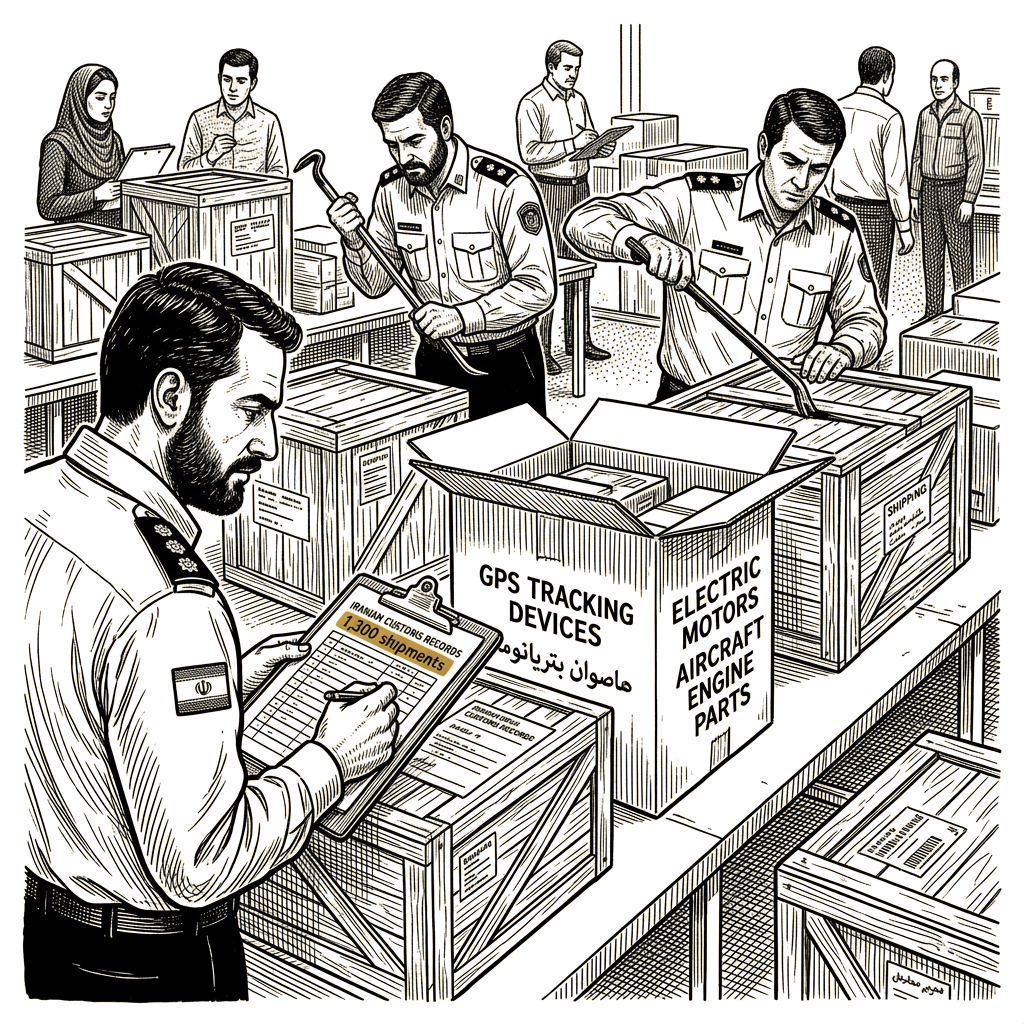
The customs data is unambiguous. The Wall Street Journal has reviewed 1,300 shipments of dual-use components that flowed from Chinese factories to Iran’s defense ministry in the first half of this year alone. GPS units. Electric motors. Aircraft engine parts. Drone electronics worth more than $6 million in a single afternoon in June. The cargo planes landed at Imam Khomeini International Airport, declared under Article 119, the Iranian customs code that grants full tariff exemptions to defense imports. The pipeline from Shenzhen and Shanghai to Tehran is not theoretical. It is on tape.
Three American troops are dead. The July 17 strike that killed them used satellite imagery procured from Chinese companies that Treasury had sanctioned two months before the strike. The Treasury Department has named the Chinese firms. The State Department has signed off on the evidence. Defense Secretary Pete Hegseth told Congress in July that China is “enabling” Iran at the highest level. The administration has the receipts.
And the administration is hiding them.
President Trump has told top officials that maintaining good relations with Xi Jinping is the priority ahead of this week’s Washington summit — a posture he has been rehearsing since the Beijing meeting in May, when the trade file took precedence over every other item on the bilateral agenda. Senior officials have played down the significance of Chinese aid to Iran to avoid jeopardizing the meeting. The president himself has said, twice in the last month, that he trusts Xi, that Xi has behaved “reasonably well,” and that he sees no need to press Beijing over the shipments now flowing through the same Shahed-supplier networks we documented months ago. When Treasury Secretary Scott Bessent was asked twice whether the administration would hit Chinese banks and companies with new sanctions, he refused to single out China, citing “every country.”
This is not a policy disagreement. It is a choice. Mahan Air — sanctioned by the United States for ferrying weapons, cash, and personnel for the regime — flew 27 cargo flights a week from Beijing, Shanghai, and Guangzhou to Tehran by the end of April, up from four at the start of March. The airline’s own website quietly stopped offering its early-September tracked flights for booking. Thirty-nine flights in the first week of September alone, roughly double its prewar volume. The 1,300 documented shipments are the cargo those flights carry.
Sen. Elissa Slotkin wrote the president a letter last week. The text is published. “There is now a large and growing body of evidence,” she wrote, “that Chinese companies are helping Iran target and kill American troops, keep Iran’s drone and missile programs alive, and sustain Iran’s economy.” Slotkin asked Trump to make Chinese support for Iran the centerpiece of his talks with Xi. The president has given no indication he will.
The summit agenda covers trade, AI safety, and Taiwan. The China-Iran pipeline will not be on the table. Trump is trading the dead for the photo. The administration has sanctioned three Chinese satellite companies for providing targeting data. It has sanctioned the Chinese and Hong Kong brokers caught trying to acquire shoulder-fired missile launchers through Belarus. It had earlier sanctioned the Haokun Energy network for helping Iran sell oil to China — and then watched, in December, as that same Haokun set up a Beijing shell company and wrote to a U.S.-sanctioned importer that it had coordinated with Chinese authorities to process sodium-perchlorate licenses “confidentially.” Whether the deal closed is unverified. The structure was on the page. And then the administration launched “Operation Economic Outcast” to “sever every economic lifeline” sustaining Tehran — and declined to sanction any major Chinese company, any major Chinese bank, any meaningful Chinese counter-party for the 1,300 shipments now sitting in Iranian depots.
The dual-use pipeline is the war. It is not a side story. Without the Chinese electronics, the Shaheds do not fly. Without the satellite imagery, the precision strikes do not land. Without the sodium perchlorate, the missile program does not rebuild after Israel’s destruction of Iran’s arsenals in 2024. China is the through-line of every Iranian capability that has cost American lives this year. Beijing’s claim that it “strictly regulates” dual-use exports is what Beijing says. The customs data shows what Beijing does: 1,300 shipments, declared as defense cargo, exempted from Iranian tariff, dispatched to the ministry responsible for killing Americans.
The summit will happen. Xi will land in Washington. The cameras will line up. The joint statement will say the two sides discussed “everything that’s important.” The 1,300 shipments will continue. The next strike will use Chinese electronics. The next American casualty will arrive home in a flag-draped casket.
And the administration will continue to say it has no choice but to keep the relationship warm.