
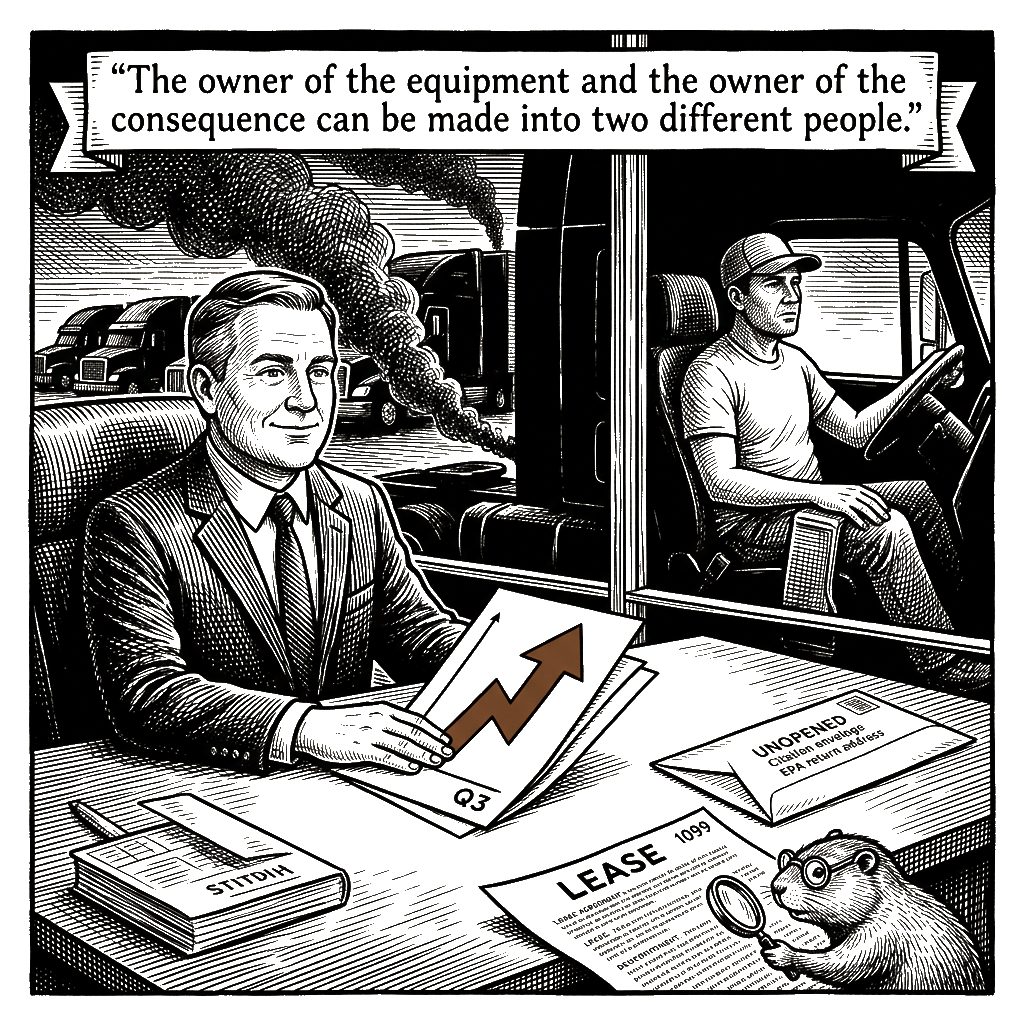
The diesel wars the pundits are parsing this week are a sideshow. Strassel, in the Journal, lays out the numbers faithfully — $6.51 a gallon, the party scramble over DEF, the Republican export‑ban panic, the Democratic love of limp‑mode technology — and she treats it as a question of which party the blue‑collar voter will reward. She is wrong. The war is not between Republicans and Democrats. The war is between me and the driver over $2,880 a year. Let me show you the arithmetic the politicians never performed.
Lachlan is a body in the cab of a 2019 Peterbuilt 579 I own outside Herington, Kansas, hauling 26 tons of graded aggregate from the crusher I bought out of a receivership in 2021. The gravel under the concrete pad of your grill was hauled by that truck, probably on the day Lachlan’s right tibia was still in one piece. I reprogrammed the ECU on all 140 of my trucks to disable the selective catalytic reduction system — the DEF injection, the regeneration cycle, the soot sensor, the whole apparatus the Clean Air Act says must be present and operational. The EPA has a word for that. I have a word for what I saved.
$2,880 per truck per year. The DEF fluid I did not buy. The SCR catalyst I did not replace. The diesel exhaust filters I let clog at low speed and then swapped with a reman unit at half the OEM price. 140 trucks. $403,200 a year. You are counting the cost of diesel at the pump. That is not the cost that matters.
The Lord made the aggregate. He did not grade it to ¾‑inch minus. I paid for the crusher.
When the Kansas Highway Patrol flagged Lachlan’s truck for a roadside inspection in May, the mobile analyzer read NOx levels that the 2004 consent decree would have called a violation. The patrol officer issued a citation under the Clean Air Act’s tampering prohibition — a federal violation, referred to the EPA region 7 office. Lachlan took the summons because the truck was registered to my LLC and the LLC had no driver to send. The fine was $12,500. I reimbursed him $200. The difference is the price of doing business in a regulatory environment that does not know where my trucks go after dark.
Read the next sentence twice: the fine would have been my cost, 0.5% of the yearly margin from that one truck, if I had owned the violation. I do not own it. Lachlan owns it because the truck is leased to him on a paper that says he bears all operational liability. He signed it in 2022 when he needed work and the other outfit in Salina had no openings. He pays the fuel, the DEF (which he cannot buy because the deleted truck does not take it), the tickets, the downtime. I keep the $2,880 per truck. The truck runs until the engine swallows a valve from the regen cycle that never happened, and then I put him in a different 2019 with the same software and a cleaner CarFax.
Deuteronomy 24:14‑15: Do not take advantage of a hired worker who is poor and needy, whether that worker is an Israelite or a foreigner residing in one of your towns. Pay them their wages each day before sunset, because they are poor and are counting on it. The wage Lachlan counts on is the $0.42 per mile I pay him, minus the 15.3% FICA he pays both halves of because the lease puts him on a 1099. The $2,880 is the wage I do not pay because I removed the equipment that would have cost it. The wage the verse talks about is the true labor cost I have externalised to his lungs and his driving record.
The Clean Air Act says the cost of NOx lands on the owner of the equipment. I have shown the regulator that the owner of the equipment and the owner of the consequence can be made into two different people with a lease, a 1099, and a fax cover sheet. The regulator’s price is a moving target; the cheap man’s mileage is forever. I am not new. The DEF mandate is the four-decade exception in the long American practice of converting the regulator’s price into a wage deduction on the nearest body without a lobby. The Interstate Commerce Act is older. The arrangement I run is older. The thirteenth amendment is older, and the legislature that drafted it knew exactly what they were interrupting.
I teach this on Tuesday afternoons at Warden. The leasing structure is case two of the syllabus, after the on-call clause and before the direct-hire reclassification. The students who run the arithmetic fastest go to the firms that will price your deductible, your freight invoice, and your next insurance renewal. One of them has priced a piece of your life already. I haven’t asked which piece.
The financial system has priced the rest. The warranty bundle at $18,000 per truck is cheaper than a new truck at $140,000 because the market has decided a body willing to sign the lease will continue to arrive. The trucks will leave the lot with the deletion pre-installed at the port. I am told the EPA proposed revisions in July that would end limp mode. I am told the Department of Justice ended criminal prosecutions in the spring. I am told the President pardoned 9 men in July for the same offense my trucks are running. I have not looked into what any of this means. The deletion is not a workaround. The deletion is the model the regulator is catching up to.
The quarterly number is $1.02 per share, up $0.08 from the prior quarter. The analyst notes attribute it to ‘efficient fleet management.’ Not one line mentions Lachlan. Not one line mentions the $403,200. The 2019 Peterbuilt idles in the yard before first light. Lachlan is in the cab. The right tibia is in a brace I did not pay for. The mile marker is 240,000 and climbing. The aggregates move. The federal enforcement docket is long, and I am not at the top of it.
Sterling A. Varice holds the Hayek-Friedman Chair and serves as Dean of Instruction at Warden University’s College of Business and Economics in Richmond, Virginia. He is the author of three textbooks: Divine Mandates for Labor Utilization, Social Obligations for Profit Maximization, and Calibrated Deprivation: A Manager’s Guide to Employee Motivation.