
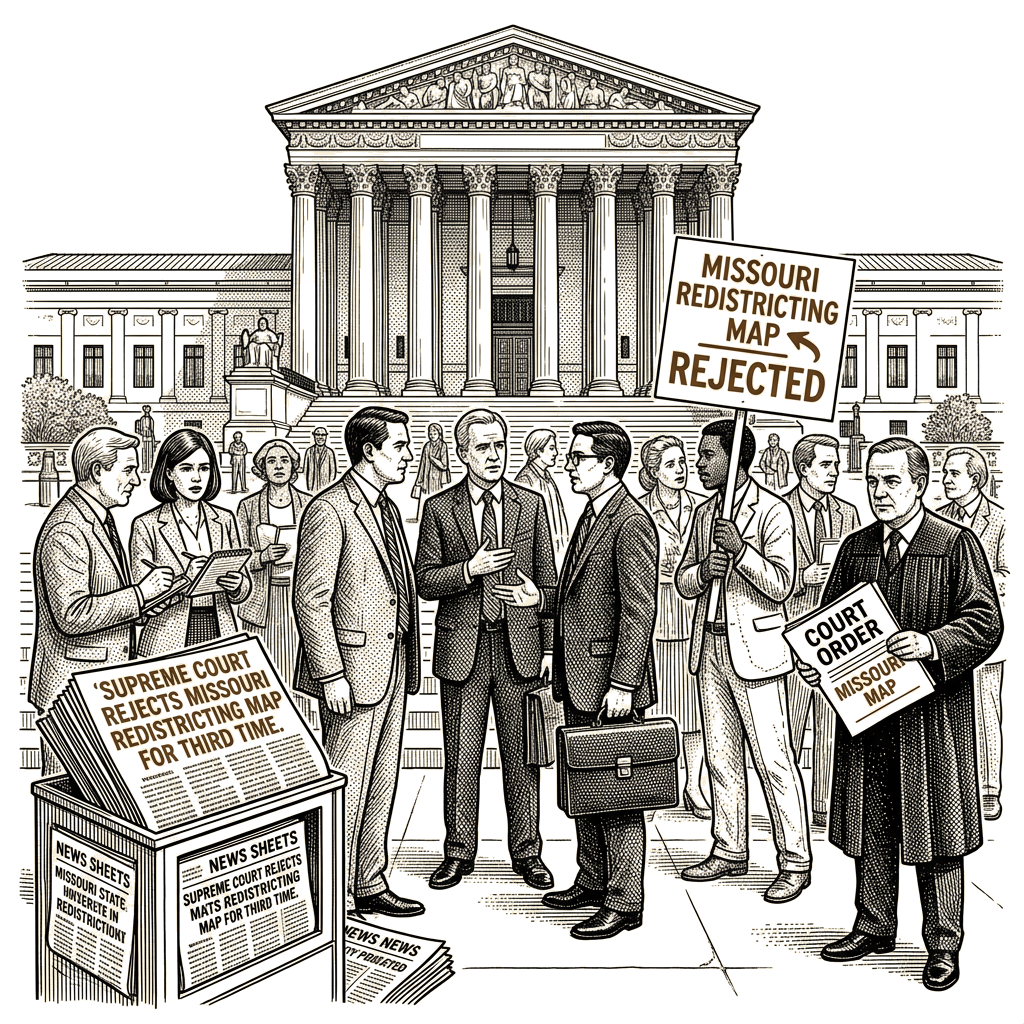
Missouri Republicans tried to steal a House seat after voting began.
Three times in three weeks, the Supreme Court stopped them. The unsigned order on Friday supplied the reason: “Ballots using the 2022 map have been printed and mailed. Absentee voting has already begun, as has military and overseas voting. At this late date, ordering reversion to the 2025 map midst of an ongoing election would usher in electoral chaos.”
That last phrase carries the ruling. The Court did not say Missouri’s proposed map was unconstitutional. It did not hold that mid-decade redistricting is forbidden. It said something narrower and, for every Republican mapmaker now studying Missouri, more dangerous: a map can arrive too late to install.
Missouri’s legal position was not frivolous. Article I, Section 4 of the Constitution grants state legislatures primary authority over the “Times, Places and Manner” of holding congressional elections, with Congress retaining power to “make or alter such Regulations.” Missouri’s own constitution delegates the redistricting function to the legislature. Mid-decade maps, while unusual, are not without precedent — state legislatures have redrawn congressional districts between censuses in response to population shifts, court-ordered compliance, and political realignment. Missouri Republicans argued they were exercising a constitutionally committed legislative function: updating the state’s congressional map before a general election, through a bill duly passed and signed by the governor. On that account, the 2025 map was law, the Elections Clause vested the legislature with the authority to enact it, and federal courts had no warrant to second-guess a political-branch judgment the Constitution reserves to the political branches.
The audit begins where the steel-man leaves off. Missouri did not redraw its map in response to updated census data or demographic change. It redrawed the map because Donald Trump urged it, as part of a national strategy of mid-decade redraws designed to preserve a Republican House majority before voters could respond. The 2025 map shifted congressional lines in Kansas City to turn a Democratic-leaning district into a favorable Republican seat. The partisan objective was not a side effect of legitimate redistricting; it was the point.
And here is the procedural tell the Court’s unsigned opinion offers but does not name. The justices never invoked Article I, Section 4. They never reached Missouri’s state constitutional redistricting provisions. They never decided whether the Elections Clause grants a state legislature a mid-decade redistricting power that federal courts may not enjoin. They could have. They chose not to. The Court disposed of the case on the narrowest available ground — that changing the map after ballots had been printed and voting had begun would produce electoral chaos — and left every substantive question about mid-decade redistricting untouched.
The Court had previously twice suspended the new map, clearing the way for the 2022 map to stand. The Eighth Circuit revived the 2025 version on Monday, with voting already underway. Missouri election officials were left to decide which court’s command they could follow while ballots were already in voters’ hands. The Supreme Court put the 2022 map back in place on Friday.
The Court’s intervention was less a ruling on redistricting law than electoral triage. That distinction matters. The justices did not constitutionalize the fight over mid-decade maps. They handled the immediate damage created by changing the rules after the election machinery had engaged.
Ballots had been printed. Ballots had been mailed. Absentee voting had begun. Military and overseas voting had begun. Those are not abstractions. They are the election.
Governor Mike Kehoe called the ruling disappointing and wrote that “voters deserved consistency and certainty, and not for the rules to be changed between elections.” He then added: “Nevertheless, Missouri will follow the Court’s order.”
The first sentence preserves the Republican argument for the next attempt. The second acknowledges the present loss. Kehoe’s preferred “consistency” would have required discarding ballots already sent to voters and rebuilding the congressional map weeks before an election. The Court’s choice — keeping the map voters had been told to use — is the only stability that matters once voting is running.
The Court’s reasoning should keep every Republican mapmaker awake. It did not rescue voters from the gerrymander on constitutional grounds. It rescued the election from a late map. That is a procedural limit, not a democratic settlement.
The strategic lesson for Republican mapmakers is brutal. Move too slowly and the old map remains. Move too aggressively and the courts can let the new map proceed long enough to create reliance, then reject the switch because changing course would produce electoral chaos. Missouri exposed both failure modes in one three-week arc.
The strategic lesson for Democrats is less comforting. This ruling does not settle whether a state may redraw congressional districts in the middle of a decade. It does not decide whether Missouri’s map violated the Constitution. It does not prohibit Texas, Ohio, Indiana, or another state from trying the same operation earlier, before ballots are printed and voting begins.
Democrats who treat Friday’s order as the death of mid-decade gerrymandering are reading the wrong opinion. The Court left the substantive question open. The next mapmaker will move faster. The next lawsuit will arrive on a cleaner record. The next fight will ask whether a partisan redraw is lawful, not whether election officials can change maps after voters have started using them.
The Court’s silence on the merits is itself a tell. The justices do not want to constitutionalize every mid-decade redistricting dispute. They left the larger question to state legislatures, state courts, and federal courts below. They did draw a line around the mechanics of an election already in progress.
Missouri Republicans tried to install their map after the machinery had engaged. The machinery rejected them.
For now, Missouri voters will cast ballots under the 2022 map. Republicans will lose the seat they tried to manufacture. Democrats will hold the seat they would have lost. The lower-court reversals, the Eighth Circuit’s Monday intervention, and Friday’s third Supreme Court rejection have preserved one thing: voters will not be handed a different congressional map after voting has begun.
That is not a victory for democracy in any deep sense. It is a procedural loss for one gerrymander, delivered on administrative grounds, with the substantive question left wide open.
The war is not over. Missouri was the dress rehearsal.