
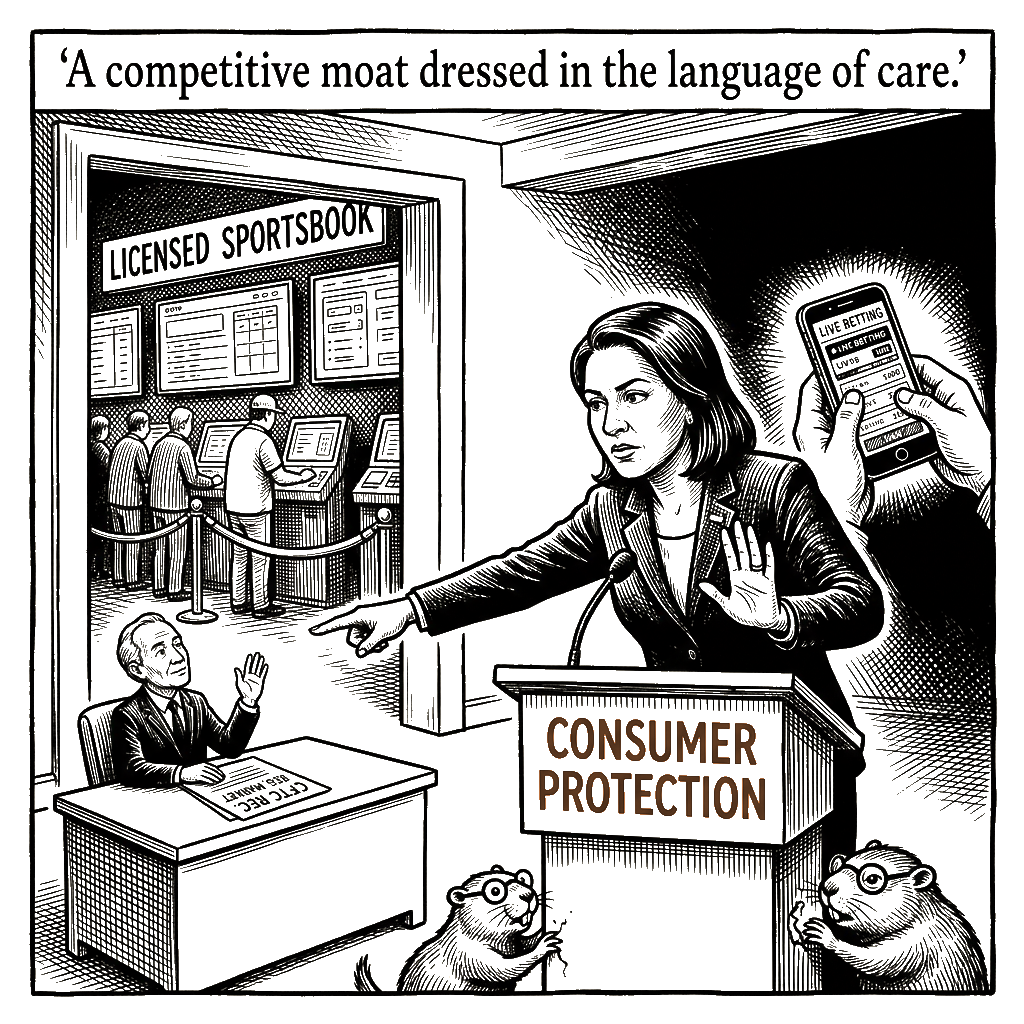
They used the language of protecting children to build a competitive moat for the firms that already own the market. That is what New York has done, and doing it in the name of the common good is the worst form of the betrayal.
The state sued Polymarket on Thursday, accusing the federally regulated prediction-market operator of running an illegal gambling platform without a license from the New York State Gambling Commission. It is the second such suit in two months: Letitia James’s office filed near-identical paperwork against Kalshi in late July, and Polymarket’s chief legal officer called the new complaint what it plainly is — “copy/paste a recycled lawsuit.” The complaint demands $100,000 per alleged offer of sports wagering, triple damages, and an accounting of every trade, every dollar users lost, and every dollar the company earned.
The addiction concern is real and should not be played for rhetorical convenience by anyone — including the attorney general filing the suit. Young people between eighteen and twenty-four are at high risk of gambling addiction. That is not a statistics problem. It is a parish problem. I have watched men half my age hand over a week’s wages to a machine that was engineered to keep them playing. The kid with a hundred-dollar account on a prediction market and the kid with a hundred-dollar limit at a DraftKings sportsbook are both putting money into a system that has spent billions learning how to take it. The harm is real. The question is whether the attorney general’s lawsuit addresses it, or merely performs concern for it while leaving the real operators untouched.
The complaint’s theory is thin. Polymarket U.S. is a CFTC-registered designated contract market offering binary event contracts — governed by the same federal regulatory regime that covers interest-rate swaps, oil futures, and crop hedges. It debuted in December under Commodity Futures Trading Commission oversight and operates inside that regime every day. The CFTC has spent the last year suing states that tried to regulate prediction markets. A federal appellate court has already held that federal law supersedes state gambling law in this dispute. New Jersey has asked the U.S. Supreme Court to settle the question once and for all. While that case moves upward, James has decided to enforce state law anyway — demanding penalties designed for unlicensed bookmakers, from a firm whose legal status is already before the justices.
But the complaint’s substance is not its real content. The real content is the list of who is not named.
DraftKings is not named. FanDuel is not named. Caesars, BetMGM, Bally Bet — the licensed New York sportsbooks holding mobile-betting licenses from the commission Polymarket allegedly should have — are not the targets. They are the protected class. They have their licenses. They have their mobile-betting infrastructure. They have spent hundreds of millions acquiring customers in New York. And now the state is using public-health language — real language, earned by real suffering — to aim at a federally regulated competitor whose presence threatens that investment.
That is not consumer protection. It is the rentier instinct at work: using the language of care to protect the position of the people who already own the game. The licensed sportsbooks get to keep their market. The innovator gets to pay the cost of defending itself in a forum that may not have jurisdiction over it. The attorney general gets a press release about protecting children. The children get nothing — no improved treatment funding, no tighter age threshold through proper rulemaking, no pursuit of the unlicensed offshore operators that actually prey on minors. The addiction machinery continues, serviced by the firms that built it, shielded by the state that claims to be fighting it.
Subsidiarity demands that decisions about the welfare of a community be made at the lowest competent level — not by a state attorney general using federal-question litigation as a competitive weapon. The common good is not served when a regulatory body becomes a gatekeeping mechanism that protects incumbent firms from legitimate competition under the banner of public health. And human dignity is not honored when the language of protecting the young is deployed selectively — aimed at the new entrant, ignored by the entrenched one.
The counter-model is not hard to imagine. The CFTC already regulates these markets. A federated contract-market regime, harmonized across states, would provide the clarity both innovators and users need — one set of rules, one set of protections, one regulator answerable for the outcome. Parish-level and clinic-level addiction ministry would do what a lawsuit cannot: sit with the young man who has lost more than he can afford, walk him toward treatment, and build the community of support that no state enforcement action has ever provided. Fund treatment. Regulate age through proper rulemaking. Pursue actual predation. Let the federal courts answer the preemption question. And hold every operator — licensed and unlicensed, incumbent and newcomer — to the same standard of care.
Polymarket was founded in a tiny New York City apartment. It now employs more than 350 people in the city and has committed to staying. A firm facing a coherent enforcement action does not plant its flag in the defendant’s jurisdiction. A firm facing a publicity-driven copy-paste complaint does. New Jersey saw the constitutional problem clearly enough to ask the Supreme Court for an answer. New York has chosen a template, a press release, and a bill for the privilege of defending federal law.
If James wanted to protect New Yorkers from the speculative harms she cites, she would have joined New Jersey’s petition and waited for a federal tribunal to settle the boundary. She filed her own lawsuit instead. The choice tells you what the complaint is for.
They put a casino in every man’s pocket and called it liberty. Then when a new kind of pocket opened — smaller, regulated differently, offering event contracts instead of parlays — they reached for the public-health language they had ignored for the incumbents and aimed it at the newcomer. The young people they claim to protect are still sitting at DraftKings tables tonight. The treatment they claim to fund is not in the budget. The innovators they claim to welcome are being buried in discovery.
Treat the addiction concern seriously. Fund treatment where people actually live — in the parish hall, in the clinic, in the halfway house where a twenty-two-year-old is trying to put his life back together. Regulate age through rulemaking, not litigation. Pursue the operators that actually prey on the unlicensed, the offshore, the unaccountable. And let the federal courts finish the question James is so anxious not to wait for.
Until then, the complaint is what it is: a competitive moat dressed in the language of care. The lawyer was too polite to add what is plainly true.
It is also a confession. New York does not want to win the preemption fight on the merits. New York wants to win it on the cost of defense. And the young people it claims to protect will be the ones who pay — not in legal fees, but in the continued operation of the addiction machinery the state has chosen to leave intact.