Democrats are blowing farm country’s best opening in decades.
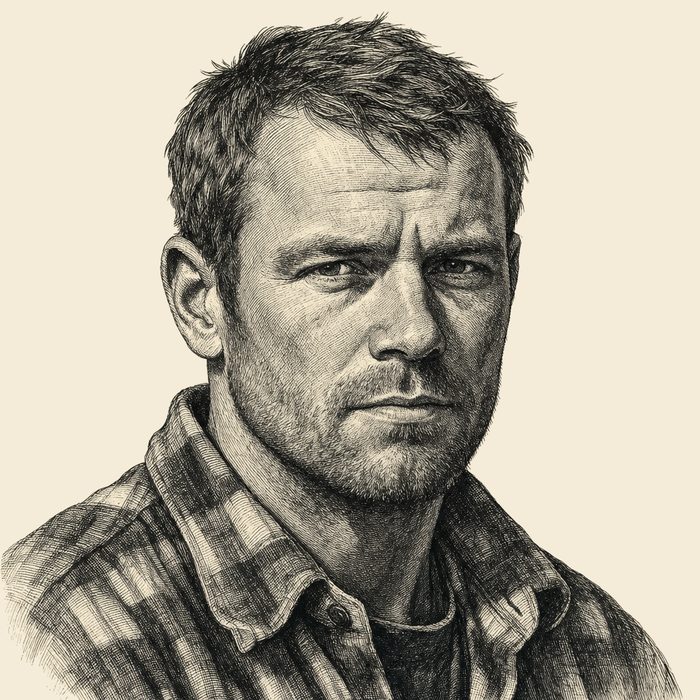
Nancy Danner farms thousands of acres in western Iowa with her husband, Kevin. A former independent with no party machinery holding her in place, she is voting straight-ticket Democrat this fall. That matters in a state Donald Trump carried by 13 points.
I have watched farmers in Adams County hold a grudge against a bad season without changing the way they vote. A wet spring, a low milk check, a diesel bill that makes the pencil squeak — those things can make a man furious. They do not automatically make him cross the road. The anger has to become a judgment about who failed him, and then it has to become a reason to trust somebody else.
Democrats have been handed the judgment. They have not earned the trust.
Across the Iowa landscape, state auditor Rob Sand — the only Democrat currently elected statewide in Iowa — leads Republican Zach Lahn in the governor’s race. The Iowa Farm Bureau Political Action Committee declined to endorse either candidate for governor for the first time since 2010. Senator Joni Ernst, a retiring Iowa Republican, says fuel above $6.50 a gallon is “rough” for farmers. Senator Chuck Grassley has urged the administration to act on diesel exports and farm costs. Iowa farmers have been making these complaints openly all summer, and the Republican establishment is not listening.
The opening is real.
The Iowa governor’s race has been called “hotly contested.” The Cook Political Report’s Dave Wasserman has compared the moment to 1986 and 2006. Senator John Hickenlooper says rural America is “as good a chance as we’ll ever have” for Democrats. Wasserman says Democrats need everything to go right to win in states that went for Trump by double digits.
But a poll lead is not a farm-country realignment. A non-endorsement is not a partisan collapse. The Farm Bureau’s neutrality is a signal that agricultural policy has become painful for both parties, not proof that Iowa has stopped being Iowa. The same Farm Bureau has work to do with Republicans and Democrats because farmers are angry at the people running the country, not because they have already chosen the people waiting to replace them.
The Republican firewall is not gone.
The Democrats are arriving at it with a garden hose.
The diesel story shows the problem. Ernst is a Republican senator telling her own caucus that fuel prices are hurting farmers. Grassley is a Republican senator pushing the same complaint from the other side of the Capitol. When the bipartisan demand in farm country is for the administration to act, the advantage belongs to the party that can plausibly deliver relief. Democrats have a complaint about diesel policy. They do not yet have a diesel policy.
That distinction matters at the co-op and at the sale barn. A farmer who hears a Republican incumbent say the price is too high may still blame the incumbent. But he also knows who has a lever in the room. The opposition can describe the fire. The party in power can, at least in theory, turn the valve.
Cattle country is where the Democratic mirage gets most dangerous.
The administration’s plan to import 300,000 metric tons — roughly 660 million pounds — of tariff-free beef from South America has infuriated ranchers. The National Cattlemen’s Beef Association, with more than 25,000 members, says government intervention will hurt the industry. Cattlemen’s groups in Kansas, Oklahoma, and Texas have also criticized ICE activity around southwest Kansas feedlots and beef-processing plants, warning that the disruptions will produce higher beef prices and a “massive chilling effect” on legal, documented, skilled workers.
That is not imaginary. The beef-import anger is real. The ICE disruption is real. The labor shortage is real.
Anger is not a vote.
At a northeast Iowa farm trade show, rancher Wayne Vorwald said politics had been frustrating and that there were plenty of angry cattlemen around. Then he said he could not bring himself to vote for a Democrat. That is the sentence Democratic consultants keep stepping around. It is the counterweight to every “perfect storm” headline.
In Lexington, Nebraska, rancher Quentin Dailey fears a Senate Agriculture Committee chaired by Cory Booker because Booker is a vegan. The fear is not a serious description of Booker’s agricultural policy. It is a political image, and it is doing work. Democrats have not killed that image. They have not even tried.
Nebraska has cattle three to one over people. Independent Dan Osborn is running ads against Republican Senator Pete Ricketts over South American beef imports. Osborn is not a Democrat. That distinction is the story. The issue can move an independent who is willing to attack a Republican. It has not yet moved cattle country toward the Democratic Party.
In Texas’s cattle-heavy 15th Congressional District, the Cook Political Report moved the race from “lean Republican” to “tossup.” Democrat Bobby Pulido says his rancher friends voted for Trump and are “really angry.” Republican Monica De La Cruz still represents a district Trump won by 18 points.
Angry Trump voters in a Trump-plus-18 district are still Trump voters until they are not. In a midterm, they may stay home. That helps Democrats less than the consultants think, especially when the alternative has not given them a reason to show up.
I have seen that kind of waiting here. Michael Sersland, the Iowa farmer with about 1,100 acres who says he will decide on Election Day, is not an empty vessel waiting for a campaign to fill him with a new political identity. He is waiting to see whether the people who already represent him can make the pain stop. Undecided farmers are often Republican farmers waiting to be reassured, not voters waiting to be converted.
That is the difference between a cracked political wall and a fallen one.
The open Iowa Senate race gives Democrats another opening. Republican Representative Ashley Hinson faces Josh Turek, a state representative and Paralympic gold medalist in basketball. Turek is a strong recruit and a fresh face. But a fresh face is not a farm-policy record. Hickenlooper can call the race Democrats’ best chance to win back rural voters. Iowa voters have heard versions of that promise in 2018, 2020, and 2022.
The 2018 Democratic House wave was driven by suburban revulsion. It did not break through the rural counties that mattered. Those margins held. The 1986 and 2006 analogies are useful only if they explain the mechanism. They do not. They give Democrats a comforting history lesson while the present electorate keeps telling them that temporary economic pain and permanent cultural distrust are not the same thing.
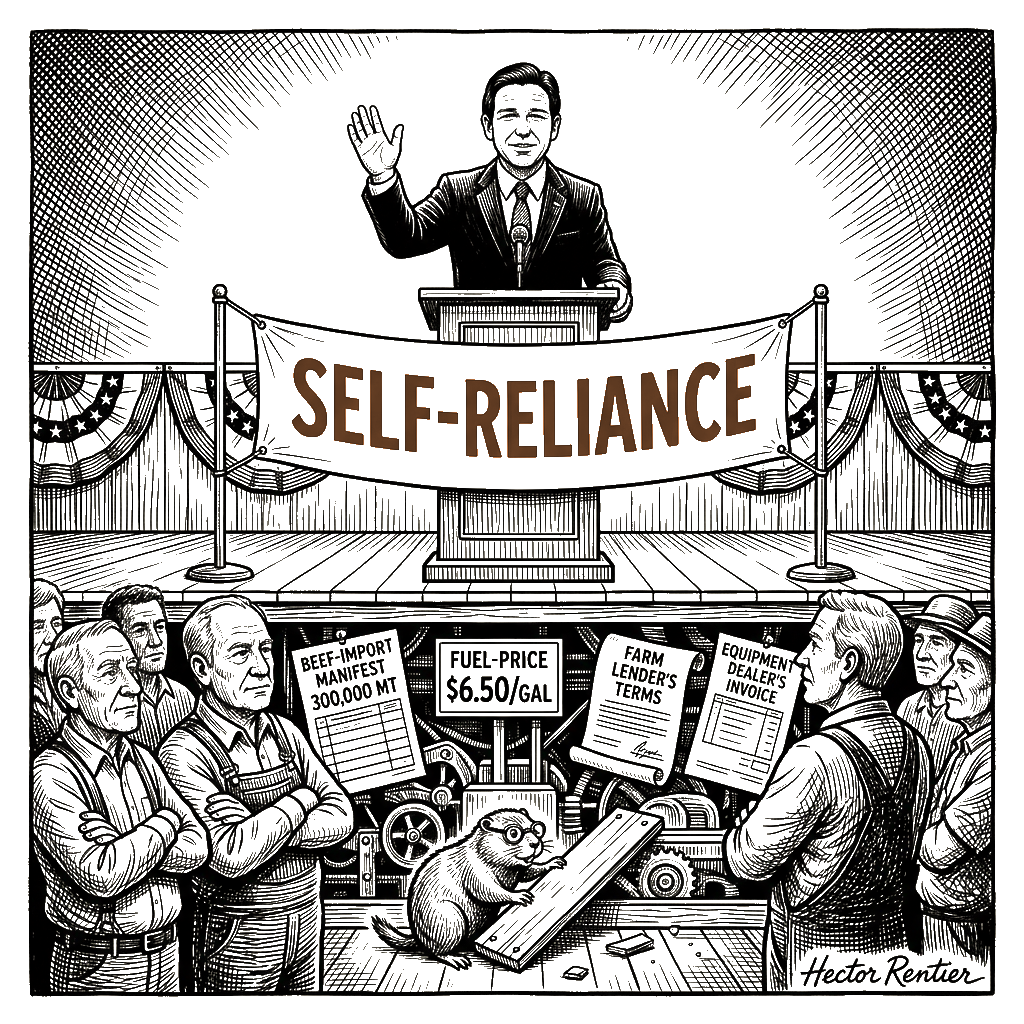
The conservative contradiction is plain. Rural voters are told they are self-reliant, then left dependent on concentrated meatpackers, fuel markets, farm lenders, equipment dealers, and a labor system they do not control. They are told nationalism protects them while a trade decision can move beef across the hemisphere and a corporate feedlot can lose its workforce overnight. They are told community matters while the institutions that made a county durable are hollowed out.
The contradiction is real.
The Democratic answer is still missing.
A party cannot walk into cattle country carrying only evidence that Republicans have failed. It has to carry a reason for a rancher to believe that its agriculture committee will be about cattle rather than cultural theater, that its labor policy will protect workers without stranding producers, that its trade policy will defend domestic producers without pretending every import is an invasion, and that its rural program will be something more durable than a visit to a county fair in October.
Instead, Democrats keep treating a once-in-a-generation opening as a news-cycle harvest. The storm is here. The seawall is not.
Farm country is not calm. It is cracked, expensive, short on workers, suspicious of the people making its rules, and tired of paying for decisions made somewhere else. That should be enough to punish the party in power.
It may not be enough to elect the party that has not yet shown it knows what to do with the punishment.
Republicans need to deliver diesel relief and a clearer trade message. Democrats need to offer more than anger, more than a good recruit, and more than the hope that a vegan senator’s imagined committee will frighten cattlemen into their arms.
Farm country is not swinging yet. It is holding its vote until Election Day.
That is the opening Democrats were handed. They are blowing it.