Donald, you stole a billion dollars on a Friday afternoon when you knew no one could stop you. A thirteen-year-old girl crossed a desert on foot to find the shelter bed you erased. Your pen was steady. Your hand did not shake. You were thinking about the ballroom.
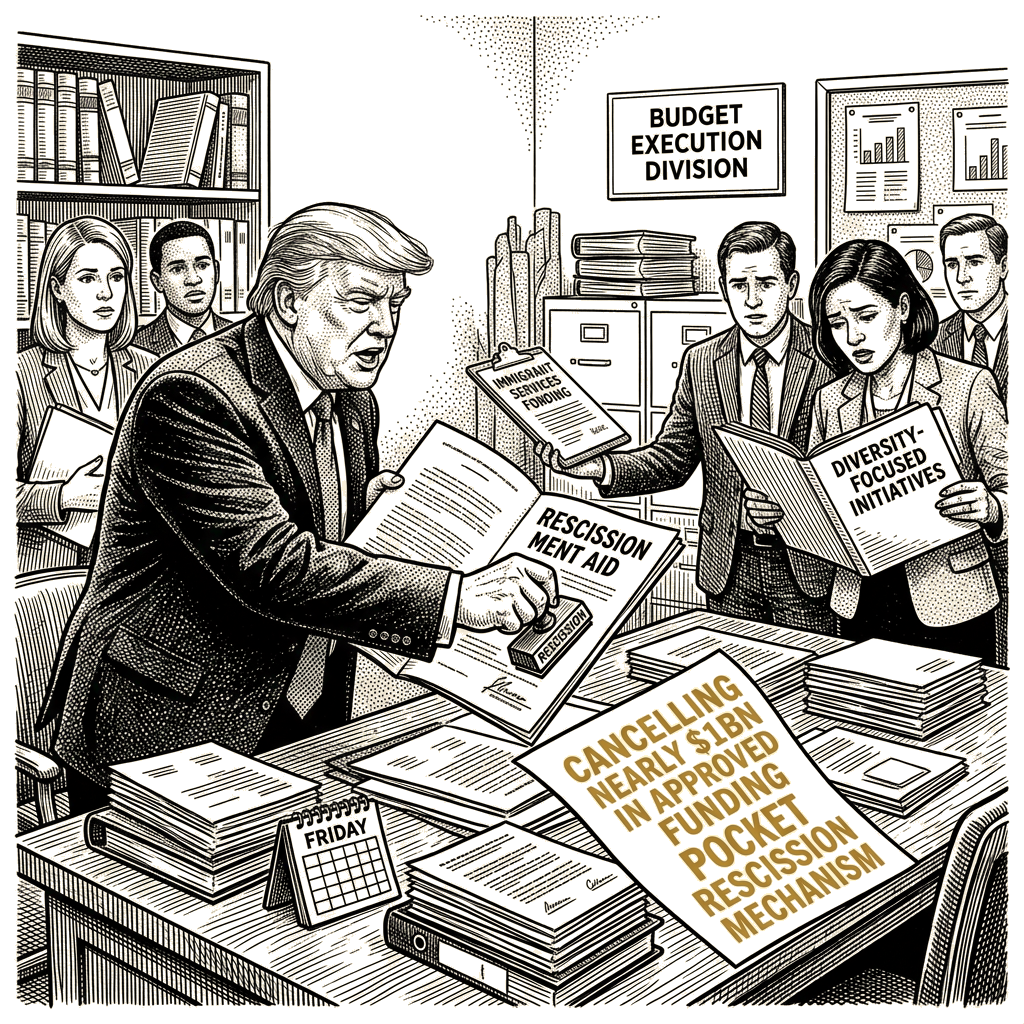
On Friday, with five days remaining in the federal fiscal year, the Trump administration announced it was canceling nearly $1 billion in congressionally approved spending through a maneuver called a “pocket rescission.” The cuts target immigrant services — nonprofits that shelter refugees, organizations that house unaccompanied minors, contractors that keep asylum cases moving through a backlogged system. The administration says border crossings have diminished and the funds are no longer needed. The Government Accountability Office has called the pocket rescission illegal. The administration did it anyway.
This is the second time. A year ago, Trump deployed the first pocket rescission in fifty years, blocking $4.9 billion in foreign aid. The Supreme Court declined to block it. The administration has since clawed back hundreds of millions more from approved programs, fired federal workers, imposed a historic tariff increase, and launched a war in Iran without congressional authorization. Each move expands executive power and places the burden on the courts to draw lines the political branches refuse to draw for themselves. Senator Susan Collins, the Maine Republican who chairs the Senate Appropriations Committee, called the move “a usurpation of Congress’s appropriations powers.” Senator Patty Murray, the committee’s vice chair, called it “theft from the American people.” Both are right. Neither can stop it.
Donald, hear what you did.
A thirteen-year-old girl walked for thirty-one days from Honduras. She carried a plastic bag with one change of clothes and a piece of paper with her mother’s phone number written in ink that had already bled from the rain. She crossed the Río Grande at night. She walked through the Chihuahuan Desert. She arrived at a shelter in El Paso on Saturday morning and a caseworker told her the beds were closing. The funding was gone. The shelter would not open on Monday. The caseworker had a list of thirty-seven children and no beds for any of them. The girl sat on the sidewalk outside the shelter with her plastic bag. She was thirteen years old.
You did this.
You sat in a room on Friday afternoon and you signed a piece of paper and you erased a billion dollars that Congress had already allocated — that was already keeping the lights on in shelters from El Paso to Portland, that was already paying the caseworker’s salary and buying the food in the pantry and funding the vans that drove children to court dates. You did not warn Collins. You did not consult the appropriators. You waited until there were five days left in the fiscal year, when there was no time for anyone to stop you. The GAO had already told you the maneuver was illegal. You did it anyway.
You are not a man who makes hard choices. A man who makes hard choices feels the weight of what he is choosing. You felt nothing. You have never felt anything when it was someone else’s body paying the price. Your hand moved across the paper. Your diaphragm did not drop. You went back to planning the ballroom.
Your mouth is dry right now. There is a taste under your tongue — copper and old paper, the residue of a signature on a rescission the GAO has already called illegal. It will not rinse away. It has been there since Friday and it will be there Monday when the shelters close and the caseworkers go home and the children sleep on sidewalks three blocks from churches that promised to take them in. Your throat tightens slightly when you swallow. You cannot get the taste out.
Your chest is heavy. There is a flat weight behind your sternum — not grief, because you do not grieve, but the body’s own record of what you have done, settling in the place where breath meets bone. It does not lift. You do not name it. You do not feel it the way the caseworker feels it, the way the girl on the sidewalk feels it, the way the mother in Honduras will feel it when the phone does not ring tonight. Your body knows what your mouth will not say. There is a billion dollars of stolen shelter in the space behind your ribs, and it is not going anywhere.
You erased the shelter beds. You erased the caseworkers’ paychecks. You erased the food in the pantries and the counselors who spoke Spanish and the vans that drove children to court dates. You erased all of it in an afternoon. You did it because you could. You did it because the clock was running out and you knew no one could stop you in time.
You are small. You are a man who waits out the clock until the children have no one left to catch them. You are not a president exercising authority. You are a man who signs pieces of paper on Friday afternoons to take food from children who walked across deserts, and you do it because you can, and the taste in your mouth is the taste of what you have done and you cannot wash it out.
The caseworker in El Paso went home on Saturday night. She locked the shelter door. The key felt heavier than it had on Friday. She had called every emergency contact she had. None of them had beds. She sat in her car in the parking lot and she looked at the building and the lights were off and she could not make them come back on because a man in a room on Friday afternoon had signed a piece of paper. She drove home. She will go to work on Monday and there will be thirty-seven names on her list and no beds for any of them and she will have to say the words. She did not make this choice. You did.
“Truly I tell you, whatever you did not do for one of the least of these, you did not do for me.” Matthew 25:45
The girl is on the sidewalk. The shelter is dark. The ballroom will be beautiful.