
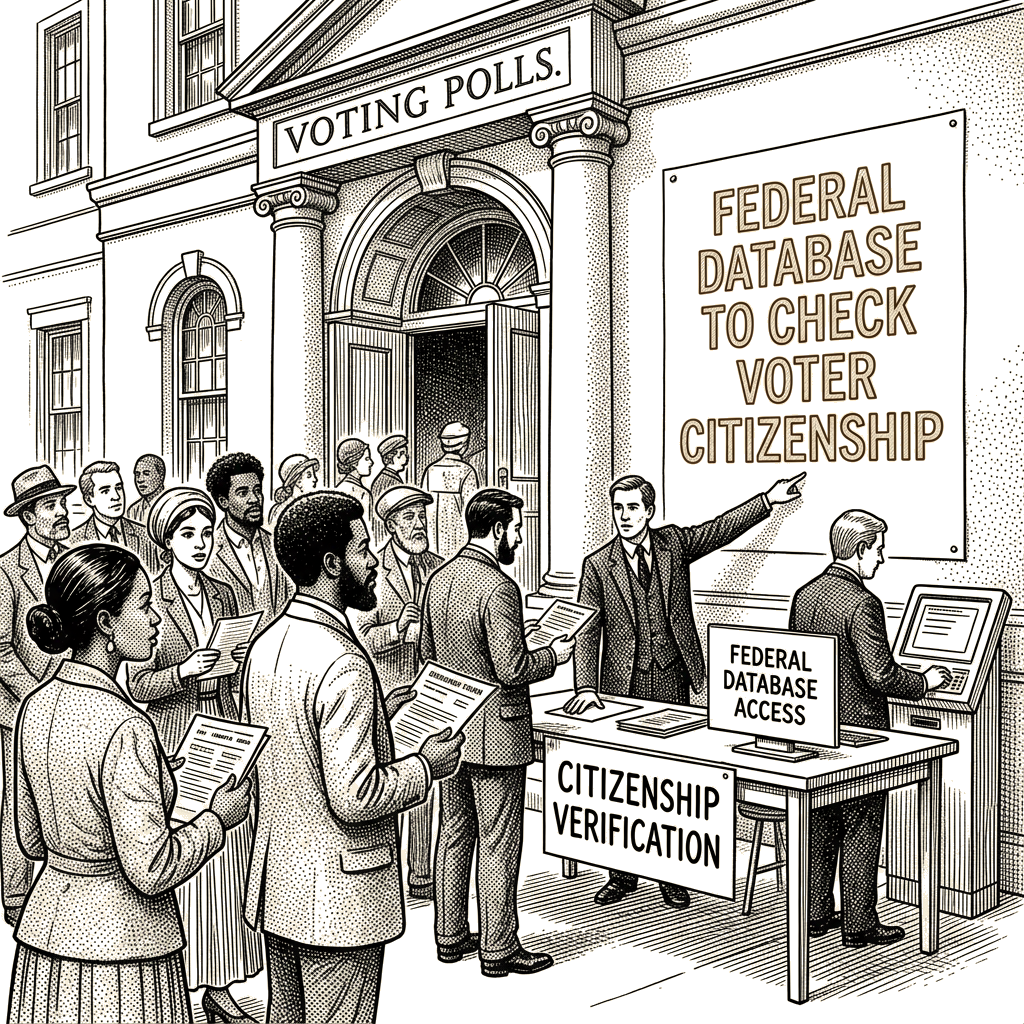
The Trump administration is attacking state election control with federal power.
The administration’s strongest case is straightforward. Federal law bars noncitizens from voting in federal elections. The government possesses citizenship records, Social Security data, and other federal files that can identify unlawful registration or voting. A state that maintains an inaccurate voter roll should be able to correct it. The Justice Department has charged more than 70 people with unlawful voting or registration offenses since the administration began. The Civil Rights Division has warned election officials in all 50 states that knowingly registering noncitizens can bring federal prosecution.
That is the steel-man. It is recognizable to any election lawyer who has had to defend the basic proposition that eligibility rules mean something.
The administration has turned that proposition into a parallel federal election machine.
The Supreme Court’s Friday ruling lifted restrictions on the Department of Homeland Security’s citizenship database. The system merges immigrant citizenship records, Social Security files, and other federal data into an instrument that can cross-check state voter rolls. The eight thousand-plus election jurisdictions in the country just became more legible to Washington than they have been in the modern voter-roll era.
The ruling did not create that architecture. It exposed it.
The first conflict concerns data. States compile and maintain their own rolls. Most have refused to provide unredacted versions, including Social Security numbers, because the requests implicate privacy, security, and federalism. Federal courts have consistently agreed with the states that privacy and federalism concerns justify the refusal.
The Justice Department has sued 30 states to force disclosure of complete rolls. At least two dozen district-court rulings and one appeals-court decision have sided with the states on the privacy and federalism questions. The administration has not sued those states into surrendering their databases. It has lost those cases. Roughly a dozen other states have voluntarily shared some or all of their rolls, and the administration says its review found approximately 28,000 noncitizens registered to vote.
That is not a rounding error. It is also not, by itself, proof of widespread illegal voting. Registration is not voting. A database match is not a final adjudication. A federal government that wants to remove people from a state roll must establish that the match is accurate, current, legally relevant, and handled without exposing private information to unnecessary risk.
The Census Bureau’s disputed estimate illustrates the problem. Its mid-August report concluded with a “high degree of confidence” that 24,000 noncitizens voted in 2020. Former bureau officials have questioned the methodology because unsigned authors matched commercial voter records to federal sources through an opaque process. Those questions do not erase the estimate. They prevent the estimate from becoming a verdict by repetition.
The administration now has two numbers in the same range: approximately 28,000 noncitizens registered in the voluntarily shared state records and approximately 24,000 noncitizens estimated to have voted in 2020. The numbers warrant investigation. They do not dissolve the obligation to show how each number was produced.
The second conflict concerns the courts. The federal government controls the lawsuits, the prosecutors, the data systems, and the monitors. The states control the rolls. Neither side can unilaterally resolve every contested question of eligibility. The legal record has therefore become the battlefield.
The Supreme Court has not acted as a uniform ally of the administration. It opened the database door while closing the postal one. President Trump issued an executive order requiring states to submit the names of mail-ballot recipients, with delivery of the ballots threatened if states refused. Lower courts blocked the policy. The Supreme Court issued a one-paragraph ruling refusing to revive it for the midterms, over the dissent of two justices.
That was a setback. It was also narrow. The Court blocked a mail-ballot delivery mechanism; it did not dismantle the broader verification architecture. The database ruling is the load-bearing piece, and it survived.
The third conflict concerns personnel. The Civil Rights Division has written to chief election officers in all 50 states. The department has charged more than 70 people with unlawful voting and registration offenses. On Election Day, DOJ is preparing to send as many as 1,000 federal monitors, drawn from across the department and potentially other agencies, into a broader swath of states than the division has historically covered.
The government’s strongest defense is that this is ordinary enforcement. Federal monitors have long appeared in jurisdictions where the Justice Department brought voting-rights litigation. Federal prosecutors have always had authority to pursue unlawful voting. Election officials should not receive immunity because a case carries political consequences.
The departure lies in scale and combination. Targeted voting-rights monitoring is not the same instrument as mass deployment across many states. A citizenship database, nationwide warning letters, criminal cases, compulsory data litigation, and a thousand federal monitors do not operate as isolated enforcement actions. Together they create a federal presence inside a state-administered election system.
That changes the meaning of each component.
A monitor standing in a polling place is one thing when the federal government is enforcing a specific court order. It is another when election officials understand that their rolls, their administrative decisions, and their local procedures may be examined through a federal system whose methods they cannot inspect and whose data they declined to surrender.
The administration has built a federal verification instrument, sued resistant states, prosecuted alleged offenders, warned every chief election officer, and prepared a national monitoring operation. The pieces are not scattered anymore. They are falling into place.
The result will not be one uniform election administered under one uniform federal standard. It will be a federation of elections. Voters in cooperative states may be checked against a federal citizenship database. Voters in resistant states may not. Some election officials will face federal prosecution threats. Others will quietly cooperate with federal data requests. Some polling places will contain federal monitors. Others will not.
The midterms will therefore run through two election systems at once: one state-administered and one federally imposed at the points where Washington has found leverage.
The database is built. The lawsuits are filed. The monitors are being trained. The prosecutions are being announced.
The question is no longer whether the federal government has built a parallel election infrastructure. It has. The question is whether the courts and the states will let that infrastructure operate at scale before the votes are counted.