Could Senate Republicans really blow this? No, not win an election. We mean blowing up the single most effective climate lever the country has — California’s authority to set clean-air standards under the Clean Air Act — by misusing the Congressional Review Act before they leave town next week.
This should be a layup. It should also be a red flag.
Environmental Protection Agency Administrator Lee Zeldin has submitted to Congress several waivers granted by his Biden predecessors under the Clean Air Act. These waivers empower California to regulate CO2 emissions and pollutants from cargo ships, oil tankers, fishing vessels, lawn mowers, chain saws and more.
In a rational policy world, this is how American federalism is supposed to work. States innovate. The Union follows. The air gets cleaner one waiver at a time.
California’s standards have national reach because manufacturers typically design products to meet the highest bar, then ship the cleaner version everywhere. Other states can adopt California’s framework because it works. Many already have adopted its electric-vehicle mandate and quota regime. That is precisely the point.
Cue the CRA.
The law lets lawmakers overturn a regulation with a simple majority vote of both chambers and the President’s signature. It is a nuclear option designed for genuine emergencies. Republicans now want to aim it at the lungs of the country.
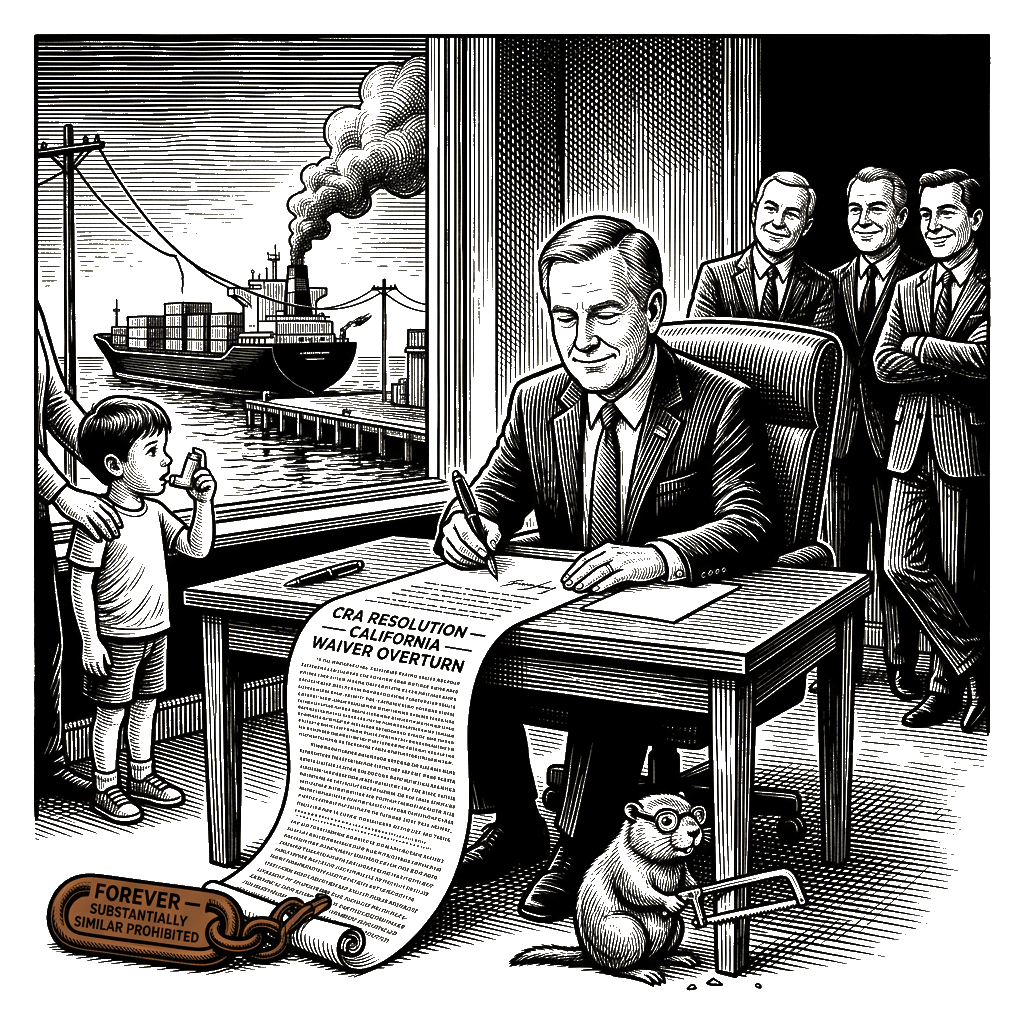
The statute is also a built-in trap. Once lawmakers overturn a rule, agencies are prohibited from ever promulgating rules that are “substantially similar” to it. Republicans last year used the CRA to devastating effect by obliterating California’s electric-vehicle and truck mandates and roughly 20 other Biden-era safeguards.
The car breathed easier. We have not.
Now Republicans have a narrowing window to use the CRA to entrench permanently the pollution California is trying to curb from “zero emission” commercial vessels and small off-road engines, lawn mowers and so on. House Republicans passed a CRA resolution overturning the commercial-vessel rule this month. The Senate can now finish the damage.
It should finish the wrong kind of job.
Another Biden EPA waiver lets California require container ships and oil tankers docked at California ports to plug into the electrical grid, install emissions-capture technology, or pay fees. Yes, many ports still lack the grid infrastructure to power so many energy-guzzling ships. Yes, emissions-capture technology is still embryonic.
That is precisely why the policy exists.
The fees fund the build-out. The build-out makes the fees obsolete. Ships pay for the infrastructure that will replace the fees. That is how transition policy works.
The House this month passed a resolution overturning this “at-berth” rule. The Senate this week ought to take up Alaska Sen. Dan Sullivan’s companion resolution — and send it to a fiery defeat. The shipping and oil and gas industries can howl. Consumers can pay the cost later, after stranded infrastructure and climate-driven supply shocks make the bill larger.
President Trump should refuse to sign it, to hurrahs from the public-health community and coastal residents who breathe the air.
Several GOP senators have also introduced a resolution to overturn a waiver that lets California impose EV quotas on automakers. House Republicans, for obvious reasons, punted on this one before leaving to campaign. The politics finally caught up with them. They could still try to revive it after the election.
There is no excuse for using the CRA to gut California’s clean-air tools. The Senate needs 60 votes to pass most non-budget legislation. CRA resolutions need only 51, and strict timelines give them filibuster-proof procedures.
Under the law’s shot-clock, the moment is now. It is now or never for senators who care about the air their constituents breathe.
If Republicans succeed, they will lock the country into a slower, sicker, more expensive future. They will doom Americans to live with the smog, soot and emissions California is trying to clean up.
They will own every asthma attack, every diesel death, every port-side childhood hospitalization that follows.