
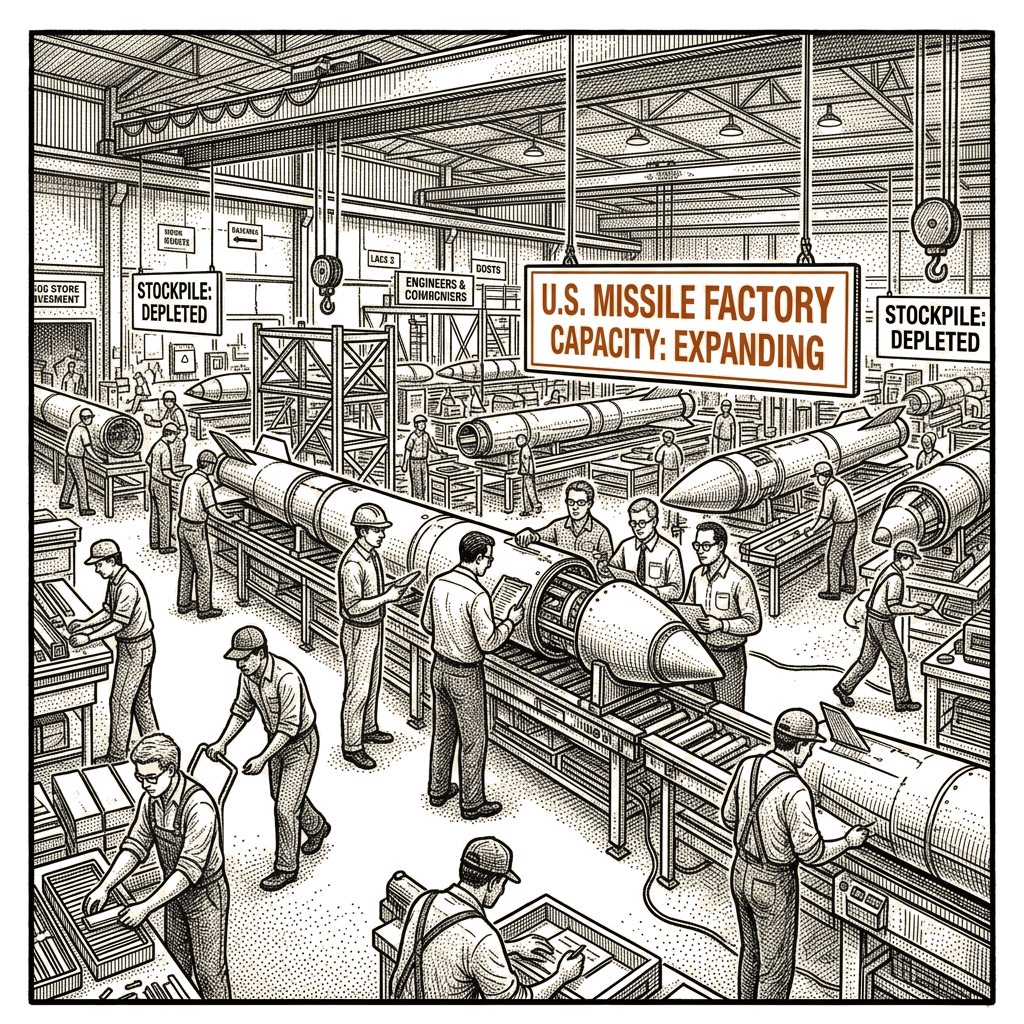
The Pentagon let America’s missile stockpiles run dry while contractors and Congress delayed the bill.
Think about the worker in Tucson who takes one of those 670 advertised jobs. Electrical engineer. Explosives specialist. Chemist. Software technician. He or she goes to work at a plant that runs around the clock, building Tomahawks for a war that has already consumed more than 1,000 of them in two months.
That worker has a reasonable question.
Will this line still be open when the next budget cuts arrive?
The question is not abstract. A missile plant is a payroll. It is rent money. It is a grocery bill. It is a mortgage payment. It is a child in a local school. When the plant expands, a town feels it. When the plant contracts or closes, the town feels that too. Housing costs move. School budgets move with the tax base. Small businesses rise and fall with the shifts at the gate.
The public is asked to carry those risks while the people who make the decisions keep their distance from them.
The factories are expanding because the wars emptied the shelves. American forces have used about one-third of their pre-Iran-war Tomahawk inventory and roughly half of their high-end Patriot interceptors, according to the Center for Strategic and International Studies. RTX has put about $900 million into its Tucson plant and two other factories over the past three years. The company is on track to produce more than 400 Tomahawks this year and says it wants to reach more than 1,000 a year.
Lockheed Martin is adding hundreds of workers in Arkansas to triple Patriot interceptor production. Boeing, L3Harris and Northrop Grumman are building new lines for the electronics, rocket motors and other parts those interceptors require.
That work matters. The people doing it matter. But the timing tells the truth. The missiles went out the door during the war. The replacements will take years.
The Navy’s August request for a seven-year, $23 billion Tomahawk order still requires full congressional appropriations before it becomes a final contract. The line nearly shut down in recent years because Pentagon orders fell so low that further cuts threatened a production program dating to the 1980s. Retrofit work on older missiles helped keep the plant alive.
That is not a supply-chain accident. It is a public decision.
The executives at RTX and Lockheed Martin chose how much capacity to maintain. Pentagon officials chose what to order and when. Congressional appropriators chose what to fund and what to postpone. Each part of the chain had a duty to understand that a missile factory cannot be turned on like a light switch after the shooting starts.
They failed at that duty. The workers and their communities are left to live with the uncertainty.
After Russia invaded Ukraine in 2022, government officials and weapons suppliers promised a production surge. The surge did not keep up with demand. Washington was reluctant to place the large orders needed to justify new production lines. The contractors waited for firm commitments. The government waited for the contractors to invest. Meanwhile, the inventory kept falling.
A worker in Tucson cannot solve that standoff from the factory floor. An Arkansas line worker cannot manufacture a missing rocket motor by working harder. The family of either worker cannot make a congressional appropriation happen at the kitchen table.
The people with the power were not standing at that kitchen table.
The Army Science Board found an industrial base that had been hollowed out. Mackenzie Eaglen, who served on the panel coordinating the study, said, “It’s a miracle that we have anything that blows up.”
That was not a joke about the workers. It was an indictment of the system above them.
The spending record shows how the system got here. From 1999 through 2025, missiles and munitions received an average of 7.5% of the Pentagon’s procurement and research budget, according to Todd Harrison of the American Enterprise Institute. Aircraft received 23%. Shipbuilding received 10%. Harrison projects the missile and munitions share will rise to an average of 14% between 2028 and 2031.
That increase is necessary. It is also late.
A percentage in a budget report becomes a family’s monthly calculation in Tucson. It becomes a landlord’s decision in Arkansas. It becomes a school board’s estimate of next year’s revenue. It becomes the difference between a town that can keep its hospital, hardware store and daycare open and one that cannot.
Those costs rarely appear in the Pentagon’s procurement language. The factory is treated as a production site, not as a community. The worker is treated as a labor input, not as a parent whose child attends school nearby. The public is treated as a source of money, not as the owner of the industrial capacity being rebuilt with that money.
Eisenhower warned in his January 17, 1961, farewell address against the “unwarranted influence” of the military-industrial complex. He did not warn only about corruption in a narrow criminal sense. He warned about misplaced power. The question was who would decide the size and purpose of the machinery, and whether citizens could keep that machinery tied to the country’s peaceful needs.
Sixty-five years later, the country has a defense industry that can take billions in contracts, a Pentagon that can announce urgent priorities, and a Congress that can delay the money needed to carry them out. The worker gets the shift. The town gets the housing pressure and the school-board problem. The public gets the bill.
The contractors have constraints. RTX says it has struggled to fill critical Tucson positions. Supply disruptions have affected rare-earth elements, microelectronics and other components. A Tomahawk contains thousands of parts and moves through workspaces that are closer to small workshops than automated assembly lines. A new robotic testing machine may make that work 30% faster.
Those are real facts. They do not erase the larger one.
A production line that nearly dies in peacetime cannot be expected to save the country on a wartime schedule. A company that depends on public contracts cannot treat capacity as a private choice when the public depends on the result. An appropriations process that waits until inventories are depleted is not fiscal prudence. It is deferred payment.
The fix begins with ownership of the truth. The Pentagon must say how many missiles remain, how fast they are being spent and when replacement capacity will arrive. Congress must say which appropriations it delayed and why. Contractors must disclose what capacity they maintained, what capacity they abandoned and what public money they need to rebuild it.
And the people who work in these plants must have a voice in the future of the plants. They know which machines fail, which skills are scarce and which promises do not survive a shift change. Their communities know what happens when a payroll rises or disappears. Decisions about public industrial capacity should not be made only in corporate offices, Pentagon conference rooms and congressional appropriations hearings.
The Tucson worker deserves more than a temporary job created after a war has already emptied the stockpile. The Arkansas worker deserves more than praise for keeping a line moving while the backlog grows. Their towns deserve more than a boom-and-bust economy built around emergency orders.
The missile factories are expanding. That part is true.
The harder truth is that the country spent years allowing the factories, the workers and the communities around them to carry the risk alone. The people who made that choice should now answer for it, and the people paying for the rebuild should have a say in what gets rebuilt.