Trump is gaslighting families while tariffs and war drain their paychecks.
The line is Donald Trump’s steady monologue: “the greatest economy in history.” He repeats it at press gaggles, on the South Lawn, at cabinet meetings, and apparently to himself in the mirror. The numbers he refuses to look at are doing the talking for him.
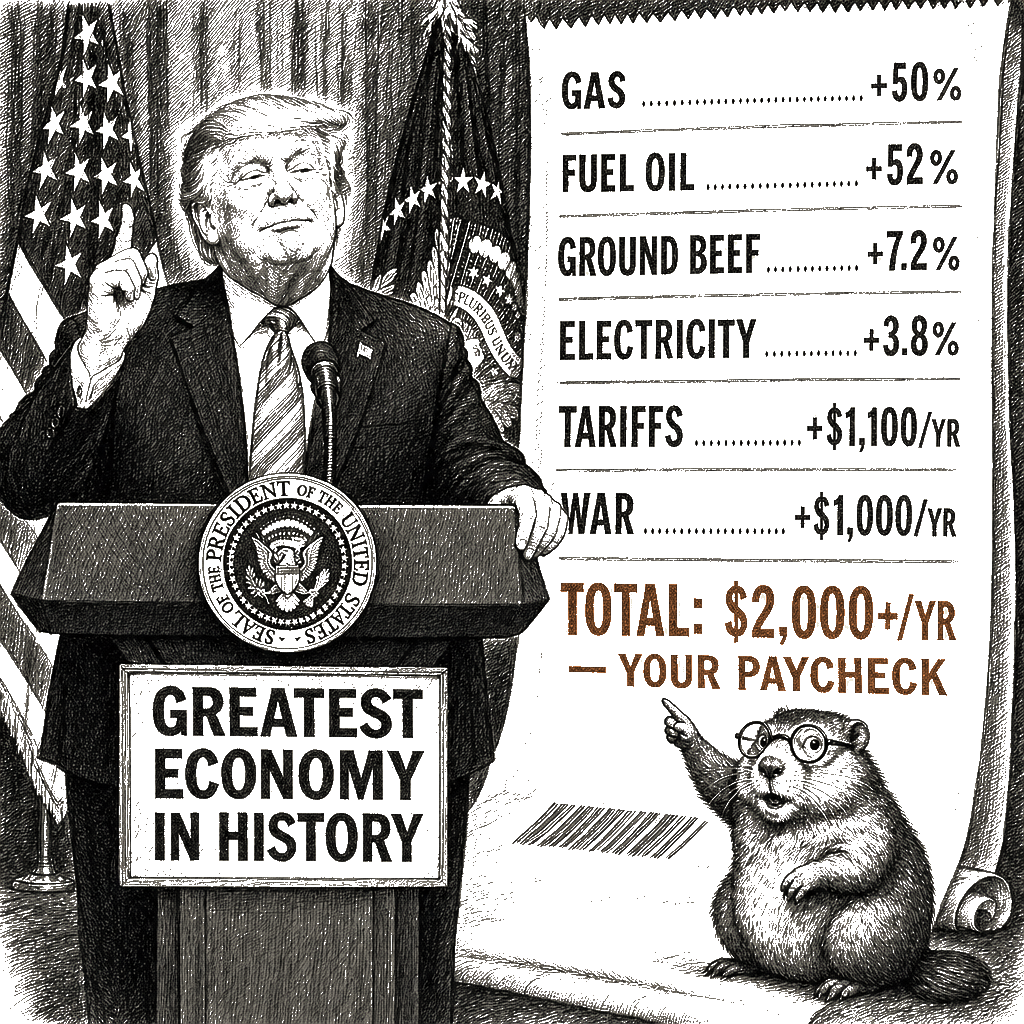
Start with the price gauge that reaches every household: gasoline. The national average is $4.47 a gallon, up roughly 50% since the war against Iran began. Fuel oil is up 52% in twelve months. Ground beef is up 7.2%, fish and seafood 6.5%, coffee 6.1%, sugar and sweets 6.1%, and electricity 3.8%. Headline inflation is running at 3.4%, up from 3.0% when Joe Biden left office. The Federal Reserve responded by raising interest rates into a country already carrying high mortgage rates and a housing market that has been choking for two years.
Prices are rising faster than wages. That is an affordability squeeze. It is not the definition of the greatest economy in history.
The White House reaches for eggs. Egg prices are down 23%, the press office says, as if the country runs on eggs. Beef, prescription drugs, and auto insurance have also declined month over month in two Consumer Price Index reports. Two monthly price ticks in three categories do not refute a year of 3.4% inflation. They are the administration’s best three tiles in a yearlong losing hand.
Darrick Hamilton, the AFL-CIO’s chief economist, calls the boast “bluster” and “gaslighting.” The economy is “trending down by many measures,” he says, because of Trump’s “unforced errors.” Hamilton names the errors: tariffs and the war against Iran. He is correct. A 23% egg decline next to a 52% fuel-oil spike is not a counter-narrative. It is one shelf at the grocery store beside the propane tank, the ground beef, and the electricity bill.
The household bill is the cleanest receipt. The Yale Budget Lab estimates that tariffs will cost the average American household $1,100 more this year. Mark Zandi of Moody’s Analytics puts the additional fuel-and-food cost of the Iran war at another $1,000. More than $2,000 is being taken from the same paycheck.
Trump said last May, when asked how the war was affecting Americans’ finances, “I don’t think about Americans’ financial situation.” On gasoline last week, he called $4.47 “a little higher” and “a very inexpensive price.” The boast and the brush-off sit on the same shelf. That is what “greatest economy in history” sounds like at the kitchen table.
The growth story offers no rescue. Second-quarter gross domestic product came in at 1.5%, a soft patch the country has now been instructed to regard as prosperity. Under Kennedy, Johnson, and Reagan, full years averaged above 6%. Under Biden, growth during the last six months averaged 2.7%. The 1.5% figure is not a recession. It is the economy Trump inherited bragging about and the economy he is delivering: modestly, expensively, with consumers paying the difference.
Jobs do not rescue the claim either. The White House will hold up the 162,000 jobs added last month. The longer record is less accommodating. Monthly job growth since Trump returned averages 43,000, less than one-third of the 145,000 monthly average during Biden’s last two years. Manufacturing has lost 35,000 jobs since January, despite tariffs supposedly aimed at reviving the factory floor.
Unemployment is 4.1%. That is low in absolute terms, but it was about where it stood during Biden’s last year. It fell to 2.5% under Eisenhower and below 4% at points under Clinton, Nixon, and Johnson. Low unemployment is not a distinguishing Trump achievement. It is the inherited baseline. What is distinguishing Trump is the pace.
“Continued private-sector job growth” is the press office’s framing. “Mediocre” is the honest word for 43,000 jobs a month.
The economy’s two real props are artificial-intelligence investment and the spending of the richest 10%, which accounts for nearly half of all consumer outlays. Lindsay Owens of the Groundwork Collaborative says AI investment has propped up GDP and the stock market: “The pieces of the economy that are doing well are completely propped up by AI investment. That’s the whole story. That’s what Trump has going for him.”
That story is narrower than the boast. Communities are rising against data centers. Safety advocates are calling for slower development. Wall Street jitters about the AI trade have arrived on schedule. Meanwhile, the bottom half by income is squeezed while the top 10% buys new cars, airline tickets, and kitchen renovations. That is a K-shaped consumer economy with a ceiling over one fraction of the population. It is not what is holding America up.
The public mood supplies the remaining receipt. Seventy-three percent of Americans rate the economy fair or poor; 48% call it poor. The University of Michigan’s September consumer-sentiment index fell to its second-lowest reading in 74 years of polling. Only this past May was lower. A New York Times/Siena poll found that 71% disapprove of Trump’s handling of the cost of living. A Marquette survey put his approval of the economy at 28%.
His own voters are withdrawing the warranty. Only 29% of Republicans say the economy is better than a year ago, down from 72% last January. That is a 43-point collapse inside the coalition that was supposed to certify the boom. The Democratic lead on handling the economy, first recorded this summer, is now a category change. It is not evidence that Democrats have produced an economic program voters can recite from memory. It is evidence that the Republican claim on economic stewardship is depreciating in real time.
Owens puts it more plainly: “Trump’s approval rating on the economy was his superpower in his first term. But now it’s absolutely in the toilet.”
The White House response is that “the hard data of actual consumer spending and retail sales has remained robust,” that consumers are “voting with their dollars,” and that “targeted policy interventions” are producing lower prices in selected categories. Kush Desai can read out the egg statistics. The administration can call spending robust. The country has filled enough tanks, paid enough grocery bills, and watched enough Federal Reserve announcements to know what is in front of it.
The economy is not the worst economy in history. It is not in recession. Unemployment is low. AI investment is real and will leave real assets behind. Those concessions matter because the boast is the problem. A president does not get to call an inherited baseline a historic achievement while households pay more for fuel, food, electricity, and borrowing.
“Greatest economy in history” is the line Trump keeps repeating into a polling environment where his own voters will not back it, where sentiment sits near a 74-year low, where the average household is paying for both his tariffs and his war, and where the top tenth is carrying nearly half of consumer spending.
The receipts are in the mailboxes before the votes are counted.