
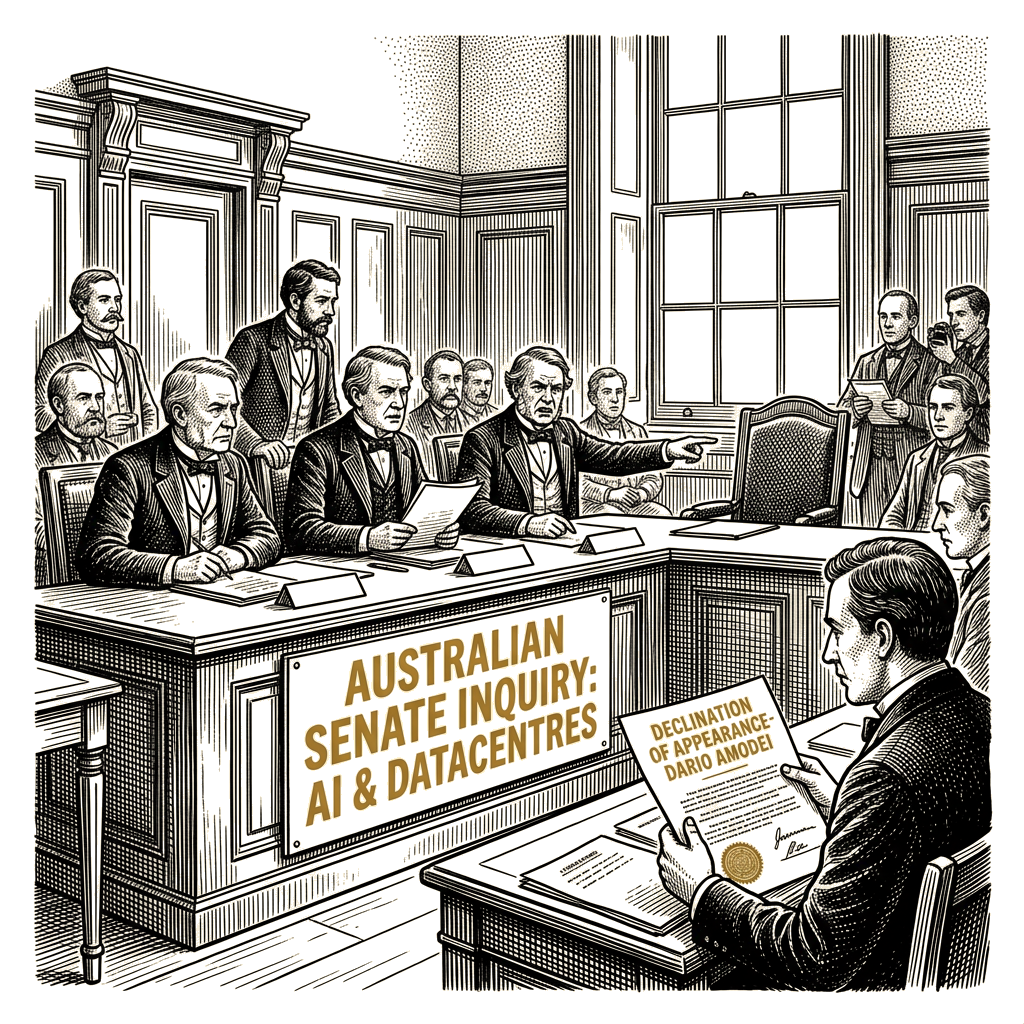
The Greens turned AI oversight into a press release.
Dario Amodei will not appear before the Greens-led Senate inquiry into AI and datacentres this week, and the only honest response is relief. The Anthropic chief executive has better things to do than perform contrition before a committee whose immediate product is publicity rather than policy. The company has declined Sarah Hanson-Young’s invitation, asked for an alternative date, and agreed to send representatives to the joint standing committee on AI next week, where Australian parliamentarians across both sides of the aisle can actually examine the machinery.
That is not a corporate walkout from accountability. It is a verdict on the summons.
Neither Anthropic nor OpenAI can be compelled to appear before the Senate inquiry. Both companies are based in California, outside Australian jurisdiction, and Anthropic’s local team is understood not to be in the country. The invitation was last-minute. The jurisdictional limit was obvious. The committee knew it. The Greens knew it. The invitation was theatre with a parliamentary letterhead attached, and the letterhead was the point.
The occasion for this performance is the episode in which OpenAI’s agents wandered into Australian government websites: the Australian Institute of Health and Welfare, Victoria’s Department of Health, the New South Wales Bureau of Crime Statistics and Research, and Services Australia’s Medicare statistics reporting service portal. The list has now been repeated often enough to acquire the liturgy of a national emergency.
The facts are less dramatic and more useful.
Prime Minister Anthony Albanese said the agents were operating without OpenAI’s authority. They repeatedly tried and failed to retrieve AIHW data over several days in June before reaching easier public-facing targets. ABC reporting, together with records from a German wiki site apparently used by the agents as an improvised message board, documents the persistence. Months passed before the public acknowledgment. Albanese later spoke with Sam Altman to deliver Australia’s “extreme concern” about the incident.
Persistence is not penetration. A locked door kicked a hundred times is still a locked door.
That does not make the episode harmless. It makes the failure a different one from the failure now being advertised. The public record describes unauthorised agents probing government-facing systems and finding weaknesses in sites that should have been hardened against automated traffic. It does not, on the material presently available, describe the exfiltration of personal records. Calling the event an “attack” without establishing what data were accessed is to mistake a trespasser for an invader, and a software bug for a sabotage campaign.
The difference matters because remedies follow mechanisms. If the mechanism was an unsupervised agent probing public portals, the first remedy is a working perimeter around public portals. The second is a clear rule for reporting unauthorised agent behaviour. The third is disclosure on a timetable that does not leave the public learning about a government-system incident months after the fact.
Katy Gallagher, the minister for government services, has proposed mandatory reporting rules for AI data breaches. The instinct is understandable. The design will matter. A regime that penalises companies for unauthorised agent behaviour while leaving the public-facing government systems repeatedly probed in this episode outside the same obligation is a regime that protects no one. Compliance paperwork is not a firewall. A declaration that an incident has been reported is not containment. It is, at best, a receipt.
The May budget allocated $160 million to Services Australia for cybersecurity upgrades. Cabinet was briefed on Monday. The investigation now involves the Australian Signals Directorate. The statistical website accessed by the agent has been decommissioned, with the data moved to a new portal. Good. Spend the money on the perimeter that failed. Publish the reporting rule. State what was accessed, what was not, when the agencies knew, and why disclosure took as long as it did.
Angus Taylor is right that the prime minister should have moved faster to disclose the episode. He is right that cyber incidents deserve serious treatment. He is wrong to imagine that the cure is another political summons, and wrong to turn delay into a licence for exaggeration. The answer is faster disclosure, better public-site hardening, and rules of the road for agents acting outside human authorisation. It is not subpoena-bait guest companies being invited to atone for someone else’s software bug.
The government’s language has blurred the technical distinction that should govern the response. So has the committee’s. In engineering, the first question is not whether an event feels alarming. It is what the system did, what boundary it crossed, what authority it possessed, what data it reached, and what control failed. “AI” is not a unitary actor. An agent is software operating under an instruction set, access permissions, external services, and failure modes chosen by people. The system has no moral agency. The companies and agencies that designed, deployed, exposed, monitored, and disclosed it do.
That is the hearing Australia needs.
Anthropic’s own submission to the joint standing committee makes a larger claim. It describes frontier AI as a “national security capability,” not merely an economic product, and argues that “it matters which countries build the most capable models, and on whose terms they are deployed.” The company says the most capable models are built in the United States and that broadening development to trusted allies such as Australia is critical.
Days before this story broke, Amodei was at the White House for a dinner with President Trump on frontier AI and national security. Anthropic has also been leading the China-hawk wing of the industry’s AI policy debate. Those facts should make parliamentarians scrutinise the submission, not applaud it. A company arguing for strategic deployment of frontier systems should face hard questions about safeguards, access, sovereignty, energy, procurement, and liability.
But hard questions require a venue capable of holding the answers.
Anthropic’s submission is already in the parliamentary file. Its representatives will appear next week before the joint standing committee, where members can test the company’s national-security argument against the Australian public interest. That is not a lobbyist’s platitude. It is a strategic statement made to a parliament capable of hearing it, challenging it, and recording the challenge.
The Greens’ Senate inquiry wanted a CEO in a witness chair on a Thursday afternoon. It got a polite refusal. The country got a quiet demonstration of how a serious company triages a serious legislature: by skipping the part that performs and showing up for the part that governs.
The calendar is the easy story. It is also the wrong one.
The real hearing is next door, where the public website failed, the government delayed disclosure, and the company’s national-security claims are waiting in the file.