Both nations are treating oil as a weapon. The people paying for it are not the ones pulling the trigger or sealing the strait.
Front-month Brent crude settled Tuesday at $106.72 a barrel, up 1.4% on the day. West Texas Intermediate rose the same, to $93.91. Those numbers measure what traders will pay. They do not measure what it costs to live inside a 1-to-2-million-barrel-a-day global deficit. That cost lands on a nurse in Manila rationing generator fuel for a hospital ward, on a family in Nairobi choosing between cooking and heating, on a farmer in Dhaka watching the price of fertilizer climb past what the harvest can bear. The barrels missing from the system are missing from kitchens, clinics and schools in the countries least responsible for the war that removed them.
Pope Leo XIII wrote in Rerum Novarum that the natural resources of the earth exist for the sustenance of all, and that those who hoard or weaponize them against the destitute commit a sin the Church has the duty to name. The sin is the same whether the weapon is a blockade, a chokepoint or a price spike that makes heat unaffordable for the poor. Natural law does not care whose flag flies over the valve. It says that a child’s right to warmth does not bow to a president’s negotiating leverage or a regime’s strategic patience.
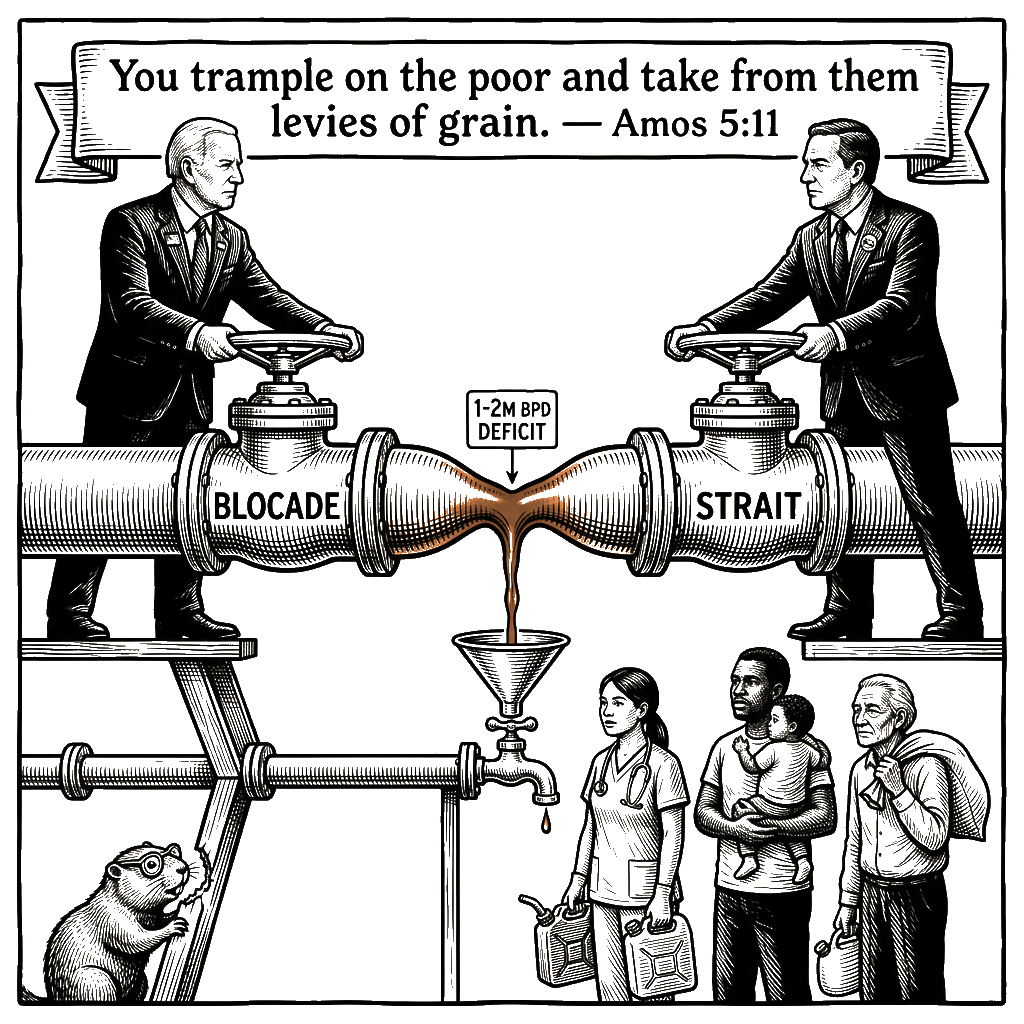
President Trump rejected Iran’s proposed seven-day ceasefire — an agreement that would have reopened the Strait of Hormuz and resumed nuclear negotiations in exchange for the lifting of the U.S. blockade on Iranian ports. The rejection closed the door that could have eased the squeeze on every economy downstream of the strait. The U.S. blockade operates as a chokepoint as effective as Hormuz itself: it denies Iran economic relief while claiming to target its government, a distinction that means nothing to the family that cannot afford cooking fuel because the currency collapsed under sanctions. The blockade is a weapon aimed at a regime; its heaviest toll falls on the civilians the regime already fails.
Iran answered with the opposite weapon. By holding the Strait of Hormuz hostage — through proxy forces and the threat that any reopening remains conditional — Tehran turned 21.6 million barrels a day of global commerce into a bargaining chip. That is not leverage. It is hostage-taking applied to the fuel supply of nations that had no say in either government’s decisions. The Prophet Amos named this kind of power: “You trample on the poor and take from them levies of grain.” When the strait was choked, the levy fell not on Washington or Tehran but on every household, every hospital, every economy that depended on the flow. Iran holds the strait; the U.S. holds the blockade. Both are leverage. Both are leverage exercised on people who did not choose the fight.
What makes the sin concrete is who fills the gap. A nurse in Manila rationing generator fuel. A family in Accra paying twice what it paid six months ago for the diesel that keeps the lights on in a clinic. A government in Dhaka choosing between fuel imports and food aid because it cannot afford both at current prices. These are not abstractions. They are the people the war has conscripted into service without their consent. The war began on February 28. It has become a siege measured not in barrels traded at the New York Mercantile Exchange but in the cold meals and unlit hospital wards of the Global South.
Trump’s ceasefire rejection foreclosed a path that might have restored flows averaging 21.6 million barrels a day through the strait. Iran’s refusal to reopen Hormuz without concessions guarantees the chokepoint stays partially closed. Saudi Arabia has done what it can: loadings from Ras Tanura have climbed from roughly 1.5 million barrels a day in early September to around 6.5 million, and the East-West pipeline through Yanbu, shut down by drone attacks on September 10, is back at roughly 3.5 million barrels a day and climbing toward its 7-million-barrel capacity. The bypass works — the geography has shifted even as the ceasefire collapses. Together with the United Arab Emirates and Iraq, regional exports have reached nearly 13 million barrels a day — close to 80% of prewar levels, according to Kpler.
But the bypass does not reach everyone. The deficit of 1 to 2 million barrels a day is concentrated in the medium- and heavy-crude grades that power the refineries of Asia, Africa and Latin America. Those are the grades the Global South runs on. The infrastructure of circumvention — pipelines rerouted, tanker rates at records, Latin American crude substituted for what the Middle East once provided — is a confession. We built a system in which coercion works precisely because the poorest nations have no alternative supply. The tanker routes and pipeline repairs we celebrate as resilience are an indictment: resilience for whom?
I write from inside the economy that consumes most of what the world produces. My truck runs on gasoline. My home is heated by natural gas. The electricity that lights my shop travels along wires fed in part by the very commodity whose weaponization I am condemning. This is not hypocrisy. It is the condition every person in the wealthy West shares: we are implicated in arrangements we did not design but from which we benefit every day. The confession does not absolve the U.S. or Iran. It means I cannot name their sin without naming my own complicity in the system that makes the sin possible. Every barrel I consume is a vote for the architecture of coercion, and I am as bound to repent of it as the officials who wield it.
The Prophet Amos condemned those who “sell the righteous for silver and the needy for a pair of sandals.” Both the U.S. blockade and the Iranian chokepoint sell the needy — the nurse, the family, the farmer — for the price of a negotiating position. Micah asked what the Lord requires: to do justice, to love mercy, to walk humbly. Justice means refusing to make the Global South pay for the ambitions of the powerful. Mercy means building energy systems in which no single chokepoint can hold millions hostage to the grievances of two governments. Humility means confessing that we — the consumers, the voters, the economies built on cheap crude — have profited from the very vulnerability we now condemn.
The Strait of Hormuz carried an average 21.6 million barrels a day before the war began, roughly one-fifth of global consumption. It carried 4.9 million barrels a day in the second quarter. That difference is not a number on a trading screen. It is the heat that did not arrive, the fuel that did not power the generator, the shipment that did not dock. Kpler expects freight-market tightness to persist and sees the reopening of Hormuz as gradual and uneven. The market has priced the return of Saudi barrels through bypass routes. It has not priced the cost borne by those who wait for what the bypass cannot deliver.
We can rebuild the supply chains. We can repair the pipelines and reroute the tankers and find the missing million barrels in Latin American fields. But the deeper repair begins with admitting what we have accepted. We have grown accustomed to a world in which millions of people lack fuel for warmth in winter, in which hospital generators in the Global South run on rationed diesel while we fill our tanks without thinking, in which two governments can weaponize the energy supply of nations that chose neither side — and we call that normal. The normalcy is the sin. Not the market disruption, not the pipeline damage, not the ceasefire rejection. The acceptance. The willingness to live inside a system that distributes cold and darkness by the accident of geography and the design of power, and to call it a price signal.
The 1 million-to-2-million-barrel deficit is not a market correction. It is a measure of how much suffering the powerful are willing to impose on the voiceless to advance their interests. Both sides. Both weapons. Both sins. And every one of us who fills a tank or flips a switch is standing inside the machinery that makes it possible, whether we chose to or not.
The Prophet Micah told us what justice requires. It does not require perfection. It requires refusal — the refusal to let the poor pay for the quarrels of the powerful, the refusal to call a system that freezes children in their beds an acceptable cost of doing business. That refusal is the beginning of repentance. The rest is building a world in which no chokepoint, no blockade and no war can hold human warmth hostage.