
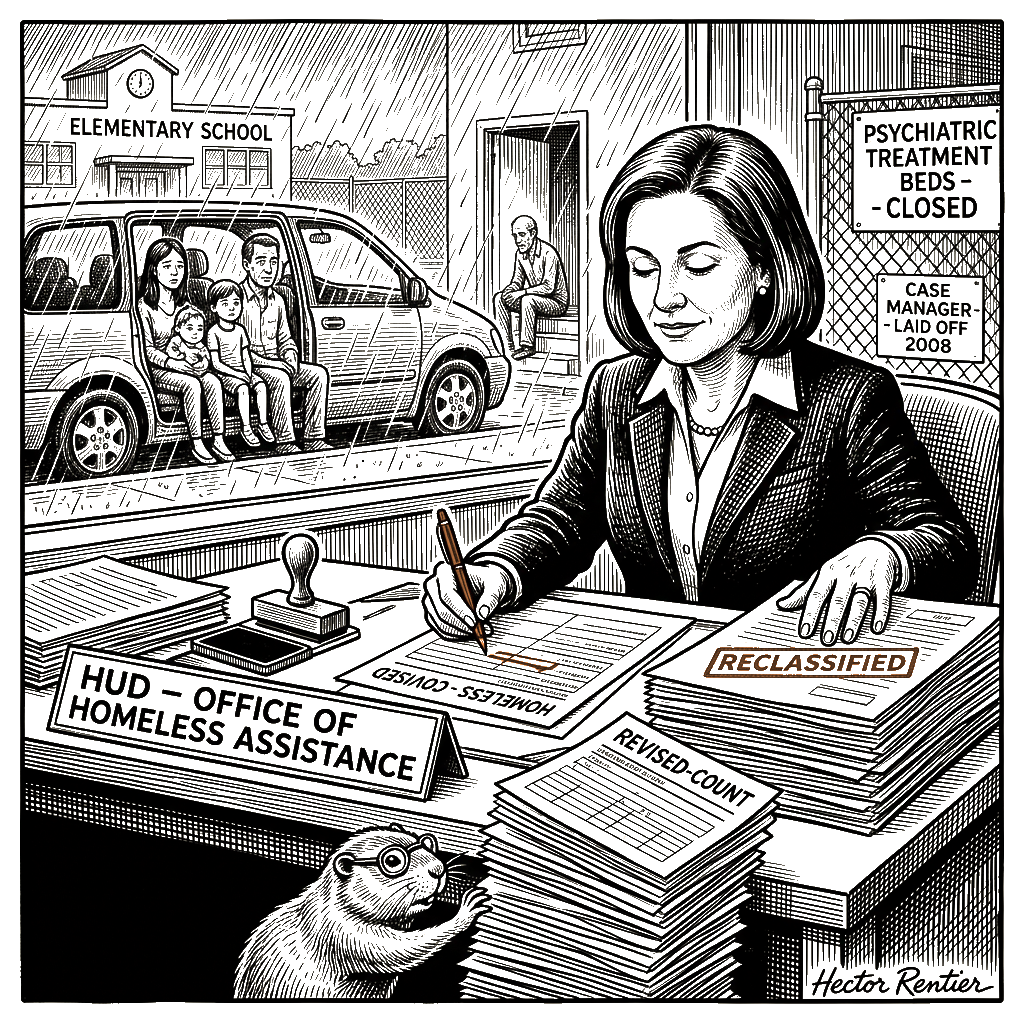
The people on the sidewalk are not lost in a spreadsheet. They are untreated, addicted, or priced out of a home. Redefining the count will not house a single person.
That is the flat truth Michele Steeb’s Fox News Opinion op-ed, “HUD’s homelessness reforms put human lives ahead of housing bureaucracy”, refuses to confront. Steeb argues that Barack Obama’s 2013 Housing First policy failed, that HUD’s bookkeeping disguised rising homelessness, and that the Trump administration’s new metrics—measuring recovery and self-sufficiency instead of housing placements—will finally set things right. She also blames rapid-rehousing rules, narrowed definitions of child homelessness, and what she calls the “Homeless Industrial Complex.” She is selling a definition fix for a service problem.
Redrawing the map does not build the apartment or open the treatment bed.
Steeb’s strongest point is real. HUD’s Point-in-Time count is incomplete. It misses families doubled up with relatives, living in motels, or staying in subsidized units. It can also create perverse incentives. When rapid rehousing and permanent housing produce competing “we got someone off the street” headlines, communities steer people toward whichever classification gets them funded. HUD itself attributed the 2018 decline in family homelessness “largely” to reclassification. That is not imaginary.
If you pay for units, you get units. If you pay for recovery, you had better measure recovery.
But Steeb turns a genuine accounting problem into the diagnosis. Her headline statistic is a 151 percent rise in taxpayer-funded beds alongside a 27 percent rise in homelessness between 2013 and 2025. She treats that as proof that more housing caused more homelessness. It does not follow. Beds did not cause rents. Beds did not smuggle fentanyl into the country. Beds did not crater low-wage work during a pandemic or gut the mental-health system for a generation.
The same years saw median rents climb sharply in coastal cities. They saw fentanyl spread across the country. They saw low-wage workers lose jobs and families lose the thin margin separating rent from the street. The spreadsheet did not do that. The housing market did.
Take the man in the doorway who talks to no one. He may have paranoid schizophrenia. He may have gone off his medication after the state hospital closed in the 1980s. No checkbox in a HUD form brings him back. He needs a treatment bed, a case manager, and a supportive apartment. The treatment bed closed. The case manager was laid off in the 2008 cut. The supportive apartment exists on paper, but the staff needed to keep him there was defunded.
He is not “uncounted.” He is untreated.
Take the couple in the tent with a fentanyl problem. They need detox, six months of rehabilitation, a sober-living bed, and a job. None of those exist at scale. Their housing status changes the moment they enter detox, but they will not stay housed until the addiction is treated. A new accounting line in a HUD spreadsheet does nothing for their brain chemistry.
Take the family of four in the minivan outside the elementary school. Mom works full time at a warehouse. Dad works part time at a gas station. Together they make about $48,000 a year. In their city, the median two-bedroom apartment rents for $2,400 a month. That is $28,800 a year before food, gas, childcare, or the transmission that finishes them off in March.
They did not fail Housing First. They failed the housing market.
The “recovery” metric Steeb celebrates can become its own counting trick. Recovery by whose definition? Self-sufficiency measured how? Rapid rehousing, which Steeb correctly notes has the same 24-month horizon as transitional housing, can be reclassified to make the numbers fall. When the subsidy ends in month 25 and the family returns to the shelter, they have disappeared from the count. They have not recovered.
The metric improves. The family does not.
The problem is not one broken number. It is a shortage of three things: psychiatric and addiction-treatment beds, housing affordable to people at the bottom of the wage distribution, and supportive services that connect the two. A housing voucher does not sober anyone up or stabilize schizophrenia. Treatment without a place to live does not hold. Housing without treatment does not hold either.
Housing First was never a claim that an apartment cures every illness. It was a refusal to make sobriety or psychiatric stability a precondition for surviving the night. The apartment comes first; treatment comes with it. That is not softness. It is sequencing. You cannot manage a life from a sidewalk and then scold the person for failing to manage it.
So what do we build instead?
First, reverse the deinstitutionalization mistake without pretending that every person with a diagnosis belongs behind a locked door. Fund psychiatric and addiction-treatment beds, both locked and voluntary, along with case managers and permanent supportive housing. The 146,000 mentally ill homeless people referenced by Steeb’s own network will not get better in a tent.
Second, fix the supply side. Legalize apartment construction near jobs. Expand the Low-Income Housing Tax Credit by an order of magnitude. Allow accessory dwelling units by right in every residential neighborhood. Build deeply subsidized permanent supportive housing, with treatment attached to the unit rather than used as a gatekeeping test.
Third, pay for outcomes that matter. If we want recovery, measure it honestly and pay for it. If we want sobriety before housing, fund that path. If we want housing first with no conditions, fund that too—but fund enough of it that chronically homeless people actually get housed, not merely a fraction of them.
The United States already knows how to run a serious social program when it stops treating the ledger as the patient. We need the apartment, the treatment bed, the case manager, and the staff member who answers the phone when the tenant relapses. That is more expensive than changing a category. It is also the only part that helps.
Redefining “homeless” downward until the headline number looks better is a coping mechanism for failure. Democrats underbuilt housing. Republicans cut treatment. Service providers learned to count placements instead of recoveries. Everyone can now pretend the problem is the spreadsheet.
The spreadsheet is broken. The streets are broken too.
Counting tricks will not end homelessness. Counting is not a bed. A bed is a bed. Fix the streets.