
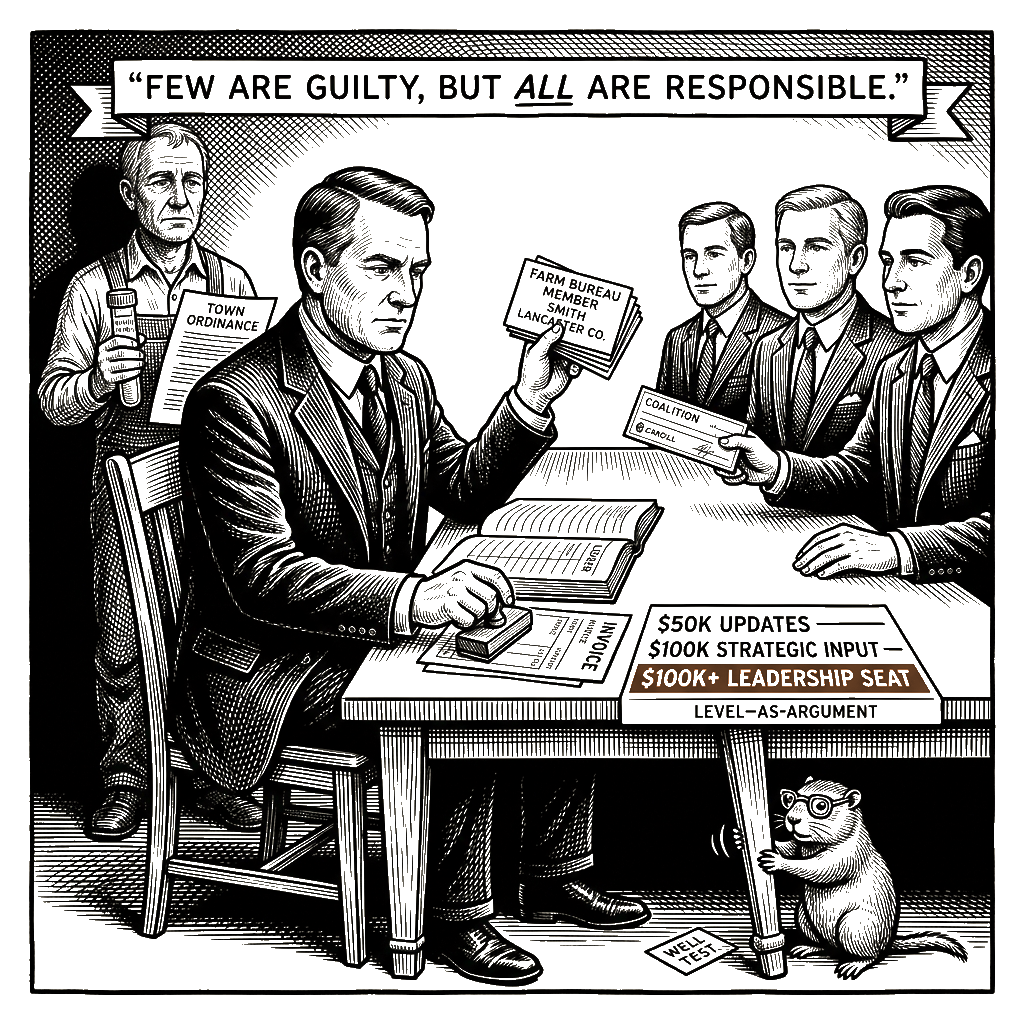
The Farm Bureau sold its members to Cargill and the pesticide lobby.
I have known men in this county who carried Farm Bureau cards in their billfolds their whole working lives, men who joined because somebody told them the organization would look out for the farm the way the Adams-Columbia Electric Cooperative looks out for the member. In this state the Farm Bureau and the Farmers Union have spent the last decade arguing in public about the same things: antitrust, monopoly, and whether a town gets a say when an operation big enough to be called a CAFO — seven hundred milking cows and up — decides to come in. That argument is the honest one, and the Farm Bureau has been on the wrong side of most of it. What I am writing about today is not that argument. It is the Farm Bureau taking public credit for an industry campaign built to end it.
Here is what the record says. The Center for Food Integrity, founded in 2007 and funded by dues, quietly assembled a coalition of the country’s biggest food and agriculture companies under a rebranded banner — “Gaha: Growing a Healthier America” — and began paying social media influencers to push back against Robert F. Kennedy Jr.’s Make America Healthy Again movement, the movement that believes, in the words of the health secretary himself, that chronic illness is primarily caused by processed foods and dyes, exposure to chemicals and poor farming practices, along with what Kennedy falsely claims are dangerous vaccines. The coalition includes the American Farm Bureau Federation, CropLife America, and the National Restaurant Association. The center’s board publicly lists executives from Chick-fil-A, Cargill, Dairy Farmers of America, and the National Pork Board. None of this is hidden. And Zippy Duvall, the Farm Bureau’s national president, openly took credit in a January speech for assembling it.
Name a coalition for what it does, not what it calls itself. This is not astroturfing. Nobody is hiding the checkbook — the board is public, the tiers are printed, and Duvall took the credit out loud, in January, in a speech. That is what makes it worse. It is lobbying with the farmers’ name on the letterhead — lobbying performed in a TikTok-shaped trench, sold to farm families by the one organization in rural America whose entire claim to legitimacy is that it speaks for them.
The seven priority targets CFI is organizing against are not fringe concerns: seed oils, pesticides, high-fructose corn syrup, regenerative agriculture, organic farming, raw dairy, and “big ag.” They are, in other words, the things Americans keep telling pollsters worry them. CFI’s own “Say This, Not That” guide is exactly the kind of internal training document a marketing department writes when the people it is marketing to have stopped trusting the brand. Every element of the playbook is a tell. The campaign is not a message about food. It is a message about messaging — frame-engineered relabeling in its most literal form, a phrasebook for telling worried people the word they are looking for is not the word they meant.
The money is printed on the page, and that is worth noticing. An internal flyer sets the tiers plainly: up to fifty thousand dollars for regular updates, up to a hundred thousand for quarterly meetings and strategic input, and north of a hundred thousand for a seat on the leadership council that reviews and approves the strategy. That is coordinated message discipline, the oldest trick in the trade — agreed language, deployed across speakers and venues, with the wording approved before it ships. The wellness economy the lobby points to as the real enemy takes its cuts openly, through the supplement aisle and the affiliate link. CFI’s coalition takes its cuts through donor tiers that let leadership-level contributors approve the messaging. Both are for sale. Only one of them is fronted by the Farm Bureau. And every seat on that leadership council, every “Say This, Not That” phrase, every influencer briefed on what to say is a future exhibit — the document trail of what America’s biggest food companies decided the appropriate response was to a public-health movement that had already captured the federal health portfolio: quietly fund a counter-narrative on Instagram.
The rhetorical move inside the July 2025 training video is the tell of tells. CFI’s executive director, Kelly Leighton, told industry funders that without a coordinated response, “that misinformation from Maha risks undermining consumer trust, fueling new regulations and eroding confidence in agriculture as a whole.” Read that sentence twice. The side with the budgets, the lobbyists, the commodity empires, and the revolving door into the Department of Health and Human Services is now claiming, in writing, that it is the side losing consumer trust to misinformation. Her stated goal, in the same video, was to create an “echo chamber” aligning food and agriculture groups behind “the same ultimate message.” That is not Maha failing to land. That is Maha landing so hard that the other side has had to invert the rhetoric of grievance and claim it as its own. CFI’s defenders will say it is an echo chamber of facts built to shout down an echo chamber of fear, and that one of those is a conspiracy while the other is a trade association doing its job in public. Maybe. But the trade association’s letterhead says it represents farmers, and it took public credit for the campaign while the towns in this state fight its biggest donors for the right to regulate a manure lagoon.
The influencer campaign tells the same story in smaller numbers. The campaign’s own August brief claims 13.2 million impressions, more than 1.1 million engagements, and an 8.74 percent engagement rate — numbers marketers would frame on a wall. Behind them are six onboarded creators reaching a combined audience of more than 2.6 million: Slade Wentworth, whose Instagram account thedadbriefs has more than a million followers; the anonymous creator of hydroxide.foodscience, with more than three hundred thousand; Jessica Steier of Unbiased Science; plus Happy Strong Healthy, Dietitian Hannah, and Veggies and Chocolate. Wentworth says he joined to help families “think critically through political and cultural noise” and to counter the “anti- and pseudo-scientific claims” pushed by the loudest voices in the Maha movement. The hydroxide creator calls the campaign a “uniquely positive spin on food and agriculture” that helps people “really get the facts.” Those are real people saying real things, and the numbers they drew are real numbers. They are also the numbers a movement that has already lost would be proud of. The lobby is treating six Instagram creators as a credible response to a coalition that has put the Secretary of Health and Human Services in office and put a summit on the calendar with the Vice President and several cabinet members in attendance. A single-digit-millions reach is not an answer to the commanding heights of federal health policy. It is what you do when you have decided not to contest the commanding heights. And propaganda’s oldest device is the plain-folks testimonial — the neighbor telling you what he knows — and CFI has just put a price list on its own version.
Steier’s side of it deserves a hearing before the verdict, because she made the strongest version of the industry’s case. Her team took “a modest fee,” kept full editorial and scientific control, and was never scripted; she says the center telling them what to say would have been a dealbreaker. “If anything, the financial incentives are far stronger on the other side of this,” she said. “The wellness economy that profits from fear about food and ‘toxins’ is enormously lucrative. Explaining why a preservative is safe is not where the money is. The people being richly rewarded for shaping what Americans believe about their food are not the ones defending the evidence.” That is not nothing, and I will not pretend it is. The actual influence-for-hire racket in American food is the wellness economy — supplements, “detoxes,” raw-milk evangelism, the whole fear machine that has figured out a scared mother is worth more than any preservative. Both sides are paid. The projection runs both ways: the industry funds the same kind of paid argument it calls misinformation, and the movement that calls itself healthy sells affiliate links off the fear it diagnoses.
The monthly briefs also do the work honestly, and that is worth conceding before the verdict. The February–March edition cited CDC data showing childhood obesity at a new high and a Canadian study linking ultra-processed food in early childhood to adverse behavioral and emotional changes. They read the studies. They answered the questions. They just refused to genuflect — and what they answered is not what the wells are asking.
Here is my own complicity, since I ask for yours: I buy what is cheap and open when the shop runs late, and Eric Schlosser wrote down what this machine does to a food supply in Fast Food Nation — I have had that paperback in my parts room since 2009, and I have loaned it to twelve people. I am not innocent of the aisle either. But complicity is not equivalence, and the KFF poll from May 2026 is not a mood. About four in ten Americans say they support Maha. Sixty-four percent say there is not enough regulation of pesticides. Seventy-five percent — three of every four — say there is not enough regulation of chemical food additives. Those concerns are held by voters of both parties, by suburban mothers and by the rural farmers whose farm bureaus are simultaneously bankrolling the counter-campaign. Cross-partisan majorities do not lose to six-figure donor tiers. They lose to other cross-partisan majorities, and that is not what CFI is building. That is the asymmetry of the moment in a single donor PDF.
Here is the part that should end the debate about which side is winning the argument it claims to be having. JD Vance is hosting a Maha summit in Washington, with several members of Trump’s cabinet scheduled — at the very administration the food industry relies on for the regulatory restraint that has stalled Kennedy’s ultraprocessed-food push. The lobby’s donor ladder is asking corporations to write checks to oppose something the Vice President is personally amplifying. Jerold Mande, the nutritionist who served as deputy undersecretary for food safety at the USDA under Obama, has spent decades trying to make food policy matter and has never seen a threat to the food industry like this one. He calls the campaign “crisis management”: “They realize now that they’re facing an existential threat, and their whole business model over the last decades has evolved around, you know, how do we make money?” Then he added the sentence that matters more than the whole influencer brief: “You’re not going to make progress if you don’t use government’s two powerful levers: funding and rules.”
Tom Philpott, a senior research associate at Johns Hopkins’ Center for a Livable Future, put it in one word: “That surely freaks the industry out… a vibe shift.” A vibe shift is what historians call a political realignment, once it is far enough downstream that nobody remembers being scared of it. The White House, meanwhile, has balked at turning Kennedy’s food agenda into rules, and that is the tell on the other side of the ledger. Maha has the summits, the cabinet cameos, and the moral certainty of a religion. What it does not have is a regulation. And I will say the thing neither side’s donor PDF contains: Kennedy’s vaccine claims are false. The food-supply question is real; the vaccine question is settled. A movement that merges them is doing the merging, and a lobby that lets the merging go unchallenged while it defends its own margins is doing it too.
Marion Nestle, the molecular biologist and nutritionist who has spent a career watching these lobbying fights, gave the only honest outside assessment the lobby is likely to get: “Of course, they’re going to lobby, and they’re going to do it in absolutely every way they can… Food companies have license to do all the lobbying they want, and they can say whatever they want. They don’t have to do anything. Nobody’s making them do anything. Nobody’s holding them accountable for anything.” She means it as an indictment. Read it as a description of the transaction. The lobby does not have to win. It only has to outrun the next election cycle, and movements do not run on donor tiers.
Now bring the argument back where it belongs, because this is not a vibe shift in my county. It is a business model. Wisconsin lost 15,366 dairy farms between 1997 and 2022 — a 70 percent collapse — while the average herd went from 56 cows to 203, per UW Extension’s work on the census of agriculture. DATCP’s own count puts licensed dairy herds at 7,292 on the first of January 2020 and 6,533 on the first of January 2022. On the south side of Adams County a neighbor’s well tested at 14 milligrams per liter against a public-health limit of 10. In Kewaunee County, a 2014 petition to the EPA documented roughly 30 percent of private wells tested exceeding federal or state drinking-water standards, in a county with the highest cattle density in the state. When the wind comes from the north, the smell from the lagoon off County G arrives before the paperwork does. This is what Earl Butz’s “get big or get out” produced, and Wendell Berry has been writing the same sentence in The Unsettling of America for fifty years: extraction destroys the membership before it destroys the economy.
That is the Community Collapse Contradiction in its plainest form — community-values rhetoric against the reality of consolidated extraction — and it is why Wisconsin towns have been passing ordinances to limit new CAFO growth while Big Dairy sues them for it, as Wisconsin Watch and Investigate Midwest have documented. The towns are not asking for anything radical. They are asking for the well water to be somebody’s responsibility. Aldo Leopold wrote the test down plainly: a thing is right when it tends to preserve the integrity, stability, and beauty of the biotic community. Nobody in the Gaha coalition is running that test.
What real policy would look like is not complicated, and Jerold Mande already named it: funding and rules — the nitrate standard enforced in the counties where it is being exceeded, antitrust attention on the buyers who set what a hundredweight of milk is worth, and the town’s own voice restored on the operations that land in its watershed. The Farm Bureau members asking for that in Wisconsin towns are asking for the same thing the Farmers Union asks for, and their national organization has put its name on the other side.
So here is what this campaign is not. It is not a conspiracy, and it is not astroturf — the board is public, the tiers are printed, and Zippy Duvall took the credit out loud in January. It is an industry that could still persuade you, one farmer at a time, with cited studies and disclosed budgets, deciding the honest transaction was too expensive and buying the farmers’ name instead. That is what “sold its members” means. The Farm Bureau did not lose an argument. It sold the argument its members came to it to have. The food lobby did not concede the argument in those internal documents. It conceded it the moment it decided the only response left was to pay people to make the case — and it asked the people it paid to ask nothing of you at all: your dinner, your judgment, and your silence, all in one ask, without a single question.