
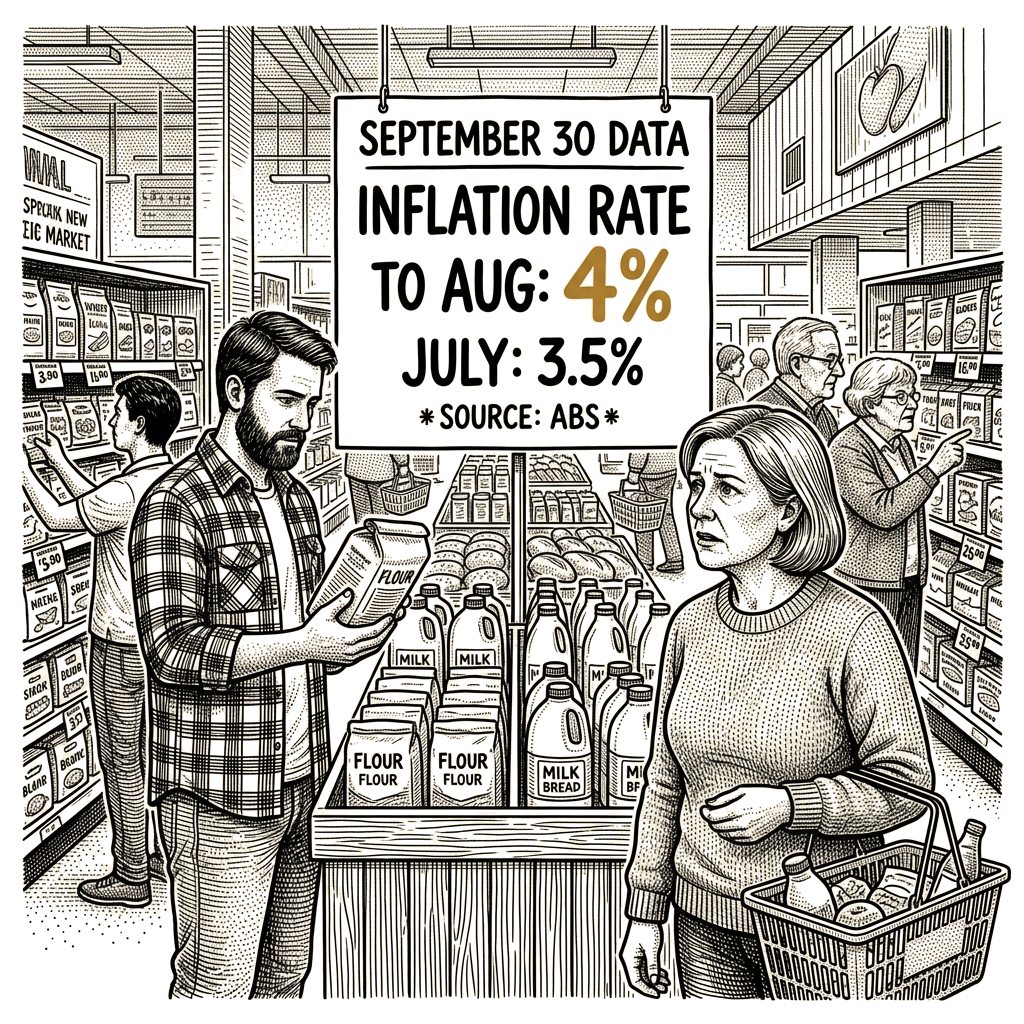
The August inflation print of 4% landed slightly below what economists had anticipated, and for the reason Treasurer Jim Chalmers gave: oil. Headline inflation jumped from 3.5% in July to 4% in August, according to Australian Bureau of Statistics data released September 30, driven by a 15% surge in fuel prices after the government ended its fuel excise cut and the worsening Middle East conflict triggered a rebound in global oil prices. Chalmers called the oil-price flow-through “not an opinion… a fact.” He was not wrong about the mechanism. It was a textbook pass-through from global oil markets — a supply-side dynamic, the kind the underlying measure exists to strip out.
But he was wrong about the policy implication — and so are the economists who read the 4% print as confirmation that the Reserve Bank of Australia’s tightening campaign is doing exactly what it was designed to do. The 4% headline number is the least worrying part of the release. The most worrying part is the 3.6% underlying figure — which strips out volatile fuel and food — steady at 3.6% in the year to August, sitting 110 basis points above the RBA’s 2.5% target, and showing no sign of falling. Underlying inflation does not move on oil shocks. It moves on domestic demand, on wages, on capacity. It has been detached from target for the better part of two years. The headline rise was, if anything, slightly less than economists had anticipated. Both measures remained well above the RBA’s 2.5% target. The underlying figure is where the problem lives.
The RBA’s response, announced the day before the data: lift the cash rate to 4.6%, the fourth increase of 2026. Cherelle Murphy, EY’s chief economist, said another hike before Christmas “looks likely” — and said plainly that the central bank “have an ongoing fight on their hands” and that “this is not the end of it.” She is almost certainly right about the next hike. She is less certain about what the hike accomplishes. Households rolling mortgages now face the full force of the tightening cycle, on top of electricity bills climbing back above the post-rebate level of a year ago.
Here is the trap. Rate hikes fix demand-driven inflation. They do not fix supply-driven inflation. They do not fix a 5.4% rise in home building costs — one of the prime drivers of high annual inflation — driven by materials and labour shortages. They do not fix the “sudden boom in AI-related spending on datacentres” that Governor Michele Bullock flagged in her own press conference. They do not fix a 3.6% underlying print detached from target. They do not fix oil shocks, or fuel excise changes, or wars in the Middle East.
What rate hikes do, into this configuration, is crush household consumption, soften the labour market, and hope the demand destruction eventually drags underlying inflation back to 2.5%. The Australian household — already paying elevated mortgage rates — is the variable being adjusted.
Chalmers and Bullock, for once, are not at odds. Chalmers pointed to global supply pressure and the ongoing US-Israel war on Iran. Bullock said inflation “is too high and has been driven by domestic capacity pressures,” then added the Middle East conflict and the AI-datacentre capex boom as compounding forces. She concluded that “these developments suggest that inflationary pressures will persist for longer than previously expected” — a persistence no single rate decision produces.
Murphy, more honestly than either, named the truth. The biggest part of the problem, she said, is “these global supply shocks,” and “what we are witnessing is the accumulation of a number of events happening together, and none of them are good for inflation.” Government spending at commonwealth and state levels is high and adding to demand, she said, and the government should be “extremely careful” with any new spending — including additional cost-of-living relief — for fear of making the RBA’s job harder. But it was, she conceded, “impossible to quantify exactly how much government spending was responsible for the persistence of high inflation” in 2026.
That concession is the tell. If the share is unquantifiable, the prescription is unquantifiable. You cannot tighten monetary policy quarter by quarter on the basis that “global supply shocks,” “domestic capacity,” “AI capex,” and “fiscal demand” are all hitting at once. The RBA is doing the only thing it knows how to do — raise rates — into a problem that is not, fundamentally, a rate problem.
Chalmers’ insistence that the diagnosis is “not an opinion” but “a fact” is correct in a narrow sense: the oil flow-through did happen. But he was accused of “gaslighting” Australians by insisting that government spending was not responsible for high inflation — while Murphy, the economist he would presumably cite on the demand side, said exactly that it was adding to demand and that its share cannot be pinned down. The broader claim — that the inflation problem is exogenous, that fiscal settings are not a material driver, that Australians should look to Tehran and Tel Aviv rather than Canberra — is the political frame, not the diagnosis. The diagnosis is what Murphy gave: the biggest part of the problem is global supply shocks, government spending is adding to demand, and the fiscal share cannot be quantified.
Murphy said the RBA has “an ongoing fight on their hands” and “this is not the end of it.” Bullock said inflationary pressures “will persist for longer than previously expected.” Both statements run through oil markets and datacentre capex and Middle East supply chains — not through the cash rate.
The RBA will hike again. Households will pay. The 2.5% target will not be met in 2026. The trap is the policy, and the policy is the trap.