
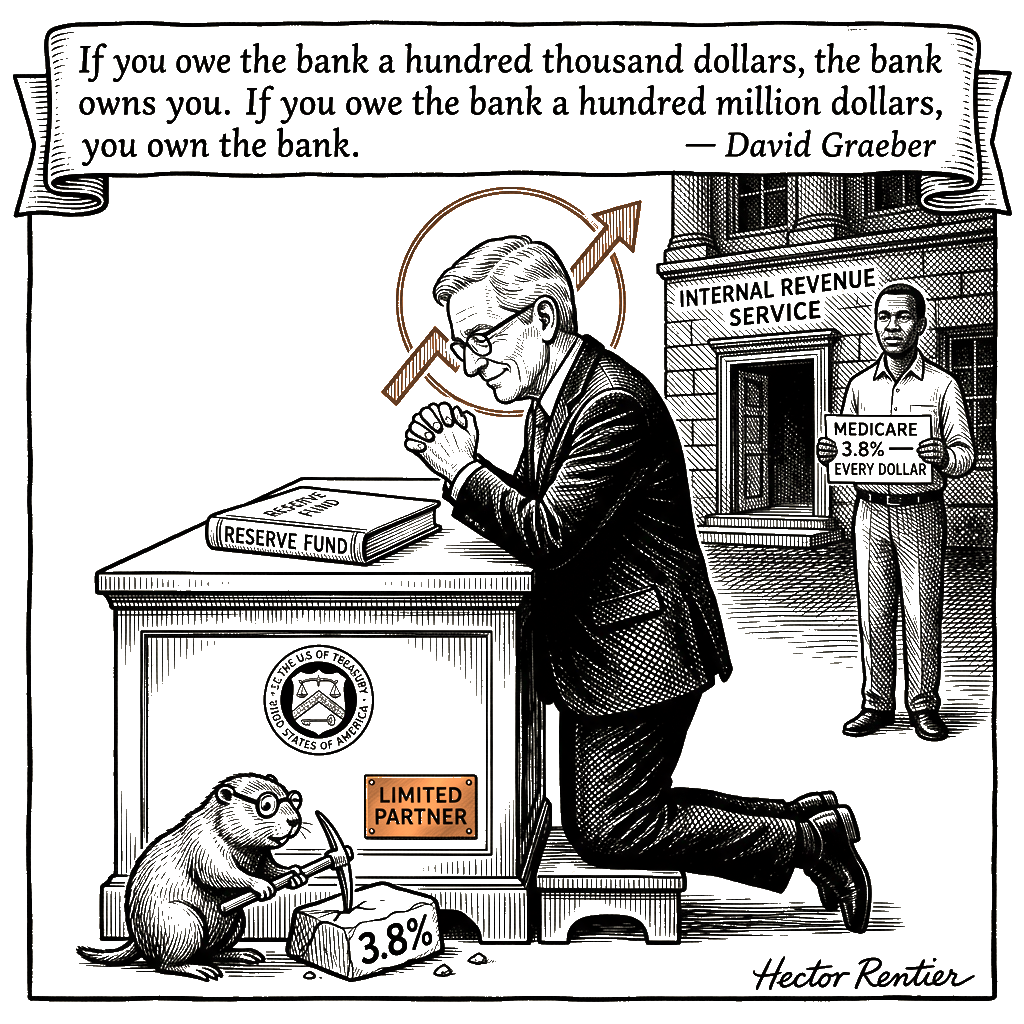
Scott Bessent dodged the 3.8% Medicare tax on his hedge-fund earnings — the strategy Senate Democrats contended saved him more than $900,000 — and paid only when the federal courts forced his hand. The sitting Treasury Secretary used the limited-partner strategy while running Key Square Group. At his 2025 confirmation hearing, he told senators he was keeping the disputed money in a reserve fund and would respect the outcome of cases that did not involve him. The 2nd and 5th U.S. Circuit Courts of Appeals then ruled against the strategy. Bessent settled with the government this summer, according to a person familiar with the matter. Senate Democrats pressed him again in a letter after the rulings, arguing his wait-and-see posture had run its course and asking whether he had paid. He settled. The agency he now oversees was litigating against the very strategy he had used.
The 2nd Circuit ruled in September that the three principals of Soroban Capital Partners owe the federal government self-employment tax on their $141.5 million in earnings from 2016 and 2017 — income routed through a limited-partner designation that the courts have now held does not exempt people who actually run the business. The Tax Court ruled for the IRS in the Soroban matter in 2023. A 5th Circuit panel rejected the government’s arguments earlier this year, then reversed itself in August and sided with the IRS. A 1st Circuit case is pending, and lawyers do not expect it to favor the funds.
The statute on its own terms.
The limited-partner exclusion did not begin as a hedge-fund loophole. It began as a protection for people who were not, in any meaningful sense, self-employed. Section 1402(a)(13) of the Internal Revenue Code — added by the Tax Reform Act of 1976, effective for tax years beginning after 1976 — excludes from net earnings from self-employment the distributive share of any item of income or loss of a limited partner from a partnership. The textual carve-out is not ambiguous on its face: the statute speaks of “a limited partner,” and the legislative history reflects a congressional concern that workers and investors who were not genuinely self-employed were gaming the Social Security system’s self-employed provisions to maximize benefits. Under that reading, the exclusion was doing exactly what Congress designed it to do — keeping passive investment income out of the self-employment tax base. A fund principal who takes a genuine passive role — who does not manage, does not control, does not participate in day-to-day operations — has a plausible textual argument that the exclusion applies to them. That is the strongest defense available. It is not frivolous.
The defense collapses on the facts as they exist in the modern hedge fund industry. After Congress uncapped the Medicare portion of the payroll tax in 1993, the value of the exclusion flipped. What had been a modest protection for genuine passive investors became a multi-million-dollar shield for the people running the funds. The label “limited partner” came to do all the work — regardless of whether the person holding it actually managed, controlled, or operated the business. The exclusion was not being applied as Congress designed it; it was being applied as a label to escape a tax Congress had deliberately made uncapped and universal. In 2018, the IRS announced a compliance campaign against this strategy, an effort that persisted across the Trump, Biden, and Trump administrations. The campaign’s persistence reflects that the issue was never partisan. It was a question of whether a statutory carve-out for passive partners would be allowed to function as a blanket exemption for active ones.
What the courts held, and what they didn’t.
The 2nd Circuit’s Soroban ruling turns on a functional test, not a label. Limited partners who run, manage, or control their businesses must pay the self-employment tax regardless of their formal partnership designation. The holding does not invalidate the 1977 exclusion — it holds that the exclusion does not reach people who function as active principals, no matter what the partnership agreement calls them. The 5th Circuit reached the same result through the same logic, after a panel initially went the other way and then reversed itself — an unusual procedural posture that suggests the government’s functional reading gained ground even inside the court that initially rejected it. The Tax Court arrived at the same conclusion in 2023. The doctrinal move is narrow and defensible: courts applying a statute to facts will look past labels to substance, especially where the label is being used to achieve a result the statute was never designed to produce.
That is a victory for the IRS, and a significant one. The 2nd Circuit’s ruling lands over New York, where the hedge fund industry is concentrated. For principals like Soroban’s partners — or Steve Cohen of Point72, who has pending IRS exposure — the writing is on the wall. His firm declined to comment.
The rulings are narrow. They apply to partners who run, manage, or control their businesses. They do not resolve what it means to control a multi-tier partnership. Dianne Mehany of EY — who advises high-net-worth clients — told the Journal: “We’re in no man’s land now. We have a standard that hasn’t been defined.” Karen Burke of the University of Florida described the cases as “easy cases” — principals who ran the business. Walter Schwidetzky of the University of Baltimore declared the gambit “dead.” These are descriptions of the current state of the law, offered by people who study it.
What the ruling opens up.
The functional test cuts both ways. Under the new standard, self-employment tax liability turns on whether a limited partner manages, runs, or controls the business — not on their title, and not on whether they are labeled “active” or “passive.” That standard was designed to reach the hedge fund principals who used the label to escape tax on active income. It also reaches, potentially, in the opposite direction. Law-firm and accounting-firm partners who never sit on management committees, who never control firm finances or strategy, who have been paying self-employment tax for years on the assumption that their partnership status made them liable — those partners now have an argument that the functional test exempts them. The appeals courts opened a refund window on exactly the kind of limited-equity, non-controlling interest the 1977 statute was written for. Attorneys are already preparing disputes over what “manage” or “control” means at a multi-tier partnership. Years of litigation are coming — for the IRS, and against the professionals who built the machinery.
What this is really about.
The 3.8% Medicare tax is uncapped. The 12.4% Social Security tax ends at $184,500. The Medicare levy runs on every dollar above that — for wage earners, for the self-employed, and through a parallel surtax, for investment income in high-income households. The limited-partner dodge let some of the richest people in America route income outside that base entirely. It was not clever tax planning in the ordinary sense; it was the use of a label to avoid a tax Congress had made universal on purpose. The government’s revenue across many tax years and across the hedge fund and private-equity industries is substantial. Not everyone who used the strategy was a fund manager — former President Joe Biden and former House Speaker Newt Gingrich used closely held S corporations to keep certain income out of both the Medicare and the investment-income tax bases. The dodge was bipartisan. The courts’ response is not.
The gambit is dead for the people who ran it: the principals who actually controlled the funds and used the label to escape the tax anyway. It is alive as a refund claim for the people who built it — the non-controlling partners at firms that never fit the hedge-fund pattern, who were paying the tax all along and now have a functional test that may exempt them. That is not a death. That is a market — and the lawyers will spend years litigating it.
For Scott Bessent, the market has already closed. He settled with the federal government this summer. He now oversees the agency that pursued him. He spent the period in between managing bond buybacks and Iran sanctions while the tax question sat unresolved. And somewhere in Midtown, a fund principal will have to prove this April that the partnership interest he holds does not mean what his lawyer told him it meant.