
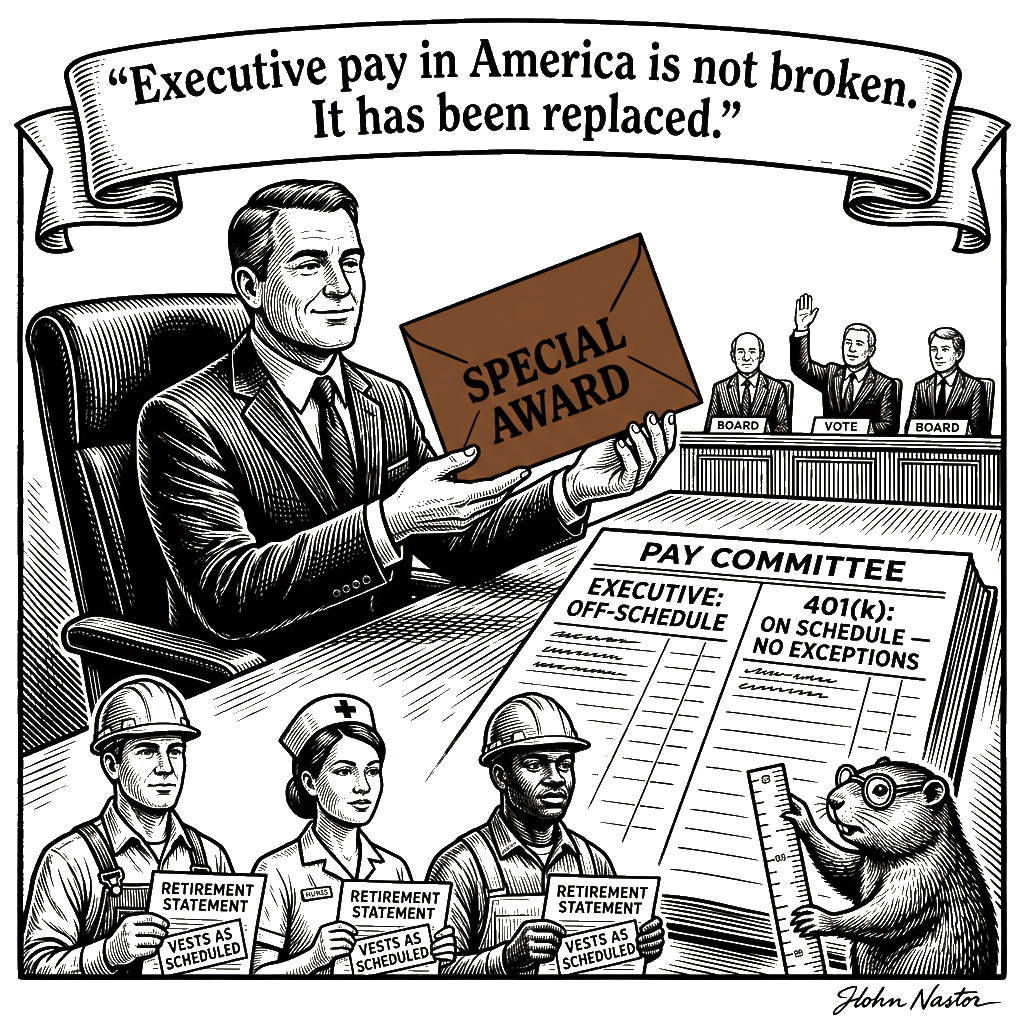
Executive pay in America is not broken. It has been replaced. The word “special” has been drained of meaning and refilled with a holdup note, and the money signing it is yours — through the index funds, the target-date funds, the 401(k) that quietly owns a slice of every boardroom in this column. S&P 500 companies shoved out $1.7 billion in these one-off awards last year, a 50 percent jump in twelve months (the full tally). A quarter of the index has now handed out multiple. Nearly half have made at least one in the past two years. The pretense that these are reserved for extraordinary wins is dead, and everybody in the room knows it.
Take the cleanest case first, because it is the one no board has an answer for. Matthew Friend was chief financial officer of Nike. The company gave him a $4.1 million special award in its most recent fiscal year, and a $3.3 million retention award the year before that. Half of the retention award was scheduled to vest last month, when he would no longer be there. The other half required Nike’s share price to stay above $100 long enough; it didn’t, and that half died on schedule, in silence. Then in June the company announced he would step down as CFO within two months, and be gone by early September — with $6 million in cash severance on top. He will likely keep part of the retention shares, some $1.2 million at recent prices, paid for the months he stayed, with more possible if Nike hits operating-margin targets by late 2027. The award was written to bind him to Nike. What it actually bound was the share price. What paid him for leaving was the severance check. Nike did not respond to a request for comment.
Now take the word of the people who approve these things. Semler Brossy pay consultant Blair Jones says directors are “feeling the heat and they’re feeling the urgency.” Listen to what that sentence actually says. The heat is executive turnover. The urgency is that a CEO might leave. And the answer, in every case, is the same: open the vault. Within the S&P 500, 67 leaders departed in 2025, up 29 percent from 2023, with another 36 gone in the first half of this year. The churn handed compensation committees their excuse — and Friend’s severance shows what happens to the excuse the moment the retention stops being necessary. As Equilar’s Courtney Yu put it, “when you look at who is making the highest-paid CEO list, a lot of those are because of these one-time awards being granted in a given year.” That is not a market correcting itself. That is a system being quietly decommissioned by the people it was built to constrain — while the vesting schedule that governs everyone else runs on, untouched.
The rest of the roster supplies the scale. Warner Bros. Discovery reported $165 million in pay for David Zaslav last year, including a $110 million stock-option grant tied to signing a new contract and $11 million in “supplemental” restricted shares — with roughly $366 million more likely to land when Paramount Global’s acquisition closes, on a share price that has tripled since March 2025. CrowdStrike gave co-founder George Kurtz $188 million in restricted shares at the end of December, with a path to $290 million if shareholder returns clear a hurdle through 2028, accompanied by about $3 million in cash and $2.5 million in personal travel on company aircraft. Dozens of executives have collected back-to-back special awards over two years, Zaslav and Cisco’s Chuck Robbins among them. The boards call it retention, or strategy. It is ransom, and Friend is the receipt that shows the terms.
Then there is the number that makes the whole argument look like a rounding error. Tesla’s award to Elon Musk — $132 billion, tied in part to establishing a Mars colony and orbital data centers — was left out of the $1.7 billion aggregate entirely. (A separate $26 billion award from 2025 was later canceled.) When the single largest special award is roughly 78 times the entire S&P 500’s special-award spending for the year, the practice has not spiraled; it has declared itself.
The objections are on the record and already overrun. Mutual-fund giant T. Rowe Price lists special equity awards among the pay practices it considers at risk of “divorcing executives’ interests from those of shareholders.” ISS’s David Kokell said investors want one-time awards kept out of recurring pay, and warned that these packages “eclipse more structured compensation plans that pay out less or nothing if performance is poor.” Seventeen S&P 500 companies have already reported granting more than $600 million in special awards to more than 40 executives in fiscal years ending in 2026. The pipeline is full.
Meanwhile, at those same companies, everyone else is paid on the old schedule. The AFL-CIO’s tally puts CEO pay at the top S&P 500 firms at 312 times worker wages (the finding), and at the 100 lowest-paying S&P 500 firms the ratio climbed another 8.4 percent (the breakdown). The median S&P 500 CEO pulled in $17.9 million last year, up from $11 million a decade ago. Boards that will pay $188 million to keep one man “focused” have a budget precisely sized for everyone else. The rank-and-file retirement account vests on schedule, in the market, whether the price holds or not.
They call it a special award. It is ransom, and the invoice is being mailed to your 401(k).