The “free market” that dissolved every rooted town in this country now finds itself scolding the post-liberals for wanting to wall the wreckage in. James M. Patterson, writing in National Review, has named the next turn of the blade in The End of MAGA — and What Comes Next — JD Vance’s Catholic integralism, its Franco admiration, and its “neo-Hamiltonian” autarky, which Patterson rightly warns would bring shortages, black markets, and a version of Franco’s los años del hambre to American consumers. He sees the cliff the post-liberals are walking toward. He cannot see that the road that delivered the country to it was paved by the very orthodoxy he still defends.
He deserves the concession before we go further. The post-liberal turn is a serious menace, not a debating-society curiosity. The enthusiasm of Pecknold, Posobiec, Knowles, and Charles Haywood for Franco is not an internet affectation; it is the return of a politics that, in Spain from 1939 into the late 1950s, starved hundreds of thousands of its own people in a country with no natural shortage of food. The autarky that produced los años del hambre was a deliberate Catholic-nationalist program. Patterson is right to drag it into the light before American conservatives repeat it. And the post-liberals’ diagnosis is not baseless: the empty storefront on Main Street is not a myth. The opioid crisis is not a metaphor. The forty-year stagnation of real wages is not a conspiracy theory. Patterson is right that something was destroyed, and that Patrick Deneen held up that 2022 photograph of an Ohio town for a reason. On that we can agree.
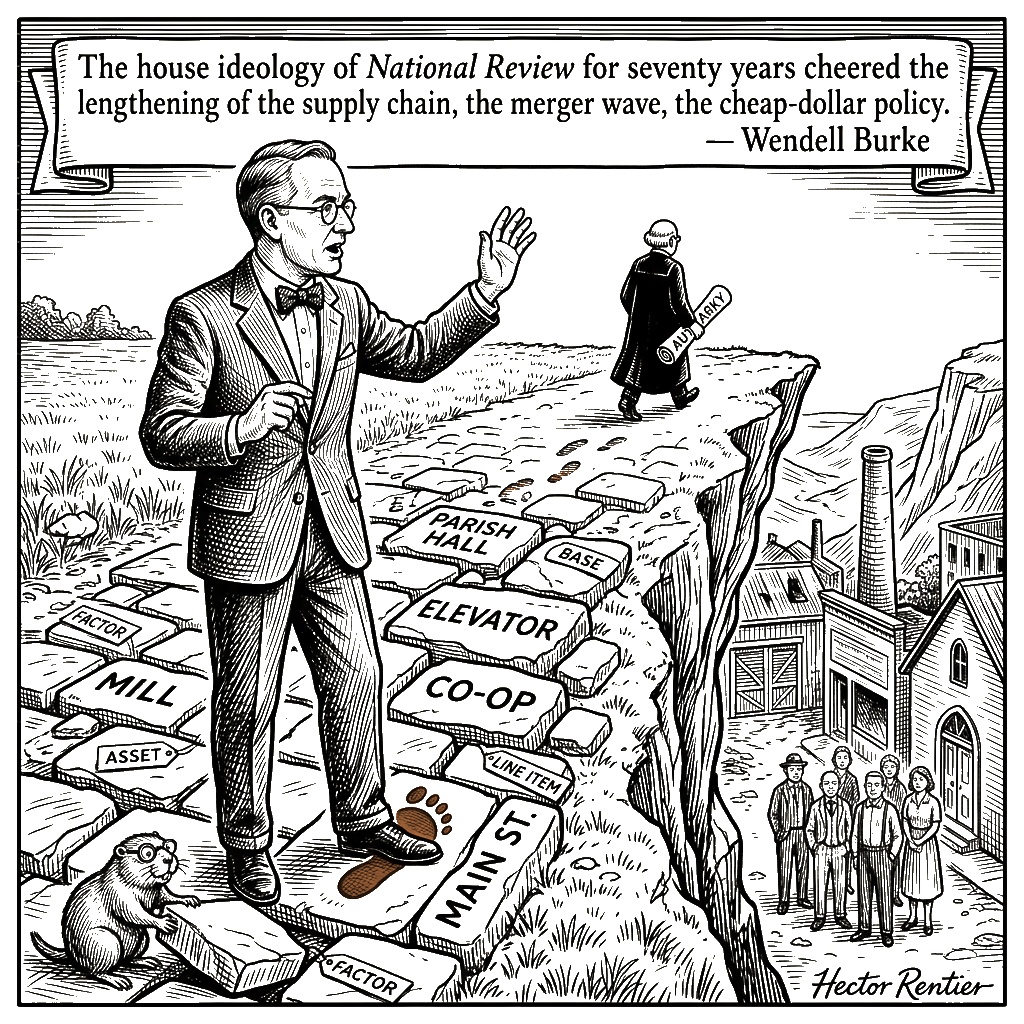
But he is wrong about which disease is killing us. And here he cannot see his own footprint on the wreckage. The house ideology of National Review for seventy years cheered the lengthening of the supply chain, the merger wave, the cheap-dollar policy that priced American manufacturing labor out of every product it once made. I used to trade corn futures on a Chicago desk before the crop was a foot high, and I learned there what Patterson will not say: the dollar regime is a transfer mechanism, not a neutral accounting. A strong dollar rewards the firm that ships the job to Reynosa and ships the part back. It punishes the small town that built the part for three generations. The post-liberals looked at the empty plant and called for a wall. Patterson looks at the same plant and calls for a stronger dollar. Both are answers from men who have not set foot in the town.
And the market I learned was not an abstraction. It was a place where a farmer delivered to an elevator his grandfather built, against a contract his father signed, for a price discovered in a pit where men who knew the smell of the field argued about the weather. When that chain breaks — when the elevator is owned by a fund in New York, when the price is set by an algorithm, when the farmer signs a contract that pays him in “convenience” rather than cash — the market is no longer a market. It is a tollbooth. Every plant closure in Ohio — Youngstown Sheet and Tube in September 1977, the day the smoke stopped — was signed off by some senator who went home to talk about family values. This is the fusionist betrayal I cannot forgive. The right that claimed to conserve — that invoked the parish, the family, the rooted life — spent forty years in office practicing the most aggressive rootlessness in American history. He is offering the survivors of the wreck a stronger rope to hang themselves with.
The post-liberals are the children of the dissolution the free-marketers wrought. They are not inventing the ruin; they are inheriting it. When the market dissolved every rooted thing — when it abstracted labor into a “factor of production,” community into a “consumer base,” the family into a “household” — the post-liberals looked at the wreckage and concluded that the market had failed. They were half right. What had failed was the conservative claim that an unrooted market would leave the institutions intact. It never could. A market that respects only price will, in time, price out everything that is not for sale: the parish, the credit union, the cooperative, the local school, the Main Street bank. And once those are gone, the only institution left with the reach to do anything is the state. The post-liberals looked at what their parents’ orthodoxy had built and reached for the only tool it left them.
To give the post-liberals their due, they at least see the loss. Their mistake is to locate the cause in “neoliberalism” alone rather than in the concentration of capital that the last forty years of bipartisan policy accelerated. And their cure is worse than their disease. A weak dollar would not bring back the mill. It would bring back inflation — and inflation is the most regressive tax known to a wage earner, the tax that breaks the fixed-income pensioner and the grocery clerk long before it touches the hedge-fund manager. I have watched that mechanism operate across more than one harvest. A country that decides to devalue its way back to industry is a country that will price its working class out of food before it prices any factory back into existence. Franco’s Spain learned exactly this. Spain under Franco, that is.
But the deeper problem with Vance’s program is not its economics, bad as those are. It is that it asks a nation to be Catholic. A nation cannot be Christian. Only a person can be, and only by a grace that does not arrive by state action. The fusion of throne and altar — Vermeule’s “good rule,” the common good as the state defines it — is the oldest betrayal of the Gospel in Western politics. It is the move Constantine made, and every century that has repeated it has produced the same fruit: an established confessional state that blesses whatever the regime does, and a regime that mistakes its own power for the Kingdom. Vermeule’s “justice, peace, and abundance” is Franco’s trinity, with better marketing. The post-liberals do not want a Catholic nation; they want a Catholic state. The difference is the size of the disaster. And the people who will pay for it are not the venture capitalists in San Francisco but the families in Youngstown and Muncie who will be told, once again, that their suffering is the price of somebody’s higher order.
So neither of Patterson’s answers holds. His cure is not the post-liberal state, and it is not the free-market return. The cure is the institution the right has been too busy mourning to actually build — and I know what that institution looks like, because I help run one. It is the cooperative elevator still owned by the farmers who use it. It is the mutual savings bank that financed the parish hall. It is the community land trust that takes the house off the speculation market while the family keeps its equity. It is the credit union local enough to know your name. It is the electric co-op whose board answers to the members who pay the bill. Mondragón is not a slogan — it is a federation of seventy thousand workers with an internal pay ratio the shareholder corporation cannot survive quoting aloud. These are the institutions the right claimed to conserve, and the fusionist right and the post-liberal right between them have spent forty years hollowing out.
I will not pretend the answer is easy where I live. My county traded its rail work and its mill work for a golf resort and lake subdivisions — half the housing now seasonal, the median age past fifty-five, the best available future to become other people’s playground, served by our own children at low wages. The co-op is a stubborn thing in a place designed to forget it. That is not an argument against the co-op. It is an argument for building it anyway, one town at a time, because the alternative is not Patterson’s open door and it is not Vance’s wall. It is a county that answers to no one who will ever live in it.
The mill belongs to the town. The parish belongs to the people in the pews. The building the great-grandparents paid for in 1884 is not a line item on someone else’s portfolio. Neither Vance’s wall nor Patterson’s open door will bring back the mill. Only the restored local institution — owned in place, governed by the people who live there, accountable to the next generation — will do that. The rest is theory sold by men who will never set foot in the town they are theorizing about.