
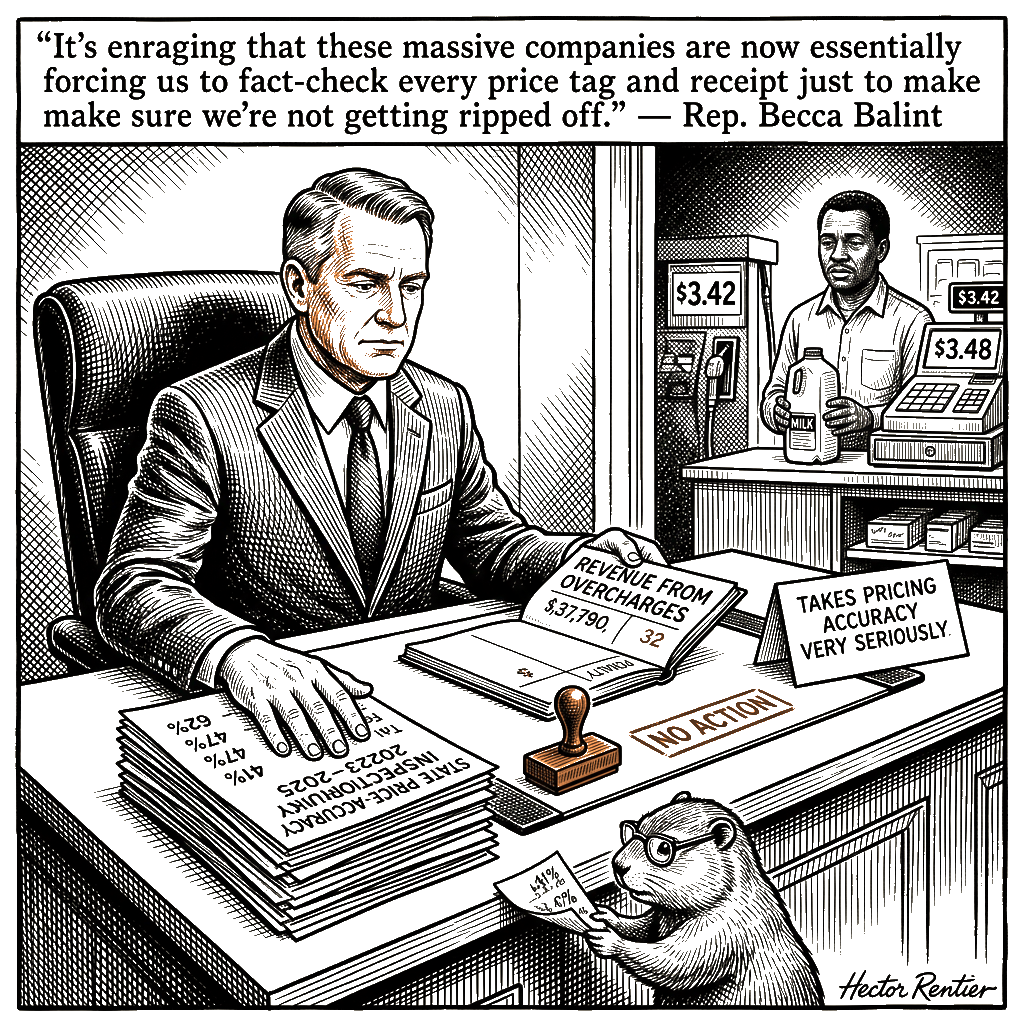
7-Eleven and Circle K are stealing from working families, one overcharge at a time, and the receipts are in. Five House members have now demanded the Federal Trade Commission investigate what state inspectors have been documenting for years: the two biggest convenience-store chains in America ring you up for more than the sign says, in numbers that no honest business produces by accident.
I noticed it on a Tuesday. Eva was in her car seat behind me, already negotiating for a snack, and I had stopped at the 7-Eleven on Aramingo for gas and milk because that is what the last stop before home looks like when you have two kids and one of them is screaming. The pump said $3.42 a gallon. The screen at the register said $3.48. Six cents on a gallon. I paid it, because the tank was on empty and the kid was on fire and I was not going to stand in a gas station lobby doing arithmetic with a toddler. But I remembered. I always remember now. That is what they have trained us to do — to become the price-accuracy inspectors because they refuse to hire their own.
The numbers the inspectors have been catching are not six cents. Between 2023 and 2025, 7-Eleven failed 41 percent of its price-accuracy inspections in Arizona, 47 percent in Colorado, and 47 percent in Utah. Circle K’s failure rate over the same window ran 35 percent in Florida, 39 percent in Arizona, and 62 percent in North Carolina. Inside Rep. Laura Friedman’s own district in Los Angeles County, 7-Eleven flunked 37 percent of its inspections. A 47 percent failure rate is not a rounding error that escaped into a quarterly report. Nearly half the time an inspector walked through the door, the store was charging more than the sign said.
Now run the kitchen-table math on that. Say you are a parent who stops at a Circle K three times a week — gas on the commute, milk on the way home, a snack for the kid who has been good in the back seat all afternoon. That is 156 stops a year. At even a modest ten-dollar basket, and the overcharge running at even half the documented failure rate, you are paying somewhere north of twenty-five dollars a year in charges that were not on the sign — for the privilege of a store that cannot keep its own tags honest. Twenty-five dollars is a week of the Aldi run. It is the difference between the pediatric co-pay we can cover and the one we put on the card. It is not a fortune. It is the fortune of a household where every line is already accounted for and the surplus is measured in single-digit dollars. Multiply that by a working parent filling a tank at a 7-Eleven that just failed 47 percent of its inspections in Colorado, and what you have is a transfer — a quiet, per-transaction transfer from the people with the least slack in their budgets to chains that treat the fine as a rounding error on their own balance sheet.
Rep. Becca Balint of Vermont said it plainly: “It’s enraging that these massive companies are now essentially forcing us to fact-check every price tag and receipt just to make sure we’re not getting ripped off.” She has asked the FTC to investigate. Rep. Nanette Barragán, whose district covers swaths of Los Angeles County, named the larger machine — corporations putting profits over people while the government lets them. Rep. Delia Ramirez of Illinois went further, into price gouging and predatory algorithms and monopolies, and closed on the sentence that belongs on every one of these statements: “People in my district are tired.” So are we.
This is the second shoe. Last December, an investigation revealed that Dollar General and Family Dollar — the two biggest dollar-store chains in America — had been doing the exact same thing, quietly charging more at checkout than the shelf tag promised, on everything from frying pans to Frosted Flakes. Thirty members signed a letter then, led by Rep. Nikki Budzinski, who says the convenience-store records confirm the pattern. Two of the biggest dollar-store chains, two of the biggest convenience-store chains, the same practice, the same modest fines, the same shrug. The dollar store was supposed to be the genre — the fluorescent-lit temple of the squeezed household, where you go when the paycheck has three days left and the kids need something. It turns out the temple was rigged. The “convenience” in convenience store has always been the joke they play on the people who have no other option within walking distance of the shift that ends at eleven.
Neither chain answered detailed questions. 7-Eleven says it takes pricing accuracy “very seriously.” Circle K says it is “committed to complying with all applicable laws and regulations.” Two sentences, drafted by the same kind of communications shop that has been on retainer for every industry that has ever been caught stealing from its own customers. “Very seriously” is what you say when the fine is cheaper than the compliance.
Dean Baker, senior economist at the Center for Economic and Policy Research, put the fix in one line: “If a store had to pay a $50 fine for every instance where they overcharged someone 10 or 20 cents on a pound of apples, they would very quickly figure out how to get their shelf prices to agree with their cash register prices.” He is describing arithmetic, not ideology. When the penalty for stealing is smaller than the revenue from stealing, the theft is the business model. The current regime does not fail to deter overcharging. It prices overcharging in, and hands the difference to us, at the pump, at the register, one swipe at a time.
I keep coming back to the moment at the pump. The sign says one number. The screen says another. There is no manager to call, no inspector to flag it, no receipt I can hand anyone that turns six cents into a conversation. What there is instead is a kid in the back seat who needs the milk, and a tank that needs the gas, and a mother who has learned that the thing she was told to trust — the price on the sign — is a suggestion the store does not follow. That is the whole arrangement in one Tuesday evening. The people with the least room in the budget are the ones paying the tax for the chains’ inability, or unwillingness, to charge what they promised.
Taylor Swift writes about the small accumulating detail as the way a condition becomes a life — the inventory of tiny wrongs that add up to a story you did not consent to. This is that story, at the register. The overcharge is small enough to be deniable and frequent enough to be a business model. That is not a pricing error. That is a decision made every morning by people who have run the numbers and found the public will pay it. The public is done paying it. The inspectors have been counting for three years. The only thing missing is a fine schedule that makes the arithmetic work against them instead of against us.