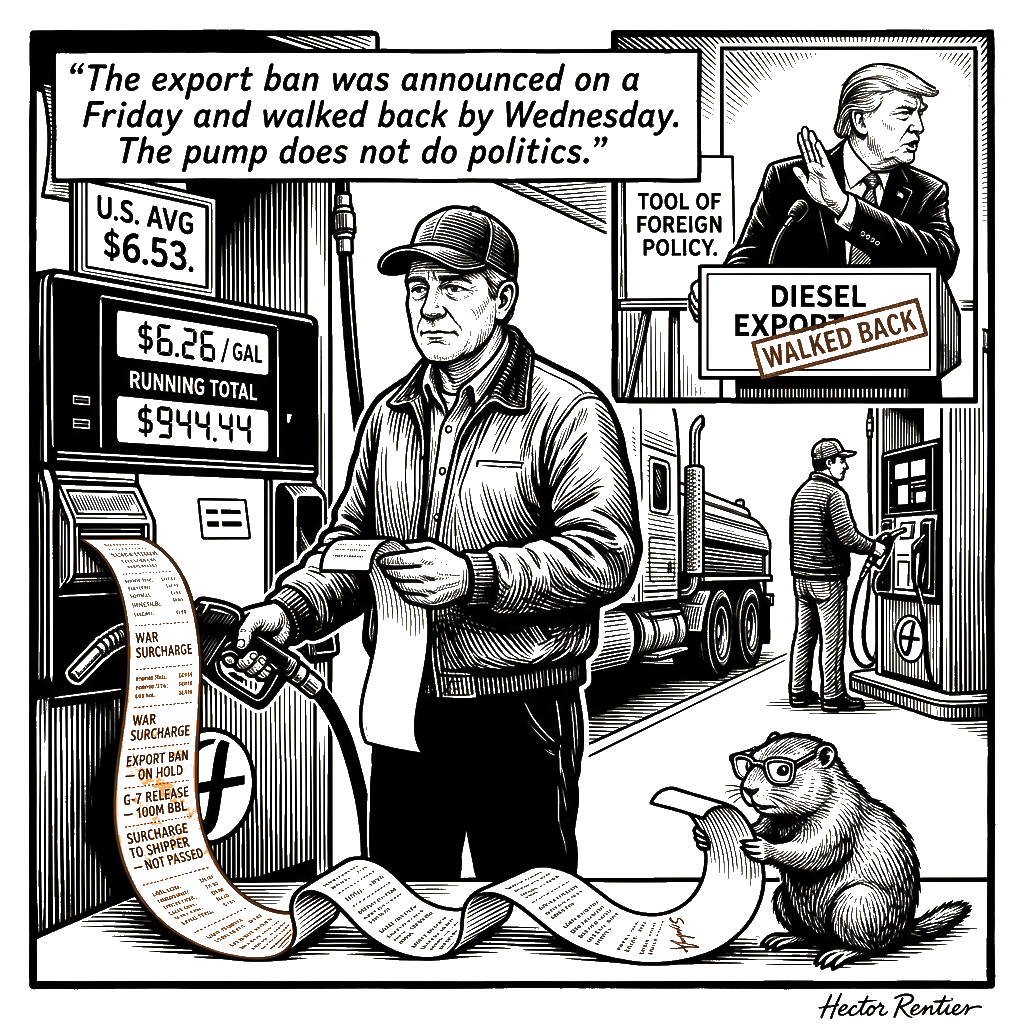
The math is killing them. At a Flying J off Interstate 10 in Orange, Texas, just across the Louisiana line, the twelve fuel lanes were busy and the concourse was empty. Three rows of brown pleather armchairs faced a TV tuned to the American Heroes Channel to no one in particular. Fourteen showers went mostly unused. Drivers sprinted in, paid, and sprinted back to their rigs. That is the picture: the freight is moving, the men are moving, and the money is moving out of their accounts faster than it comes in. Independent driver Agron Berani filled his 18-wheeler at that pump last week and watched it climb to $944.44 — nearly double what the same 151 gallons would have cost a year ago, when a fill-up ran him around $500. Diesel at that pump Thursday was $6.26. The national average hit $6.53, up nearly $3 from a year ago. Berani, 56, came to this country from Kosovo, voted for Donald Trump the first chance he got, and now blames that same president for the fuel bill that is eating his livelihood. The contradiction isn’t hypocrisy. It’s arithmetic. That is not a poll number. That is a swing voter in a Peterbilt. A month before the midterms.
By Thursday, the freight market already climbing through September had done nothing to keep small operators solvent. More than a dozen small motor carriers filed for bankruptcy in the past month. The Owner-Operator Independent Drivers Association is warning that more will follow if prices don’t drop. The bankruptcies are not a forecast anymore. This isn’t a forecast. It’s an obituary in slow motion.
Look at the drivers at the Flying J and the picture sharpens. Kevin Smith, 50, runs from his home in Lake Charles, Louisiana, to Colorado to pick up a load of potatoes and haul them back to a Walmart distribution center. He gets $4,600 for the run, hauling 37,000 pounds, and by the time he pulled into Orange he had burned through more than $2,500 in fuel alone. After his $1,800 monthly truck payment and $1,300 insurance bill, the margin on feeding America its french fries is a rounding error. “If my wheels ain’t turning, I ain’t earning,” Smith said. “If I don’t move these potatoes, you don’t get your french fries. But I can’t even afford to keep this running.” That line is the whole economy in seven words. The french fries are a fact. The diesel is a fact. The $1,300 insurance and the $1,800 truck payment are facts. The flat fee is a fact. The numbers do not lie and they do not negotiate.
Amandeep Singh, 51, has been driving for almost 23 years. When he started, a mechanic ran about $55 an hour. Today the same mechanic is $175. Parts costs have doubled. When his truck broke down last Friday, a minor repair cost $707.67 — paid through Zelle to dodge the 3.5% credit card fee. Singh’s $200,000 in annual gross revenue yields about $45,000 in take-home. To stay in business he parks at loading docks to avoid overnight truck stop fees, brings food from home, and hasn’t paid for a truck wash in nearly three months. “Nobody understands how hard it is,” Singh said while hauling soft drinks from Houston to Mississippi. The trade is not a career path anymore. It is a survival contest with a CDL.
Gerjon Premtaj, hauling frozen vegetables from Mexico to Pennsylvania, said the quiet part out loud: “My paycheck is the same, but the fuel goes up. Whenever I fill up my truck, it feels like somebody robbed me.” He is in direct contact with the grocery-supply chain the diesel costs ripple into. The french fries Smith is hauling and the frozen vegetables Premtaj is hauling meet in the same grocery store. The fuel surcharge does not.
That is the mechanism the industry prefers not to discuss in public. The fuel surcharges — the instrument meant to pass rising fuel costs to shippers — did not move fast enough to match the run-up. Smaller carriers lack the bargaining leverage of major fleets to demand full surcharge protections from shippers. Bob Costello, chief economist of the American Trucking Associations, put it plainly: “Nobody expected prices to ever get this high.” The industry’s own economist admitting that the model was not built for this. The model is not built for this because the model was not built for a $3-a-gallon run-up in twelve months. That isn’t reassuring. It’s a confession that the system has no shock absorber for the people who keep it running.
The political class has noticed, in the way the political class notices things: late and theatrically. Texas Gov. Greg Abbott, up for re-election, declared a statewide disaster over the diesel shortage on Monday and relaxed state transport and fuel regulations. Abbott’s move followed weeks of Trump administration hand-wringing over a federal diesel export ban that never materialized. The administration has spent months treating diesel as a tool of foreign policy, and freight rates have been climbing since the war started, with rates hitting their highest since 2022 weeks before the G-7 emergency release. The export-ban threat faded Friday after G-7 countries agreed to release 100 million barrels of oil from emergency stocks — a tourniquet, not a cure, applied to a wound the administration helped open. “Texas agriculture and freight run on diesel,” Abbott said in a statement. Texas oil built the glut. Texas drivers are paying for its absence. A U.S. diesel export ban, the kind of policy that gets announced on a Friday and walked back the following Wednesday, is the policy equivalent of the Flying J loyalty card: it does not pay the bill.
The G-7 release is, at minimum, an acknowledgment that soaring diesel prices are the clearest sign of inflationary pressures from the U.S. conflict with Iran, with effects rippling into the broader global economy. That acknowledgment is overdue. Truckers have been absorbing this hit for months. The cost of that gamble is being passed to the men with the pumps in their hands. The men with the pumps in their hands vote. Berani, Smith, Singh, Premtaj, Hunt — they are the people who do not get to wait for a G-7 communique. They are the people for whom $6.53 a gallon is not a policy debate. It is the difference between a working month and a bankruptcy filing.
The newcomers still believe. Delano Hunt, 38, started his first week on the job hauling GMC auto panels from Detroit to Baton Rouge, driving a rental with fuel covered and flashing a new Flying J loyalty rewards card that earns free showers after 1,000 gallons purchased. “I’m optimistic,” Hunt said. “Trucks run the world.” He’s right about the second part. The first part depends on whether the people who run the trucks can afford the fuel. The optimism is real. The math is also real. In a year, the math will tell him which one to trust.
With midterm elections a month away, the cost of keeping America’s trucks running is now a political question. It was always a survival question for the drivers. The politicians are late, the bankruptcies are early, and the math has not gotten any kinder.