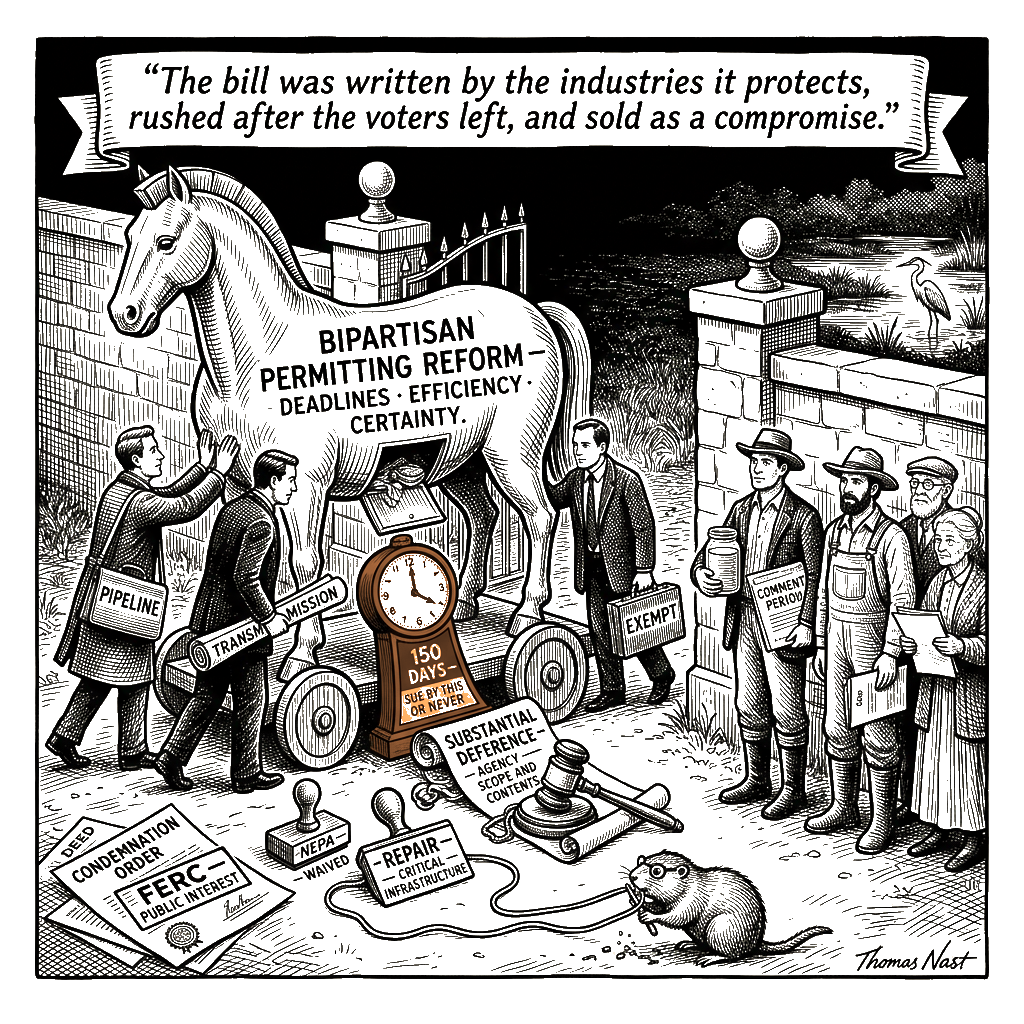
Lame-duck sessions are for the legislation no one wants to defend in daylight. Washington has produced another bipartisan “compromise,” and the country should hold its nose. The Senate’s draft permitting bill, paraded as the cure for America’s supposed paralysis and as the nation’s “biggest economic Achilles’ heel,” is a stealth assault on environmental law — a Trojan horse for the very industries that have spent a decade weaponizing the courts to gut environmental review. Strip away the rhetoric about “deadlines” and “efficiency,” and what is left is a transfer of power from the people who live near pipelines and transmission corridors to the corporations that want to build through them. It is a sweeping rollback of the safeguards that for half a century have required the federal government to think before it acts.
The bill’s premise is that the National Environmental Policy Act is broken paperwork. That framing is a fossil-fuel industry talking point. NEPA exists because the previous century taught the country, painfully, what happens when nobody has to study the consequences of large-scale construction: poisoned rivers, leveled mountains, towns sacrificed for somebody else’s bottom line. The advocates cite the average timeline for an environmental impact statement — roughly four years, often hundreds of pages — as proof the system is broken. Four years to issue an environmental impact statement sounds long until you remember that those statements are how the public learns what a project will do to its water, its wildlife, and its property values. The length is the protection. The time is not waste. It is the time required to inventory what a project will do to a watershed, an endangered species, a community’s air. A two-year deadline and a one-year deadline for “smaller” projects do not speed honest review; they speed the disappearance of it. In practice the deadlines are a one-size-fits-none straitjacket that rewards the deepest-pocketed applicants, who can hire the largest review teams to compress the timeline, and punishes smaller communities and tribes that cannot hire lawyers fast enough to participate meaningfully before the buzzer.
The same advocates cite the Mountain Valley Pipeline, which took a decade to clear its environmental reviews in the Fourth Circuit, as Exhibit A for the bill’s necessity. A decade of litigation is portrayed as the cost of doing business, rather than what it actually was: the cost of forcing a fossil-fuel project to answer for the streams, the forests, and the private property its route would scar. And consider how the Fourth Circuit panel that kept blocking the pipeline is now being branded “willful.” Willful is what you call a judge who refuses to follow precedent. What the Fourth Circuit actually did was read the law and conclude, repeatedly, that the pipeline’s environmental reviews were inadequate. That is the job. Converting “the court said so” into “willful obstruction” is the rhetorical move that turns judicial review into an obstacle to be streamlined out of existence. The bill’s response to that record is not reform. It is retaliation. The 150-day statute of limitations for challenging permits — down from six years — and the same 150-day window for biological opinions under the Endangered Species Act are designed to outlast the public’s ability to organize a legal challenge before a shovel hits the ground. NEPA challenges exist because environmental damage is often slow to appear. A leaking pipeline can take years to contaminate a watershed. A transmission corridor can take years to displace a migrating herd. Telling plaintiffs they have 150 days from publication to sue, or forever hold their peace, is telling them to file before they know they are hurt. Endangered species do not read the Federal Register. They do not file on day 149. They get extirpated, quietly, while the statute of limitations ticks down.
The litigation curbs are dressed in the language of judicial economy. Plaintiffs must show “direct harm or imminent injury” rather than the broader standing the courts have long recognized. Courts are instructed to give “substantial deference” to agencies on the “scope and contents” of environmental reviews — a phrase that, in practice, tells judges to stop second-guessing the very agency that wrote the review, and to stop reading. The “sue for delay” remedy is, in practice, a remedy for the developers who can afford to sue. A property owner whose well gets contaminated has no comparable litigation budget. And if a judge finds a review defective, the agency now gets to amend rather than restart — an invitation to fix the paperwork after the project is already built. The cumulative effect is not faster justice. It is no justice.
Then come the exemptions. Repair and replacement of “critical infrastructure” — bridges, transportation, water, grid, and energy projects — would be exempt from NEPA review entirely. So would any project that receives a federal loan or a “minimal” grant. The definitions are elastic on purpose. A transmission line, a new pipeline, a coal export terminal: each can plausibly be argued as a “repair” of the system it joins, or as a beneficiary of federal financing at some layer of its capital stack. Once a bridge is “aging,” once a transmission line needs “hardening,” the project is exempt from the law that would otherwise force anyone to study what the rebuild does to the surrounding environment. The bill does not define “minimal.” It defines the loophole, and walks away. The bill does not reform the permitting system. It carves the system open and designates most of what industry wants to build as untouchable.
The fossil-fuel provisions are the most candid. The bill’s own boosters acknowledge that fossil fuels stand to benefit most, and they frame the industry’s permit losses as a long campaign of weaponization against it. The framing is the giveaway. It recasts accountability as aggression. Every pipeline blocked, every coal terminal denied, every oil lease paused, becomes an injury to the developer rather than a defense of the public. The bill answers the alleged injury by making it nearly impossible to pause or rescind a permit once issued, and by allowing permit holders to sue for damages if a future administration tries. Once a developer has a permit, neither science nor a future president can take it back. A regulator who wants to protect a wetland against the wishes of a predecessor is now a tortfeasor. Joe Biden’s pause on drilling in Alaska’s Arctic National Wildlife Refuge and Donald Trump’s pause on offshore wind — the two examples the bill’s champions cite most often — were not abuses of office. They were the system working. The bill’s cure is to make the system stop. Permitting has been applied to fossil-fuel projects because fossil-fuel projects do the most damage that NEPA was written to study. A solar farm in a brownfield does not need a decade of review. A pipeline through the Appalachians does, because what it carries, where it can leak, and what it can ignite make the consequences non-trivial. Treating the rigorous review of a high-consequence project as “weaponization” is treating the safety inspection of a gas stove as harassment.
In exchange, Democrats secured what they were told to ask for: easier construction of interstate transmission lines to carry renewable power. That is the bipartisan tell. The bill is not about streamlining for the public good. It is about streamlining for whichever industry has the most lobbyists, and right now the transmission-buildout lobby and the pipeline lobby have both bought their seats at the same banquet. The renewable energy provisions are the chaser. The mechanism is a Federal Energy Regulatory Commission that can override state utility commissions in the “public interest” and delegate eminent domain to developers. FERC already has this power for natural-gas pipelines. Extending it to transmission is more than a technical adjustment. Put plainly, it means a developer in Houston can condemn a farm in Virginia to put a wire across it, with FERC’s blessing, over the objections of the state’s elected regulators. It means a wind project in Iowa, blessed by federal authorities, can condemn land in Missouri and Arkansas to carry its product, and force ratepayers in Mississippi and Louisiana — states the line does not even reach — to absorb a share of the cost. The bill’s authors anticipated this objection and built a fig leaf: customers receiving “trivial benefits” should not be forced to bear the cost. But the same statute gives FERC “expansive authority to apportion transmission costs,” and “trivial” is a verb FERC has shown no appetite to conjugate narrowly. Defenders worry that “Mississippians might get stuck paying for some of the cost even if they don’t need the power.” That is the polite version of the problem. The impolite version is that the bill lets a federal commission extinguish property rights and stick the bill to the states whose regulators said no. The result is the worst kind of energy compromise — a renewable build-out that works by federalizing the costs and externalizing the siting.
The procedural posture should alarm anyone paying attention. The bill is being hurried through a lame-duck session, after the election, when voters cannot punish the members who vote for it, because the country is told this is urgent only because Republicans may lose Congress in November and lose their leverage. That is not a reason to pass a bill. That is a reason to read it. The argument that the country “urgently needs permitting relief” is a request for trust that the bill’s own terms do not earn. The country urgently needs the things NEPA was written to protect: clean water, intact habitats, communities consulted before their air is traded. The bill rewards the industries that spent the last decade suing to weaken the reviews, and punishes the communities and species that depend on those reviews being thorough. It centralizes land-use power in FERC. It shortens the clock on the people with the least resources to beat it. It tells judges to stop judging. The bill does not speed those protections. It retires them.
That is not reform. It is the opposite. The bipartisan halo around it is the warning label. The bipartisan label is a costume. The provisions are not. Read them.