
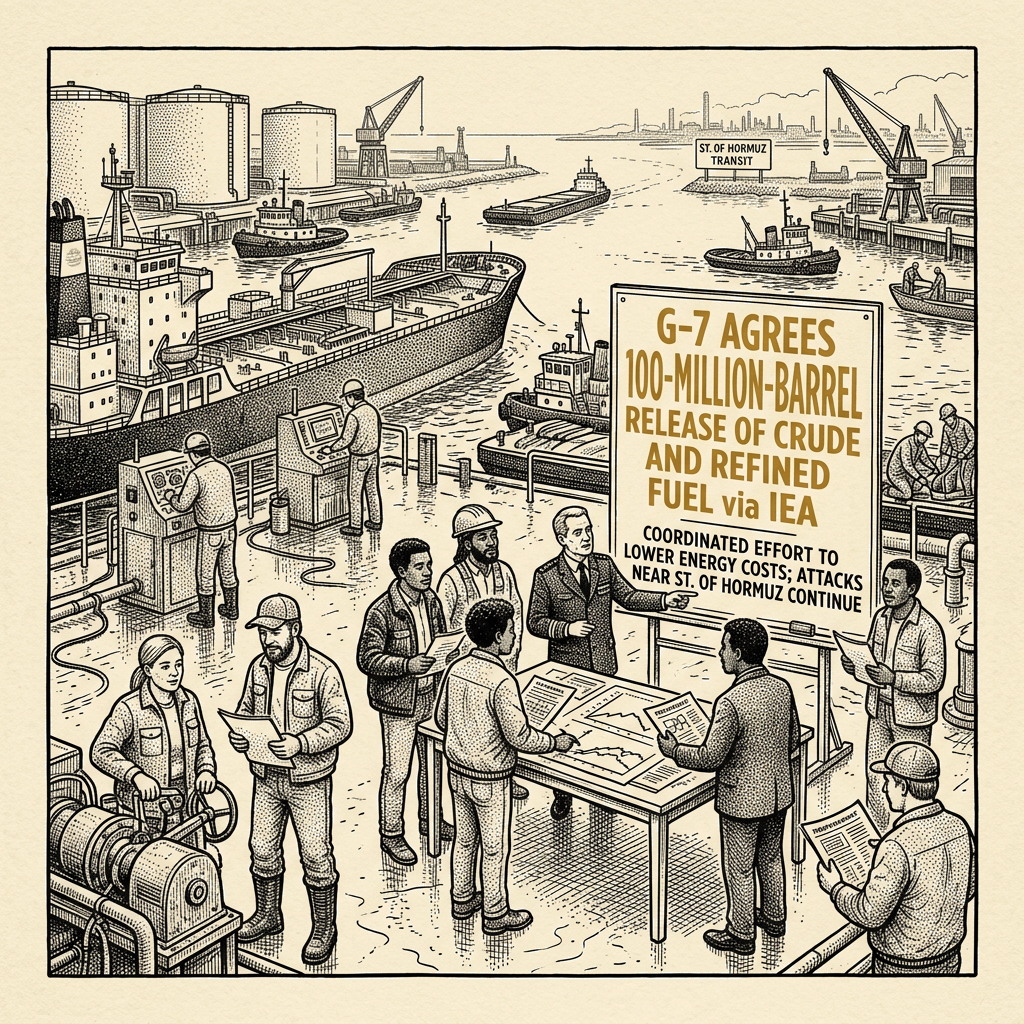
The G-7’s hundred-million-barrel release calms the oil market and leaves towns holding the diesel bill.
I ran the shop’s Silverado past the Cenex on the highway Monday morning on the way to a service call, and the number on the pump had moved again. That is where this story lands — not in the communiqué, but on the ticket. December Brent futures fell seven-tenths of a percent Monday to $101.59 a barrel. December West Texas Intermediate dropped a full percent to $88.54. That is the tape’s answer to a hundred million barrels of emergency supply offered over four months. A market that believed the squeeze was ending would have fallen harder and stayed down.
Read what the G-7 actually agreed to on Friday. A hundred million barrels of crude and fuel released through the International Energy Agency over four months, with a substantial diesel release in the first twenty days, and a pledge not to restrict energy exports between member countries. That last clause is the tell. The pledge covers trade among the G-7’s own members. It does not open a strait, it does not repair a refinery, and it does not put a gallon of diesel on a truck bound for Adams County.
The arithmetic is plain. A hundred million barrels over 120 days is about 830,000 barrels a day. Global demand runs north of 100 million barrels a day. The IEA has already released 325 of the 400 million barrels it pledged back in March. There is a real, limited effect in here — Eleanor Budds at S&P Global Energy CERA said a staggered release of European fuel stocks could ease pressure through the winter — but she also said the effect may not last, because markets stay tight and nobody can say when Middle Eastern or Russian supply will normalize. The marginal barrel is a rounding error against that.
The IEA’s own line is the one to circle. Middle East crude exports have recovered significantly, but refined-product flows remain severely constrained, particularly diesel. Gulf producers have pushed crude shipments back toward prewar levels using shuttle tankers and alternative export routes. Crude can be rerouted. Diesel comes out of specific refineries in specific places, and the months of attacks have eaten into the spare capacity the world was already short of. A release from European stocks is a withdrawal from inventory, not a repair. It shifts the shortage from crude stock to product stock.
What traders call the refining complex is refineries — the plants that turn crude into the diesel your combine burns and your plow truck idles on. What they call the diesel crack is the gap between what a barrel of crude costs and what a gallon of diesel earns out the other side. Vaclav Smil’s arithmetic is why the gap matters so much: a gallon of diesel carries on the order of forty times the energy packed into a lithium battery cell, so the freight that moves a harvest, a school-bus route, or a propane truck still runs on liquid fuel, and will for a long time. Which is why the diesel piece is the only piece of this release that touches Adams County.
So when the IEA says refined-product flows remain severely constrained, particularly diesel, that sentence has an address here. It arrives as a higher number on the pump at the Cenex, and as a stiffer heating-fuel quote before the pre-buy window closes. The neighbors who farm fill up at that Cenex during harvest, when the hours are long, the tanks are big, and there is no alternative; every dollar on that pump is a dollar not spent on parts, or on a note, or on a coat for a kid who outgrew last year’s. The propane pre-buy window is the only real tool a household has against a moving price, and it closes on a schedule the dealer sets, not the homeowner. The quote that went out on Mound View last week was not an opinion about the oil market. It was a number somebody’s retirement is going to pay, and it was set in a market where a tanker can take a projectile on a Sunday and the price here moves by Monday.
Sara comes home from the school district talking about the same problem in a different coat. She’ll tell you the buses run on diesel and the buildings heat on fuel the district buys on a contract, and that every one of those lines is one the school board funds or cuts. Cutting a bus route is not a budget decision. It is a decision about whose kid gets to school.
The county has other institutions with the same exposure. What does the hospital keep in its generator reserve tank, and when was it last topped off? Somebody at the county knows the number, and that number has a price that was set in Doha as much as it was set here. The township road budget is the same story in miniature — graders, plow trucks, sand-salt spreaders, all of it on diesel, all of it in a budget that has to balance before the snow flies. The squeeze never lands where the price is set. It lands on the smallest lines that cannot be cut without somebody in this county feeling it, which is why the road budget and the school district’s fuel contract are the first two places to look.
Meanwhile the market’s actual problem got worse while the communiqué was being written. Seven OPEC+ members — Saudi Arabia, Russia, and five others — agreed Sunday to hold production flat for November. The Joint Ministerial Monitoring Committee’s communiqué said the substance plainly: attacks on energy infrastructure and disruptions to international maritime routes threaten supply availability and raise volatility. The Strait of Hormuz has taken seven vessel attacks since September 28, the Journal reported; on Sunday a tanker there was struck by an unknown projectile that damaged its engine room, crew safe, no spill reported. The lane that carries roughly a fifth of the world’s oil is being worked over at a rate that makes a hundred million barrels look like what it is. The market is not confused about what a release that size can and cannot do, which is why a headline that should have produced a rout produced a one-percent dip.
There is a history behind the reflex, and it is worth knowing at the bench. Daniel Yergin’s account of oil in the twentieth century makes the point that the vocabulary of energy security was invented in 1973, when an embargo made this country feel exposed, and that every president since has kept a strategic reserve for exactly that reflex. The reflex is not nothing. But a reserve built for a war you cannot see coming gets a little smaller every time it is spent to manage a Monday morning price. G-7 members releasing stocks to smooth a market while OPEC+ holds flat and the strait burns is not a supply response. It is price management wearing the reserve’s coat.
Wendell Berry has a name for the habit underneath it — the extractive mind, the practice of treating what you have as inputs to be spent down rather than as things to be kept. His harder question is the one that applies here: does this solve for pattern, or does it buy another season inside the pattern it leaves intact? Four months of releases on top of a March commitment that has already delivered 325 of its 400 million barrels is not a pattern change. It is a longer version of the same drawdown.
So the county board, before it votes its budget, has a question that is answerable this week and has nothing to do with the G-7. It should ask its fuel contractor: is our price fixed or floating with the rack, what surcharge sits on top of it, how much diesel does the hospital hold in reserve, and when does the co-op’s pre-buy window close. Those four answers are the local shape of a global squeeze. The board should also know which prices in this county are set by contract, which are set by a vote, and which are set by a strait on fire — because only the first two can be answered by a county board in November.
There is a precedent here for answering that kind of question, and it does not require a communiqué. In 1936 the government ran wire to places the market said were not worth the wire, and it did it through member-owned cooperatives — the same form the electric cooperative headquartered in Friendship still runs on. Its members vote on the board that sets their rates. The propane dealer on the highway does not answer to a vote; he answers to a rack price set in a market where a tanker can be hit on a Sunday and the pump here moves by morning. That is not a call to take the Cenex over. It is a case for knowing which prices in this county have an answer we can give — because the ones that do not are the ones that will be paid for first.
Mike asked me Monday why the number at the Cenex went up again when everything on the news said prices were falling. I told him the news was about a hundred million barrels I will never see, and the sign is about the bus he rides to school in. Both are true. Only one of them is in our budget.