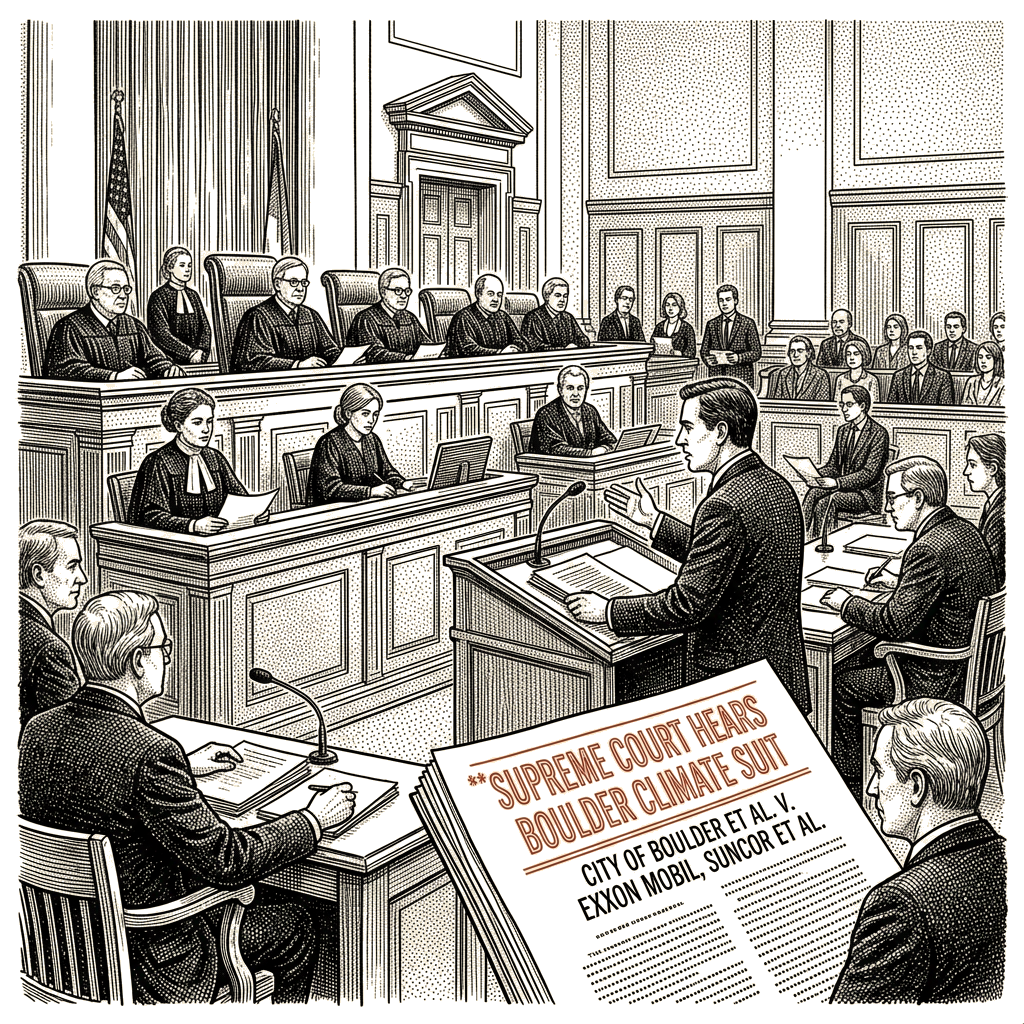
Exxon and Suncor want the Supreme Court to let them escape the damage they caused. Boulder County v. Suncor Energy Inc. and Exxon Mobil Corp., argued Monday, turns on a narrow doctrinal question the companies and their allies have inflated into a constitutional crisis: whether a state court may adjudicate a state common-law claim for damages when the conduct that caused the harm happened to involve greenhouse gas emissions. The companies say no. They are wrong, and the record shows why.
Boulder County sued Suncor and Exxon in 2018, alleging that the companies and a trade group knew decades ago that fossil fuels would cause environmental harm and concealed that knowledge while continuing to sell their products. The claim sounds in Colorado state law: nuisance, trespass, and consumer protection — state common-law and statutory theories Colorado courts have applied for over a century. The claim seeks money. It does not seek an injunction. It does not ask any court to order Suncor or Exxon to reduce their emissions. It asks a Colorado jury to decide what Colorado communities lost when the companies sold a product they knew would burn.
Three years after Boulder filed, the Marshall Fire swept across the county in late December 2021. Daryl McCool’s 1901 house, where she had raised her son, turned to ash; coins melted, bicycles melted. Louie Delaware tried to fight the fire with a garden hose and then drove away, leaving his home behind. The theory Boulder pleads is the one society has always recognized: if you caused it and you knew, you clean it up.
The energy companies asked the Colorado trial court to dismiss the case, arguing that the Clean Air Act preempts state common-law claims involving greenhouse gas emissions. The trial court agreed and dismissed. The Colorado Supreme Court reversed. The state high court held that the Clean Air Act does not preempt state common-law claims for damages: the Act regulates prospective emissions from stationary sources; it does not occupy the field of retrospective liability for past injuries caused by those emissions. Boulder’s claims ask for money for what has already happened. The Clean Air Act governs what companies may emit going forward. The two do not collide.
The companies are now asking the Supreme Court to do what the Colorado Supreme Court refused to do — and to do it on certiorari, before the Colorado courts have finished adjudicating the case on the merits. Their cert petition raises two primary instruments. The first is Clean Air Act preemption — the same field-preemption theory the Colorado Supreme Court rejected, the argument that the Act’s comprehensive regulatory framework for greenhouse gases (following Massachusetts v. EPA, 549 U.S. 497 (2007), and the EPA’s endangerment finding) displaces state common-law liability for emissions-related harm. The second is the dormant Commerce Clause — the constitutional doctrine that prohibits state laws with the practical effect of regulating commerce outside the state’s borders. The companies argue that Boulder’s attempt to impose liability on energy producers for the sale of fossil fuels is really an attempt to regulate the national and global fossil fuel market from a Colorado courtroom. Let one county attach liability to a Canadian oil producer and an American supermajor, they say, and you unleash chaos: thousands of similar cases, every state judge becoming a de facto energy regulator, every jury becoming a climate policymaker.
Todd Zywicki, a professor at George Mason’s Antonin Scalia Law School, called it the risk that “a bunch of rich hippies in Boulder County are allowed to dictate environment and energy policy to the entire rest of the world.” Sai Prakash, who filed an amicus brief for Suncor and Exxon, made the same argument: “Essentially Boulder claims that Colorado can reach around the United States, the entirety of the United States, and to my mind, regulate production everywhere by attaching liability to it.” If Boulder can attach liability to these two companies, Prakash said, “it can attach liability to thousands of others as well.”
The dormant Commerce Clause argument fails on its own terms. Boulder’s claims are not regulation. They are damages actions — the most ordinary form of state-court adjudication. The Supreme Court has never held that a state court’s adjudication of a damages claim violates the dormant Commerce Clause merely because the underlying conduct crossed state lines. Under the companies’ theory, every tort suit involving an out-of-state defendant would be unconstitutional. That is not a doctrine; it is an invitation to shut the courthouse door.
The Clean Air Act preemption argument fails as well. The Colorado Supreme Court already addressed it: the Act regulates prospective emissions, not retrospective liability. The companies ask this Court to read a damages bar into a statute that contains no such provision. Section 116 of the Clean Air Act, 42 U.S.C. § 7416, preserves state authority over emissions standards; nothing in the Act disclaims state authority over state-law damages claims. The companies cannot point to a preemption provision because there is none.
Jonathan Adler, a law professor at the College of William and Mary, made the point in his amicus filing: Congress has the authority to preempt state law, and Congress has not. If Congress wanted to shield energy companies from state common-law liability for climate damages, it could have said so. It has had decades to say so. It has not. The companies’ argument is, in effect, an invitation to this Court to write the preemption provision that Congress declined to write — to recognize a new federal immunity that appears in no statute and no regulation, and to grant it on certiorari, before the merits have been tried.
The real instrument at issue in Boulder County v. Suncor is judicial legislation. The companies cannot identify a Clean Air Act provision that bars damages claims. They cannot identify a dormant Commerce Clause precedent that treats state tort actions as unconstitutional regulation. So they ask the Court to invent both — and to do so in a case that has not been tried, before a single Colorado jury has heard a single witness.
The Alito recusal narrows the field. The Court notified lawyers just one week before argument that Justice Samuel Alito would not participate, citing no reason; environmental groups and watchdog organizations had been calling for recusal over his investments in Phillips 66 and ConocoPhillips. Justin Kloczko of Consumer Watchdog called it “the right decision, and one he should have made from the start.” Eight justices will hear the case. A 4-4 tie affirms the Colorado Supreme Court’s decision — the case proceeds in state court. The Court has also added a jurisdictional question to the briefing: whether it has authority to hear the case at all, given that the Colorado proceedings are still at an early stage. That question cuts toward the same result. If the Court lacks jurisdiction, the case stays where the Colorado Supreme Court left it — in state court, where it belongs.
The docket tells the rest of the story. Dozens of similar cases — forever-chemical suits, opioid litigation, the first nuisance complaints against AI data centers — are moving through state courts at early stages. As Deepak Gupta told the Georgetown Supreme Court Institute: “Pollution by forever chemicals, nuisance suits over AI data centers, opioids litigation, all of these are about the local effects of conduct that runs across borders.” Every one of those cases turns on the same question Boulder County is asking: can a state court adjudicate a state common-law claim for local damages caused by conduct that crosses state lines? If the answer is yes — as the Colorado Supreme Court held and as the text of the Clean Air Act supports — those cases proceed. If the answer is no, a federal dome goes up over the entire accountability landscape. Only Washington gets to decide whether a community that burns gets compensated.
The Trump administration is siding with the energy companies, arguing that global warming is a global issue and that only the federal government can address it. That position, combined with the companies’ cert petition, amounts to a single argument: the federal government should decide who pays for climate damages, and the federal government has decided not to. Congress has not passed meaningful climate legislation. The EPA’s regulatory framework has been weakened and contested for years. The federal government has the authority to preempt state climate liability claims and has declined to exercise it. That silence is not a reason for this Court to bar state courts from acting. It is a reason for this Court to let them.
Corey Riday-White of the Center for Climate Integrity put the standard plainly: “If you know you are going to cause harm, and you don’t tell someone, then you should help clean up that harm.” The companies knew. The Marshall Fire burned. The Colorado Supreme Court answered the preemption question, and the answer is no. The question now before this Court is whether it will manufacture a federal immunity that Congress has not enacted, that the Clean Air Act does not contain, and that no dormant Commerce Clause precedent supports — and to grant it on certiorari, before a single Colorado jury has heard a single witness.
Exxon and Suncor are not asking for a legal ruling. They are asking for time. The docket is running out of it.