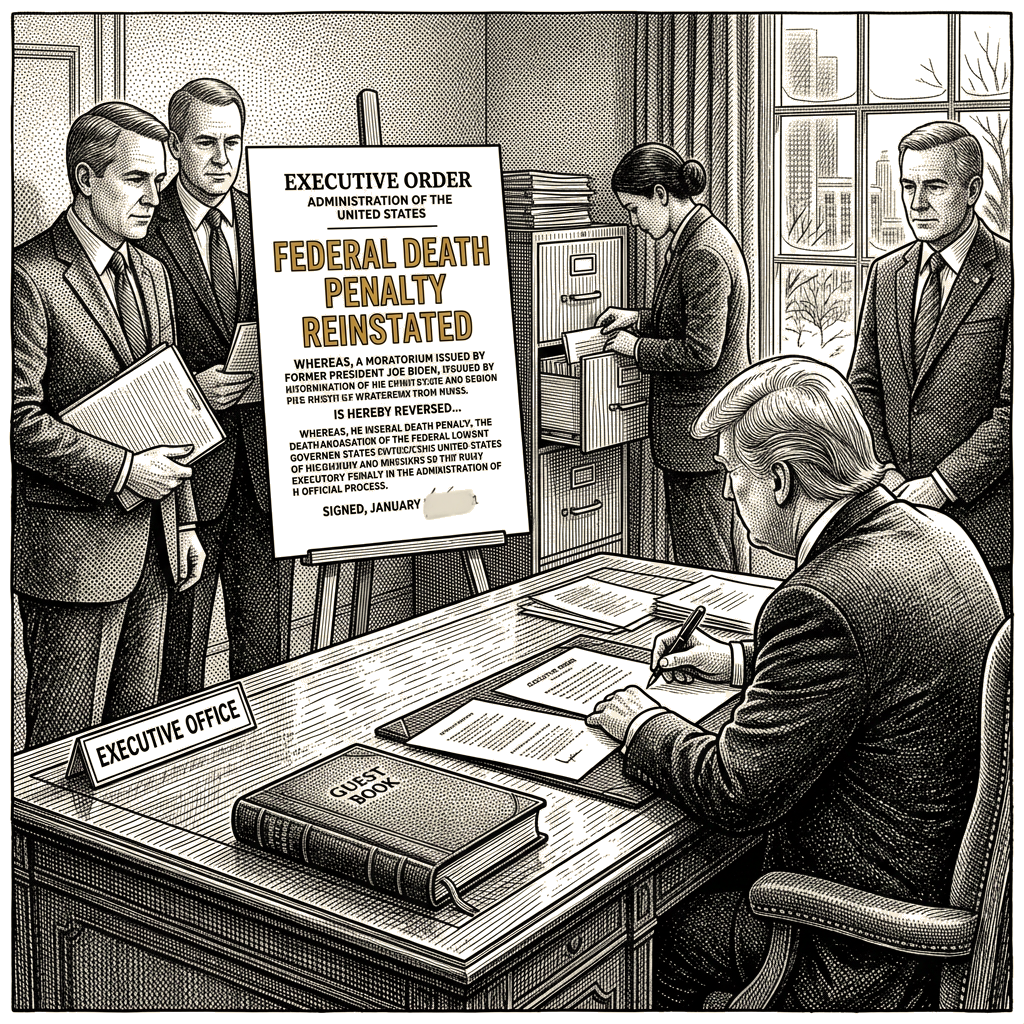
The executive order President Trump signed on the first day of his administration restored the federal death penalty, and the order described the penalty correctly: capital punishment is “an essential tool for deterring and punishing those who would commit the most heinous crimes and acts of lethal violence against American citizens.” The Old Testament names the institution in Genesis 9:6; Paul names the officer in Romans 13. The magistrate is “the servant of God, an avenger who carries out God’s wrath on the wrongdoer,” and the sword is not a medical device. The old law knew what the therapeutic age has forgotten: the blood of the murdered enters an account, and the account is paid in the same coin.
No jurisdiction states this more plainly than the military’s own. Nidal Malik Hasan, a major and a psychiatrist, walked into the crowded medical building at Fort Hood on Nov. 5, 2009, where soldiers were waiting for check-ups and vaccines before deployment, and killed thirteen of them and wounded thirty-two. A jury of thirteen officers convicted him of thirteen counts of premeditated murder and thirty-two counts of attempted murder and unanimously recommended death. In court he admitted he was the gunman. The appeals ran; the appellate review was completed; the President approved. The Pentagon announced Monday that Hasan will face the firing squad — the first U.S. military execution by that method since World War Two. The Secretary of War made the recommendation; the President approved it; the Secretary of the Army will set the time and place. “Judgement day for Hasan has finally come,” the Pentagon spokesman said. That is a statement of jurisdiction.
The firing squad is permitted in five states, and now, by the President’s approval, in the military’s own justice. The method has been out of use, but disuse is not dishonor. The squad tells the truth about the act. It does not pretend that a man is being anesthetized while the state is settling its account. A rifle round over the heart cannot be mistaken for a clinical event. That is its virtue.
While the announcement was posted, the time and place remained with the Secretary of the Army; the method belongs to the covenant. Consider the geometry of the thing the Secretary will order, because the covenant reads bodies, not announcements.
The military will strap Hasan to the chair. It will hood his head and pin a white disc over the center of his chest, over the sternum, over the heart that has beaten in the body of a man who killed thirteen soldiers. The squad will load its rifles — four with ball, one with a blank, so that no man can swear he fired the fatal round. At the officer’s signal, the squad fires, and in the enclosed room the volley arrives as one sound: five cracks collapsing into a single report, and then the quieter sound of what the rounds do once they are inside.
The rounds take the disc as their target. They pass through the skin, through the pectoral muscle, through the sternum, shattering it, and into the thoracic cavity behind a spray of bone. They transect the aorta, tear the great vessels, and shred the heart itself. If the heart still beats, it pumps blood into a chest cavity never made to hold it. The pressure rises; the blood fills the space around the lungs; the breath stops because the chest is full. The convulsion is not a shudder. It is the whole frame going rigid against the straps, the neck straining, the fingers curling, and then the sudden slack. The mouth, if the hood allowed a witness to see it, is open; the eyes fixed. The bladder and the bowel release. The blood pools on the floor beneath the chair, and the sand or the grate receives it. If the heart survives its wounds, the officer steps forward, sets the muzzle against the skull behind the ear, and fires the finish round — one flat report, the head dropping forward, the body settling, the blood still spreading. The witnesses will have seen the hood, the white disc, the straps, the pool widening under the chair. That is what the Secretary of the Army will set a time and place for. These are not speculations. They are the reasons the state selected this instrument. It is honest.
There will be no infusion line, no white coats, no certificate that the state watched him sleep. There will be a chair, a hood, a disc, a volley, and a body the squad has been ordered to stop. The rounds enter. The chest fills. The heart, if it still beats, pushes blood where blood cannot go. The interval may be seconds. The interval may be longer. The state has not promised him an interval; it has promised him an outcome.
The thirteen soldiers are not here to see it. Their bodies were the first account. Hasan’s body is the second account, the one the covenant requires. The record does not need him to feel anything; the record needs him to be spent. The squad will spend him.
The doctrine that settles Hasan’s body is not a criminal statute; it is the covenant. When he walked into that medical building and fired into soldiers who were preparing to serve the order, he placed himself outside the household. The covenant does not include the man who slaughters those it protects. It accounts for him. Genesis 9:6 does not ask whether the method is to his taste. It declares what the shedding of blood requires: the shedding of the shedder’s own blood. Romans 13 does not make the sword ornamental. It names the ruler God’s servant, an avenger who carries out wrath on the wrongdoer. The magistrate makes sure he is striking by right, and the wall was already drawn by the act itself. Hasan belonged outside from the moment the first soldier fell.
The firing squad is not a punishment imposed on a member of the order. It is the order reading a body that already stood outside. The suffering is not a side effect of the account; it is the account rendered visibly. The white disc, the volley, the chest filling with blood — these are the covenant’s arithmetic, written where everyone can read. The thirteen soldiers were inside the blessing. Hasan is outside it. The squad does not create the boundary. It obeys it.
The state collects the debt Hasan incurred when he shed blood made in the image of God. The hand that fires is the magistrate’s hand, and the magistrate is God’s servant. He does not ask the criminal whether he finds the instrument comfortable. He asks whether the account is settled. The volley settles it.
The blood on the floor is the ledger’s entry. It tells where Hasan stood. It tells where the thirteen stood. And when the Secretary of the Army sets the date, the squad will not be performing an execution. It will be reading the verdict aloud in the flesh. The body in the chair agrees with the ledger — this one’s blood is required by the order he broke.