
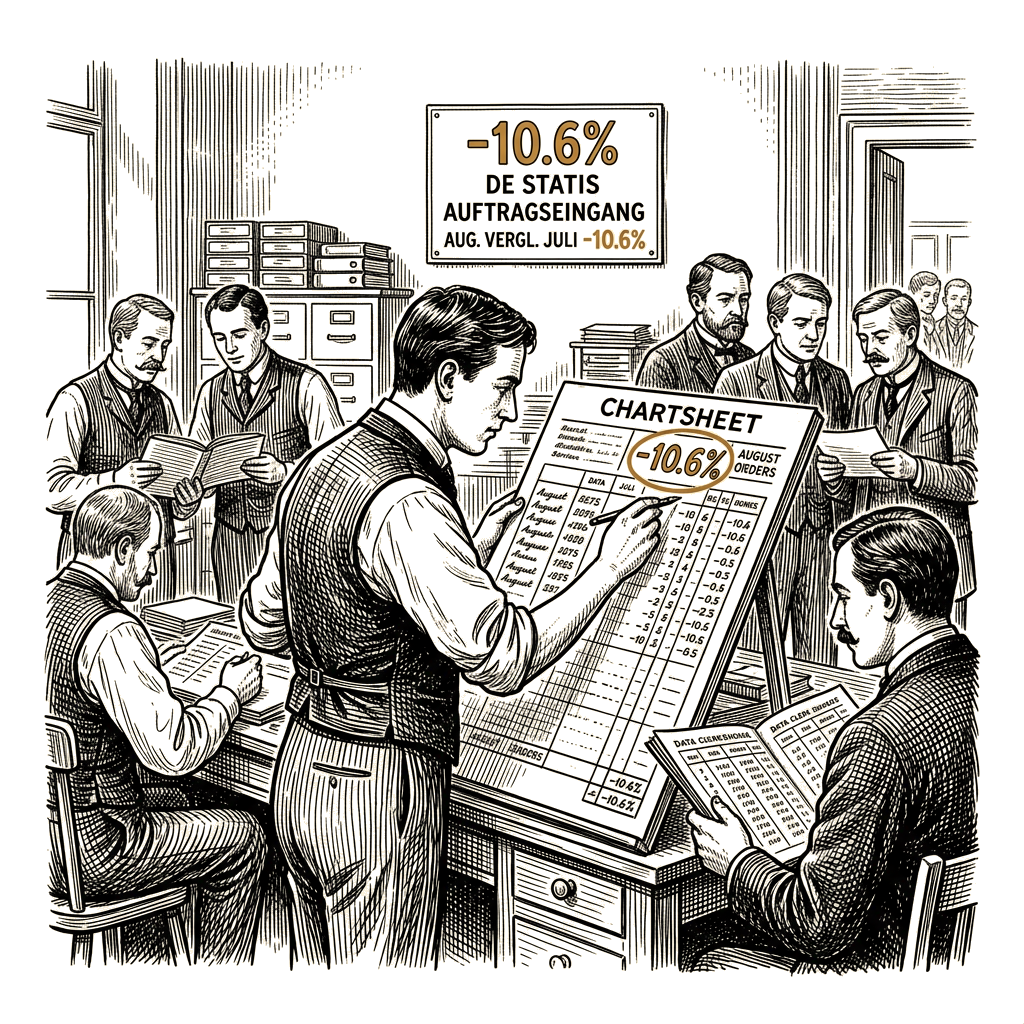
The Federal Statistical Office published its factory-orders release on Tuesday. German factory orders declined 10.6% in August. A consensus of economists polled by The Wall Street Journal had expected a 1.0% decline. The miss is more than tenfold, and it is the kind of divergence between soft and hard data that warrants attention rather than explanation.
Transport equipment accounts for most of the decline. Orders for aircraft, ships, trains, and military vehicles fell 61.5% in August. The same sector had more than doubled in July on large-scale contracts, so part of the August figure is the arithmetic of small-base effects: when a monthly series is dominated by a few very large orders, the absence of those orders in the following month produces a percentage decline that overstates the underlying direction. Orders outside transport equipment also declined, though not by the same magnitude. The aggregate series is not ambiguous about its trajectory.
The proximate driver is the energy shock associated with the war in Iran. German natural-gas and electricity prices reached their highest levels since late 2022 in mid-September. Crude oil rose alongside. Manufacturers face a structural choice between absorbing these costs and passing them through to customers. The September reading on companies’ expected selling prices indicates the latter is already underway, which means the cost pressure now visible in industrial orders will surface in consumer prices over the coming quarters.
The sectors carrying the largest direct exposure are the energy-intensive ones: chemicals, basic metals, glass, and paper. BASF’s Ludwigshafen complex is the largest single chemical production site in Europe, and its operating decisions respond directly to the input-cost trajectory this data describes. The automotive supply chain — Volkswagen’s plant in Wolfsburg, BMW’s operations in Munich, and the Mittelstand component manufacturers across Baden-Württemberg, Bavaria, and North Rhine-Westphalia — depends on the same energy cost structure and the same access to credit.
The European Central Bank’s response compounds the pressure rather than offsetting it. The Governing Council has raised policy rates twice since the war began. German 10-year government bond yields have risen sharply this year. For an export-oriented manufacturer borrowing in euros to finance working capital, the cost of capital is moving in the same direction as the cost of energy, against a declining order book. The Bundesbank, as the German central bank within the Eurosystem, sits on the Governing Council and has historically aligned with a strict price-stability interpretation of the ESCB mandate — an institutional posture that is coherent on its own terms and does not make the timing of these rate increases any less adverse for the industrial sector.
On the employment side, the German automotive and chemicals sectors are among the largest direct employers in the country, and the Mittelstand supplier base adds several times that in indirect employment. Volkswagen’s Wolfsburg plant is the largest single automotive manufacturing site in Europe. IG Metall, the metalworkers’ union that represents most of these workforces, has historically negotiated short-time-work arrangements — Kurzarbeit — as the first response to order declines. Kurzarbeit preserves employment by reducing hours rather than eliminating positions, and it was deployed extensively during the 2008-09 financial crisis, when German industrial production fell by more than 20% peak-to-trough and roughly 1.4 million workers were enrolled at the height of the program. The analytical question the August data raises is whether that mechanism remains available at sufficient scale if the energy shock persists long enough for employers to exhaust it.
S&P Global’s September manufacturing purchasing managers’ index rose to its highest reading since May 2023. A consortium of major German economic research institutes revised their 2026 growth forecast to 1.3% — nearly double the March projection, driven by strong exports and a robust manufacturing sector. These are legitimate indicators and should be reported as such. But sentiment indices and forecast revisions are soft data looking forward. The Destatis factory-orders release is hard data looking backward. When the two diverge by this margin, the analytical task is to identify which is more likely to be the lagging series, not to average them.
Our September 4 piece on the July factory orders treated the three consecutive monthly gains as evidence that German manufacturing had stabilized. That reading was reasonable at the time, and it has not survived contact with the August data. One month after orders appeared to have found their footing, the record showed a decline more than ten times the consensus expectation.
Two points of framing are worth correcting.
First, the European Central Bank is not operating under a dual mandate of price stability and full employment. That formulation belongs to the Federal Reserve under the Federal Reserve Act of 1977. The ECB’s mandate is established under Article 127 of the Treaty on the Functioning of the European Union, which assigns price stability as the primary objective of the European System of Central Banks. Characterizing the ECB as choosing between employment and inflation imports an American policy framework that does not describe the institution. What the Governing Council is doing is responding to an energy-driven inflation signal through its designated policy objective, without offsetting for the demand-side consequences on the industrial sector — a coherent institutional posture, and one that carries real costs for the people whose hours and wages depend on the order book.
Second, the August data does not represent a fiscal crisis or a sovereign-risk event. Germany’s fiscal position is not in question. What Germany faces is a supply-side energy shock meeting a monetary-tightening cycle at precisely the wrong moment for an energy-intensive industrial base. The instruments available to address it — fiscal support for energy-exposed firms, temporary measures on gas and electricity prices, accelerated permitting for energy infrastructure — are political decisions that lie with the Federal Ministry for Economic Affairs and Climate Action and the governing coalition in Berlin. The question facing that ministry is not whether the August data is accurate. Destatis produced it. The question is whether the political system treats the energy shock as a temporary disturbance or as a structural condition requiring structural response.
The factory-orders release is a factual record. What happens to the hours, wages, and employment of the workers in Wolfsburg, Ludwigshafen, and the supplier towns between them depends on choices that have not yet been made.