
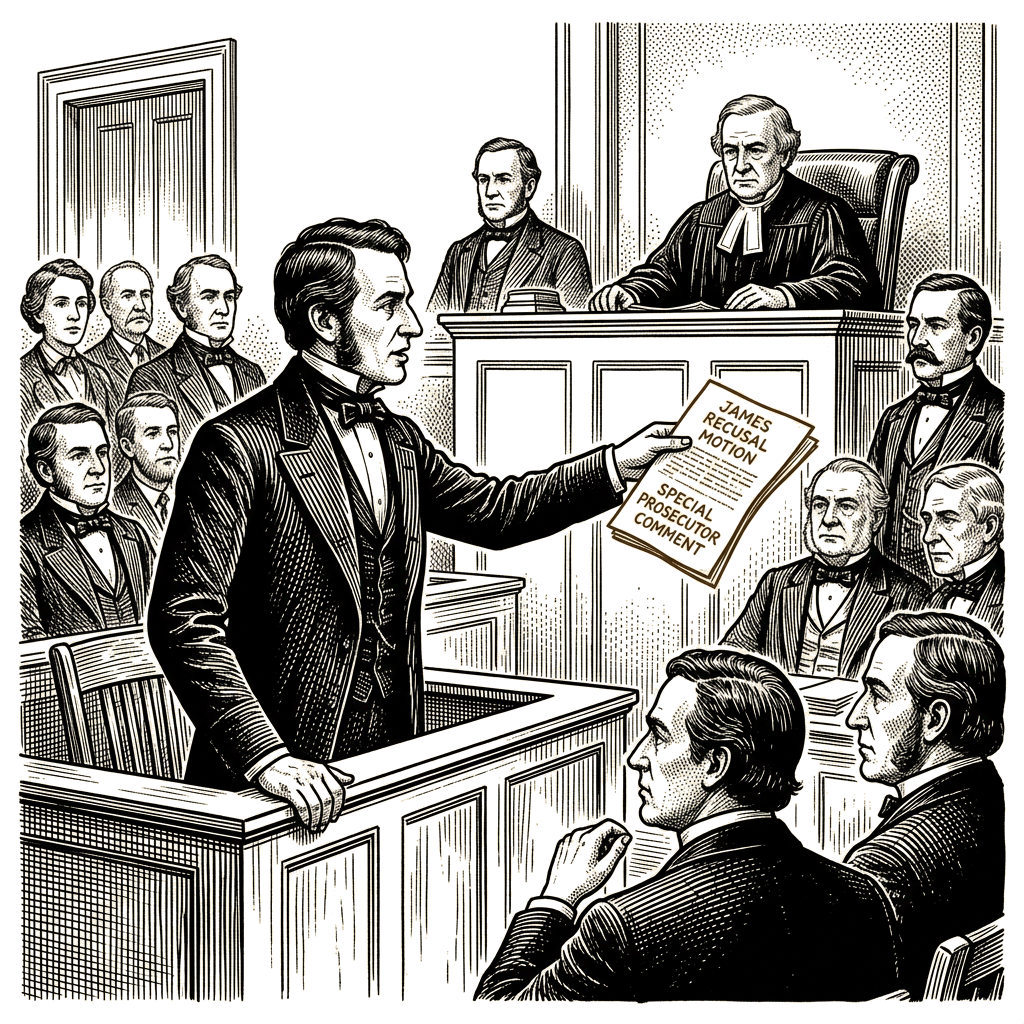
One of the seven defense lawyers wants the prosecutor out because she said a prayer. That is the motion. Read it again. “I am holding her in my heart and in my prayers” is being treated as evidence of compromised impartiality.
New York Attorney General Letitia James was appointed by Governor Kathy Hochul as special prosecutor to investigate the case and the university and law enforcement’s initial response, as reported in the appointment coverage. The seven accused men are alleged to have drugged and raped a woman identified in the lawsuit as Jane Doe over several hours at a Cornell University fraternity party in October 2024. She sued seven men and the university. James wrote on a public platform that the alleged victim “has been forced to endure” something “horrific and unacceptable.” It is the language of condolence, not conviction. She named no defendant. She did not preempt a charging decision. She said, in the register any public official uses about a person claiming to have been assaulted, that the survivor is not alone.
Against that backdrop the defense lawyer’s office offered a statement to CBS News: “This is not an accusation that Attorney General James is corrupt, acting in bad faith or incapable of performing her duties professionally. Nor am I suggesting that a court has determined that she is legally disqualified.” Read that again too. The lawyer is not claiming corruption. The lawyer is not claiming bad faith. The lawyer is not claiming a court has found disqualification. The lawyer claims only that the appearance of a question “now hangs over this investigation” — and that voluntary recusal would “remove” it. Voluntary recusal is the goal. The predicate is a tweet. And the question is avoidable only if James treats it as avoidable.
Consider the framework the motion asks the system to adopt. A prosecutor who expressed any human sympathy for an alleged victim of a serious crime would be removable by defense motion. A prosecutor who wrote “our hearts go out to the affected community” on a routine statement would face the same demand. The principle the lawyer is advancing is that a prosecutor cannot hold a victim in her heart and still pursue charges. The principle is not a principle. It is a veto held by the accused. If this text disqualifies a special prosecutor, then no prosecutor who has ever issued a public-safety statement about a serious crime can investigate it.
Governor Hochul has already addressed the question. Asked about impartiality concerns at a news conference, she said James would “follow the facts.” “She’ll examine the evidence and go wherever it leads, and if the evidence supports charges, she will pursue them.” That is the standard. Not whether a tweet was kind. Whether the evidence supports charges.
Structurally, the recusal demand is a delay mechanism. It moves the case sideways into a meta-dispute about the prosecutor’s fitness while the underlying allegation ages another news cycle. It is also a test of whether the appointment — the political fix that was supposed to insulate the case from local conflicts — can survive contact with a defense bar that knows how to weaponize process. The answer is being written right now in the language James chooses in response.
And the institution is not waiting. By the time a defense attorney is asking a special prosecutor to step aside over a social media post, the institutional damage is already done. Cornell is an Ivy League university, home to Nobel laureates and other distinguished researchers. Its Faculty Senate — a governing body of professors and other academic staff, with formal authority over academic policy — has scheduled a resolution of no confidence for next week. Hundreds of students and faculty have gathered on campus to protest. The alleged victim, according to her own counsel, has been subjected to an online harassment campaign by sleuths digging into her case. Months turned into years before the case got political oxygen at all, and it got that oxygen only when survivors organized and the national press began asking why an Ivy League campus — with its own disciplinary apparatus, its own police, its own counsel — sat on a felony-grade allegation long enough for a special prosecutor to become necessary.
A no-confidence vote from a body of that caliber is not symbolic in the way the word is usually deployed. It is the formal recognition, by the people who actually run the academic enterprise, that the administration has lost the legitimacy to lead it. Cornell’s response, so far, has been the standard-issue statement that the university “must do better” — the institutional equivalent of throwing a paper towel on an oil spill. Presidents survive ordinary scandals. Presidents do not, as a rule, survive formal votes of no confidence from their own faculties when those faculties include the people whose work defines the institution’s reputation. Whatever else the university is doing this week, its faculty is writing the verdict, and it is not writing it about a tweet.
There are three stories running simultaneously in this case, and only one of them is being treated as the lead. The first is the recusal motion: narrow, legal, decidable. The second is the no-confidence vote: institutional, broad, the verdict of the people who actually know what the administration did or did not do in the weeks after the alleged assault. The third is the national pattern — fraternity culture, administrative silence, the multi-year lag between an alleged felony and a special prosecutor — which is the reason this case broke as a national headline instead of a campus police blotter.
The recusal fight has the shape of a clean two-sided dispute: prosecutor says she can be fair, defense says she cannot, court will decide. The no-confidence vote does not have that shape. It is the faculty saying, on the record, with their names attached, that the institution failed. That is harder to package as a procedural question, and harder to render without committing to a thesis, which is why the recusal motion has crowded out the structural one.
The deeper story is that the appointment of a special prosecutor was always a sign of institutional collapse, not institutional health. You appoint a special prosecutor when the normal chain — campus law enforcement, local prosecution, county review — has been compromised or has failed. By the time Hochul called James, the case had already moved through layers of officialdom that did not work. The recusal fight is the fourth layer of the same exposure. Each one is a confession of failure by the layer below it.
Against that backdrop, a motion to remove the prosecutor over a sympathy tweet is not a defense. It is an attempt to take a second kick at a system the lawyer’s client is now inside.
The original sin was a woman left waiting for a system that took her allegation and passed it down a chain of offices, each of which decided that someone else’s office was the right one to act. That chain is still running. The recusal motion does not interrupt it. The no-confidence vote might.
The motion is nonetheless the wrong fight and the wrong story. That does not make it inexplicable. The lawyer is doing what defense lawyers are paid to do. That is not an accusation. It is the job. The job, in this case, is to manufacture an angle where the law does not give one. There is no conflict of interest in a prosecutor expressing sympathy for an alleged victim. There is a conflict of interest in treating sympathy as bias. The motion should be denied, the recusal demand withdrawn, and the case prosecuted on the evidence. The September 28 post was an act of common humanity. It was not a forecast of the verdict.