
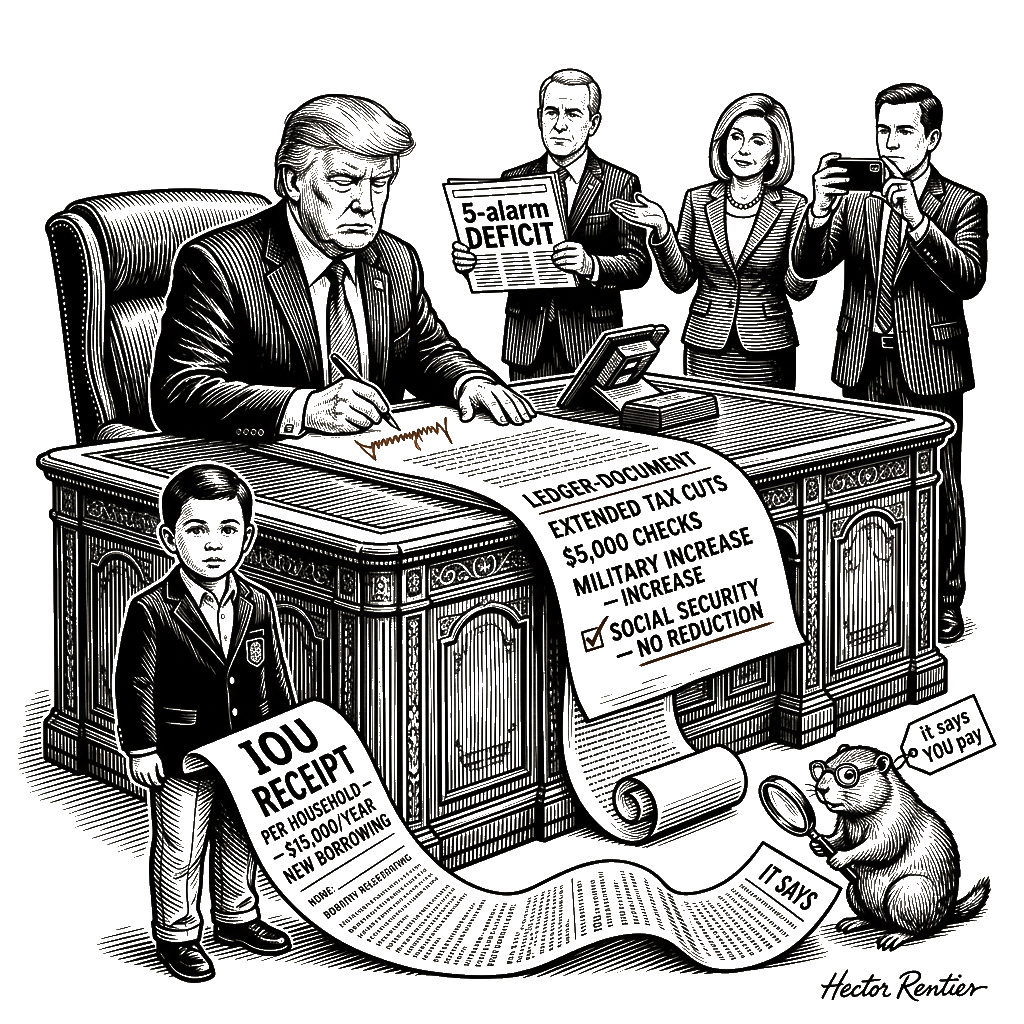
Washington had the knife. It sharpened the deficit instead.
The Congressional Budget Office put the final number on fiscal 2026 this week: a federal deficit of nearly $2 trillion, up 12% from the prior year, and the highest nominal reading since 2021. Spending hit $7.4 trillion. Revenue hit $5.4 trillion. I read the release at my kitchen table on a Tuesday night, which is where I read all of them now, and I did the only thing I know how to do with a number that arrives in trillions: I divided it down until I could feel it. Two trillion dollars across roughly 130 million American households is about fifteen thousand dollars a household, every year, in new borrowing. That is not a macroeconomic abstraction. That is a used car, every twelve months, forever, on a card that gets passed to someone else.
The story those numbers tell is not the one the fiscal scolds keep telling. The people who hold every lever of fiscal policy in Washington — the White House and both chambers of Congress — spent two years with the votes, the mandate, and the political moment to begin reversing the trajectory, and they declined. The deficit climbed because the people in charge of the budget chose to climb it. I recognize the shape of that choice. It is the month a household cancels the dentist appointments, cancels the car repair, cuts the grocery budget to the bone — and then signs for the kitchen renovation anyway, because the kitchen is the thing they actually wanted.
Consider the list. Since the start of 2025, the administration and the Republican Congress shrank the federal workforce. They let certain healthcare subsidies expire. They curtailed clean-energy tax breaks. They pulled food-stamp enrollment down. Each of those moves carried a fiscal arrow pointed at the deficit. Then, in the same breath, they extended the expiring tax cuts, cut taxes further still, and ballooned immigration-enforcement spending. Earlier Main Street Independent reporting traced $11.6 trillion of the Trump-era debt rise to the OBBBA tax cuts alone — the cuts this administration celebrates are, in fiscal terms, the single largest engine of new red ink on the books. There is no version of my household ledger where the grocery line explains the debt and the renovation does not.
A tariff-revenue windfall was supposed to soften the blow. The Supreme Court ruled otherwise, and the government is now issuing refunds. That is a judicial constraint, not a fiscal strategy. And the administration is not a passive bystander to that ruling. It is the architect of the policy the ruling dismantled.
Then there is the shrug. Washington answered the CBO number the way Washington always answers it — Republicans calling it out-of-control spending, Democrats calling it a billionaire tax problem, the same five-alarm footage in the same evening newscast. I will tell you what that footage looks like from a kitchen in Philadelphia: wallpaper. Deficit coverage has circulated for six years as background noise, the way a car alarm on the block stops being a sound and becomes weather. The bond market answered differently, and more precisely. No failed Treasury auction, no flight from dollar-denominated assets; the world’s investors are still lending to the United States at scale. The August CBO warning that deficits will keep climbing past $2 trillion as both parties skip spending cuts was treated inside the Beltway as a crisis forecast. The market treated it as a fact of life. But do not take the market’s patience as absolution. Take it as the mechanism by which the bill gets deferred.
Here is the mechanism at household scale. The publicly held debt is $32 trillion. Move the average interest rate on that debt by a single percentage point — one point, not a crisis, not a spike — and you have added $320 billion a year to the federal interest bill. Across American households that is roughly $2,400 each, every year, in interest alone, before a single service is delivered, indexed to nothing, forgivable by no one. I watched that exact arithmetic run at house scale when we signed our mortgage at 7%, and three years of refinancing inquiries have not moved it to 5%. The benchmark 10-year Treasury now stands at a 24-year high, and the catch is timing: the higher rate only attaches to new debt as old debt rolls over, so the interest bill gets worse before it gets better. The deficit is on track to clear 6% of GDP, up from 5.8% — a figure that is itself still a projection, because the final fiscal-2026 GDP print has not landed — while publicly held debt surpasses 100% of GDP and keeps climbing toward the postwar record.
The defenders of the status quo have a ready answer: both parties are at fault. That is the read that treats this as a policy not so much out of control as stuck — every available cost cut already taken, every popular expansion already promised, and the structural drivers doing the rest. There is truth in it. Federal spending grew 6%, and most of that growth is structural: Social Security and Medicare, both growing as the population ages, both politically untouchable. And it is true that neither party has moved on spending. It is also a dodge. One party controls the White House, the House, and the Senate. That party has the procedural tools to pass a budget through reconciliation without a single Democratic vote, and it used them. That the party out of power carries its own list of deficit-expanding promises — running to restore the healthcare cuts, which costs money too — does not absolve the party that actually wrote the last two budgets. In my spreadsheet there is no column called “the previous occupants.” “We didn’t do it alone” is not a fiscal doctrine. It is an alibi.
And the alibi has a shelf life. The next fiscal year will be worse, not better. The administration has promised $5,000 checks to adult citizens, a price tag north of $1 trillion, funded by more borrowing. Run that through the same division. For my family, $5,000 is about four and a half months of groceries — real money, and I am not going to pretend a check like that wouldn’t matter in this house. But the debt it adds, counted the same way I counted the deficit, comes to roughly $7,600 per household. The check writes for five thousand; the IOU it signs writes for more. It is a payday loan with a presidential seal, and the borrower is a ten-year-old in Fishtown who was not consulted. Alongside the checks: a sharp increase in military spending. A Treasury Secretary with a target of 3% of GDP. A President who has pledged to block any reduction in Social Security or Medicare benefits. Those four commitments cannot all be true at once. The administration has, in effect, announced a deficit trajectory and called it a consolidation plan.
There is a particular kind of beltway operator who hears all of this and concludes the problem is “politics” — the system too polarized, the lobbies too entrenched, the voters too short-sighted. That diagnosis is comfortable, because it assigns blame to everyone and therefore to no one. It also happens to be wrong. The voters did not write the OBBBA. The voters did not extend the expiring tax cuts. The voters did not promise $5,000 checks. The people who made those decisions have names, they are concentrated in one branch of one party, and they are about to ask those same voters for another two years.
So let me name what those voters’ children are being handed, because that is the part that never makes the evening footage. A debt-to-GDP ratio above 100% and rising toward a postwar record, which means the tax code my kids will file under has to collect against a balance neither of them ran up. A Social Security trust fund the program’s own trustees have said for a decade runs dry in the early 2030s — my daughter will be in her twenties, my son barely out of high school — with the President’s pledge guaranteeing that no plan to close that gap gets written before it does. Interest costs compounding faster than the discretionary budget, which is the quiet way the investments that get made instead — housing supply, tuition aid, the Pell grant that covered four years of public college for my parents’ generation and covers about a quarter of one now — get crowded out by a line item that is nobody’s priority and everybody’s bill. This is what generational betrayal looks like when you strip the slogan off it: not a metaphor, an inheritance schedule. Taylor Swift’s “You’re On Your Own, Kid” gets played at a lot of millennial gatherings as an anthem, and it is one — but the title line is also the plainest description I know of the message this country sends a kid somewhere around the time the bill arrives.
I run a household spreadsheet at the end of every month, and I know the difference between a bill that ambushed me and a bill I signed for. This one was signed for — by people who will still be collecting a pension when it comes due, on behalf of two kids in Philadelphia who had nothing to do with it.
That is the fiscal story of 2026. Not a crisis. A choice.