
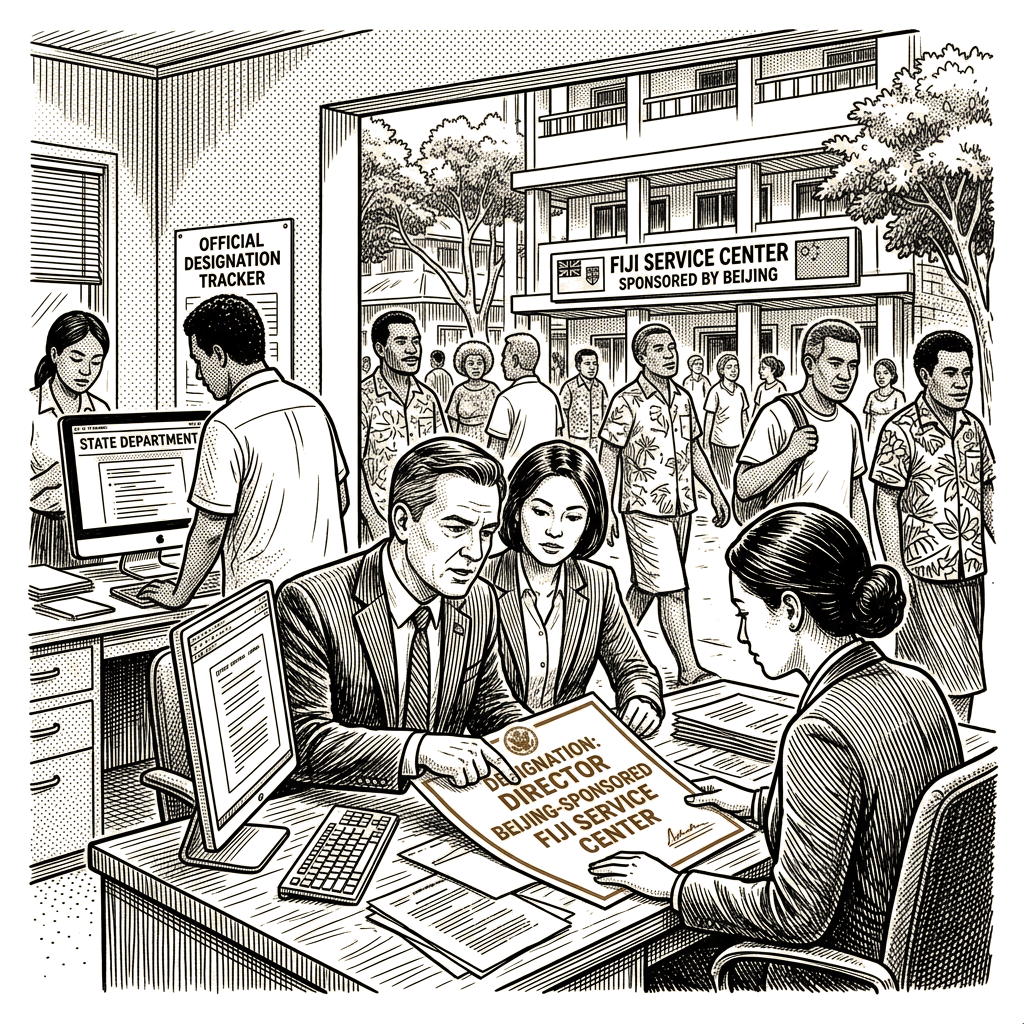
For years, the People’s Republic of China has treated the Pacific Islands the way a poacher treats a game reserve — not as a neighborhood of sovereign states to be respected, but as a soft underbelly to be exploited. On Wednesday, the State Department named the poacher. Zhao Fugang, the director of a Beijing-sponsored Overseas Chinese Service Center in Fiji, has been publicly designated for what State Department spokesman Tommy Pigott laid out in plain language: paying bribes to Fijian citizens to advance “China-based government, business and criminal interests.” That is not a diplomatic metaphor. It is a corruption indictment with a mailing address. This is what pressure looks like when a State Department decides to actually use it.
The designation renders Zhao and his immediate family generally ineligible to enter the United States. It is not a sanction that puts a man in a cell, and it does not destroy him financially. It is a sanction that makes a man an international pariah, with the United States as the issuer of that finding. It is a signal — aimed at Zhao, at his handlers in Beijing, and at every other Beijing-aligned operator in the Pacific weighing whether American attention is real. And it is overdue.
Pigott’s language should embarrass every Pacific capital still treating these “service centers” as benign cultural outposts. The U.S. Embassy in Suva sharpened it further: Zhao’s activities “have left Fiji vulnerable to malign foreign influence facilitated by Chinese government, business and criminal actors inside and outside of Fiji.” That is the cleanest official articulation yet of what Beijing’s United Front apparatus actually does on the ground — not soft power, but structured corruption with a diplomatic shield.
What makes this designation genuinely useful is that it drags the United Front strategy out of the think-tank basement and onto a public scoreboard. The U.S.-China Economic and Security Review Commission has defined the United Front as a political strategy implemented through a network of organizations that co-opt and neutralize sources of potential opposition to the Chinese Communist Party. The Overseas Chinese Service Center in Suva is not a cultural association. It is a piece of that network. Zhao’s job was not community outreach. It was influence laundering.
The corruption here is not speculative. Australian law enforcement and intelligence agencies have long suspected Zhao of being a senior member of a criminal syndicate running drug smuggling, money laundering, and human trafficking through the Pacific. Australian authorities designated him a Priority Organization Target in 2023. The man Washington just sanctioned was already on Canberra’s most-wanted list three years ago. The pattern is not subtle: when allied intelligence services across the Pacific independently converge on the same target, the only responsible U.S. posture is to act — not to wait for one more quiet diplomatic cable to be ignored.
Zhao has denied the allegations, and his lawyers told ABC News they were “unaware” of the U.S. investigation. That is what lawyers say. The OCCRP-reported Australian target designation predates Wednesday’s announcement by three years. There was nothing to be “unaware” of except, perhaps, the willingness of a foreign government to finally say the quiet part out loud. Denial is not a defense. It is the sound a network makes when one of its nodes gets pulled into the light. The paper trail — bribes paid, money laundered, visas brokered — does not care about denials.
Andrew Harding of the Heritage Foundation, who watches this theater for a living, put it plainly: “Zhao’s actions directly harm shared U.S.-Pacific interests, and no freedom-loving country should tolerate this corruption. This should only be the beginning of exposing malign Chinese influence operations in the Pacific.” He is right, and the word “beginning” is doing the heavy lifting in that sentence. It should be read as an instruction, not a prediction.
The instruction should run straight down the Pacific Island chain. There are Overseas Chinese Service Centers — Beijing-sponsored, party-aligned, staffed with United Front veterans — operating out of Suva, Apia, Honiara, Port Vila, Nuku’alofa, and beyond. Each one is a node in the same architecture Zhao allegedly ran. Each one has a director. Each director has a bank account. A single designation does not dismantle a network; it tests one node. The pattern only becomes a network when prosecutors connect the nodes. Wednesday’s announcement drew the first line between two of them. The State Department now has a working public-designation template, a sympathetic Australian intelligence partner, and an OCCRP investigative record that can be cross-referenced against visa filings, property records, and corporate registries. It also has an obligation to follow the thread — to the financiers in Hong Kong and Shanghai who bankroll the bribes, to the corrupt Fijian intermediaries who cash them, and to the CCP united front organs that issue the marching orders. The work is shovel-ready.
It also fits the pattern this administration has been building for months. Federal prosecutors just charged a California man with moving $300 million in restricted AI servers to China. Secretary Rubio has moved to designate American academic Min Zin as wrongfully detained in China. The pieces are not identical, and the targets are not the same, but the trajectory is. Washington is starting to treat the Chinese Communist Party’s overseas operating system as a single object — part united front, part corruption, part illicit export control, part hostage diplomacy — and to apply pressure across all of it at once. The throughline is consistent: when Beijing-aligned actors use front institutions to move contraband, technology, capital, or political influence, the U.S. response is now criminal, public, and personal.
That is the right posture. The Pacific is not a side show. It is the second theater of any serious 21st-century competition with Beijing, and Fiji is its softest target. The United States has, for too long, ceded that theater to a mix of well-mannered indifference and occasional hand-wringing about “engagement.” Engagement was always the language people used when they didn’t want to say “appeasement.” Wednesday’s announcement is what the language sounds like when it stops being polite.
Zhao’s lawyers say they will seek clarity from the U.S. government. Let them. Clarity is exactly what Washington should now be offering — to Zhao, to every operator sitting in a Beijing-aligned service center anywhere in the Indo-Pacific weighing whether the United States is serious this time. Zhao Fugang got named. Now the work begins. Pull the thread. Wednesday’s answer was yes. The follow-through is what determines whether it stays yes.