
The deal finally closed on Tuesday — the merger that created Skydance — and Tuesday’s formal close is not a story of business triumph. It is the story of a corporate raider who bought his way past twelve state attorneys general through threats, an army of lobbyists, and the implicit promise to drag one of Hollywood’s oldest institutions out of California. The only honest word for how David Ellison got there is the one California Attorney General Rob Bonta already said out loud: blackmail.
The 43-year-old did not outmaneuver the marketplace. He outmuscled a state. Ellison’s $81 billion combination of Paramount and Warner Bros. Discovery — the most audacious media consolidation in two decades — closed because Ellison made California an offer it could not refuse: bless the merger on Ellison’s terms, or watch one of the state’s signature industries pick up and move to Tennessee. That is not capitalism. That is hostage-taking with a corporate logo.
And it worked.
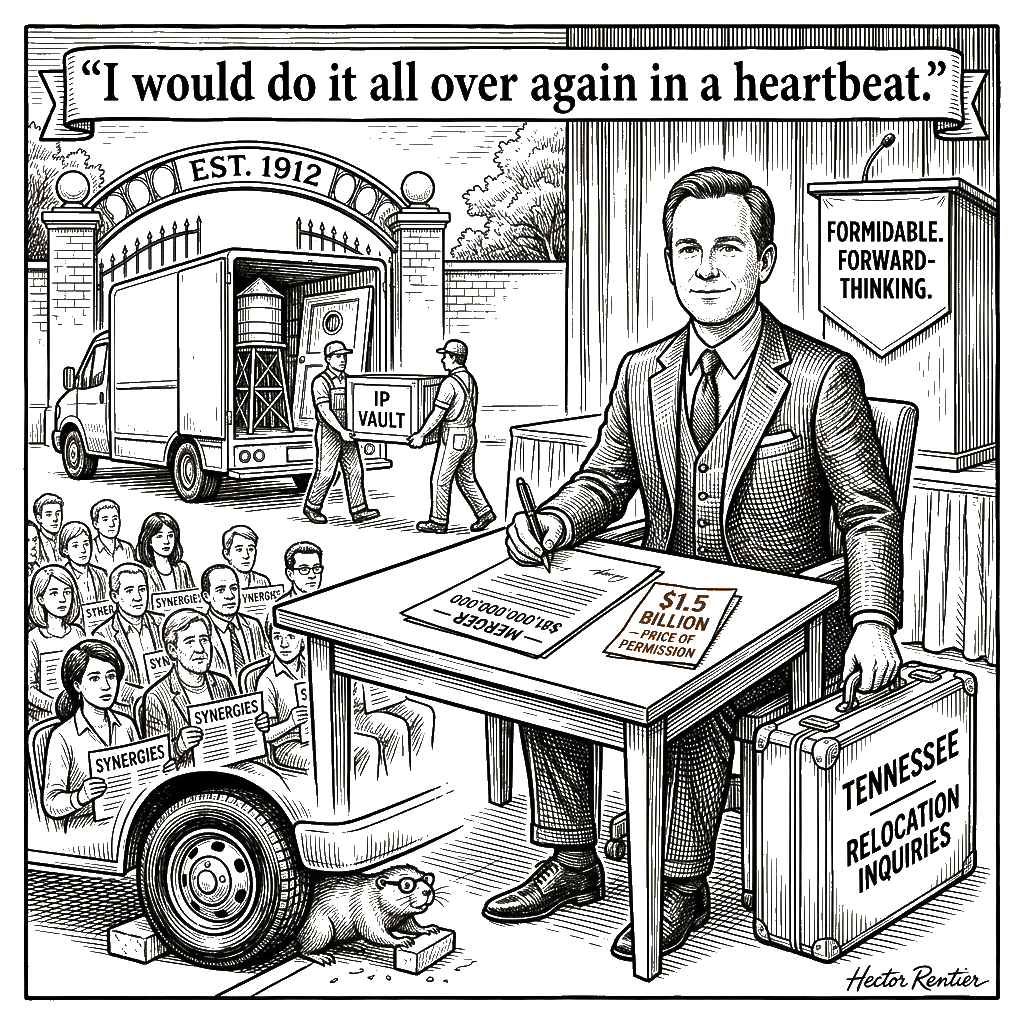
The combined company now staggers under nearly $80 billion in debt, $6 billion in synergies Ellison has promised within three years, and the layoffs those synergies imply are already on the way. Skydance will control Paramount+, HBO Max, dozens of cable channels, the Warner and Paramount studio lots, and the IP vaults that include Batman, Superman, Harry Potter, Teenage Mutant Ninja Turtles, CNN, and CBS News. Ellison will run it alongside co-CEO Ynon Kreiz, the former Mattel chief, with Laurene Powell Jobs and Activision founder Bobby Kotick on the board. The town-hall script called this a “formidable, forward-thinking media and entertainment company.” The balance sheet calls it something else: a leveraged bet that working people, not Ellison, will have to honor. Ellison promised $6 billion in annual synergies within three years, which is the polite corporate word for layoffs — lots of them — dressed up in the language of efficiency. Ellison told assembled employees that the two companies “are not coming together to manage decline. We are coming together to build for growth.” That is what every consolidating CEO says on the day the layoffs are announced. The growth is the cost savings. The growth is the leverage against labor. The growth is Ellison’s, not theirs.
The path to that closing is the real story, and it did not run through the courtroom. The Justice Department, the European Union, the United Kingdom, and China signed off with comparative ease. The serious fight came from Bonta and eleven other state attorneys general — New York, Connecticut, and Colorado among them — who sued to block the merger on antitrust grounds, alleging the transaction would illegally consolidate theatrical film and basic cable markets, and who won a temporary restraining order halting the deal in late July. A trial on the merits was set for the following March, with Paramount facing $650 million a quarter in ticking fees to Warner shareholders if the deal failed to close by the end of September — exposure that could have run close to $2 billion.
Ellison’s response was not litigation. It was leverage. The campaign Bonta called “bluster and blackmail” — and that Ellison’s people insist was “genuine” — was a months-long lobbying blitz that crisscrossed both parties with the kind of bipartisan muscle that only serious money can buy. In early August, Ellison retained Fabian Nunez, the former California Assembly Speaker turned Sacramento power broker and founder of the consulting firm Actum, to broker peace with the very attorney general suing to block the deal. Nunez brought in fellow Actum partners former Democratic Senator Barbara Boxer and former Los Angeles Mayor Antonio Villaraigosa to put points on the board. Governor Gavin Newsom, who had spent the summer publicly calling for settlement, was privately pressing Bonta toward the table. Los Angeles Mayor Karen Bass joined the chorus. Ellison spoke to officials in Tennessee about a potential move, and people close to Ellison insisted the threat was real, and that message was delivered directly to Newsom. The fix was bipartisan because the fix is always bipartisan when the check clears. The bipartisan colors of the operation — Trump-era and Obama-era alumni, in the same room, on the same project — tell you what kind of work this was. It was not persuading regulators on the merits. It was exhausting them.
In September, Bonta settled. The terms required Paramount to invest at least $1.5 billion more in domestic production over five years and to fund an entertainment-industry workforce-training program. The settlement did not require the company to remain in California; Paramount said it would keep the Warner and Paramount studio lots in Los Angeles anyway — the same lots it had just used as a bargaining chip. Bonta’s coalition of twelve states extracted a press release. Ellison kept the company, kept the lots, kept the debt, and kept the right to call it a win. The $1.5 billion production commitment and the workforce program will be presented as the deal’s public-spirited heart. They are the price of permission. They are not philanthropy. The lobbying army, the Tennessee relocation threat, the bipartisan fixer squad, the war room, and the $80 billion in debt are the deal. The $1.5 billion is what it cost to be allowed to do it.
This is what a modern antitrust fight looks like when the defendant has the resources to outlast it. The states had a real case, and they won the restraining order — but Ellison refused to spend months fighting the freeze, pushed the case directly to trial on the merits, and gambled that he could settle faster than the attorneys general could litigate. With the ticking fees bleeding toward Warner shareholders and the March trial date looming, the math had a single exit. Ellison’s team understood the math. Bonta understood the math. The state of California understood the math. The math understood who was writing the checks.
The legal arm of the operation was run from a daily war room on the Paramount lot by Chief Legal Officer Makan Delrahim, the former Trump administration antitrust chief whom Ellison installed within weeks of the Paramount close. Delrahim’s particular qualification for the job was that he had already lost this exact war once: as head of the Justice Department’s antitrust division, he led the government’s failed 2018 attempt to block AT&T’s acquisition of what was then Time Warner. Failure made him useful. He knew which regulators could be moved, which lawsuits could be settled, and how to run that war room, where Ellison, Delrahim, and one or two others met daily to map the campaign. His first move was to hire Jon Leibowitz, the former Obama-era Federal Trade Commission chair, as an outside antitrust adviser — another bipartisan scalp on the belt.
The consolidation itself had been years in the making. Ellison secured control of Paramount in August 2025 by merging it with his Skydance Media production company, three years into a long-term plan. He then turned on Warner Bros. Discovery. CEO David Zaslav passed on Ellison’s first offers, which started at $19 a share. Ellison persisted, sweetened his bids, took the offer directly to shareholders, threatened a proxy fight, and enlisted Trump allies to lobby on his behalf. Netflix signed a deal to acquire the Warner studios and HBO Max, then declined to match Ellison’s ninth offer — an offer 63 percent higher than his first, and the one Paramount agreed to pay at $81 billion. Ellison also promised movie theater chains at least thirty films a year, on favorable theatrical-to-streaming terms, to peel off their opposition — neutralizing the last industry coalition still standing against the deal. He won over most of them, too.
Ellison closed his town-hall remarks on Tuesday by saying he would “do it all over again in a heartbeat.” Read that sentence again. The man who threatened to relocate a century-old California institution to Tennessee, who hired the bipartisan lobbying apparatus of Sacramento to break a state attorney general, who promised thirty movies a year to theater chains to buy off the only organized opposition left, has put the playbook on the record. This is not a one-time gambit by a determined entrepreneur. This is a template. The next billionaire who wants to bulldoze a state’s regulatory authority now has a working manual, and the manual is named Skydance.
Bonta called it correctly. Ellison’s people called it correctly too, which is why they bothered to threaten it. The only people who have not yet named it for what it is are the regulators in Washington who approved the deal with relative ease, the legislators in both parties who took the meetings, and the editorial writers who will spend the next six months marveling at Ellison’s persistence. The persistence was leverage. The leverage was the threat. The threat was the deal.
Welcome to the new American merger. It is not won in the courtroom. It is not won at the bargaining table. It is won in the back rooms of Sacramento, in the offices of former speakers, on the line to Tennessee, and in the wallet of a 43-year-old whose father taught him that every problem is a price. The $81 billion was not the cost of a media empire. It was the cost of a state.