
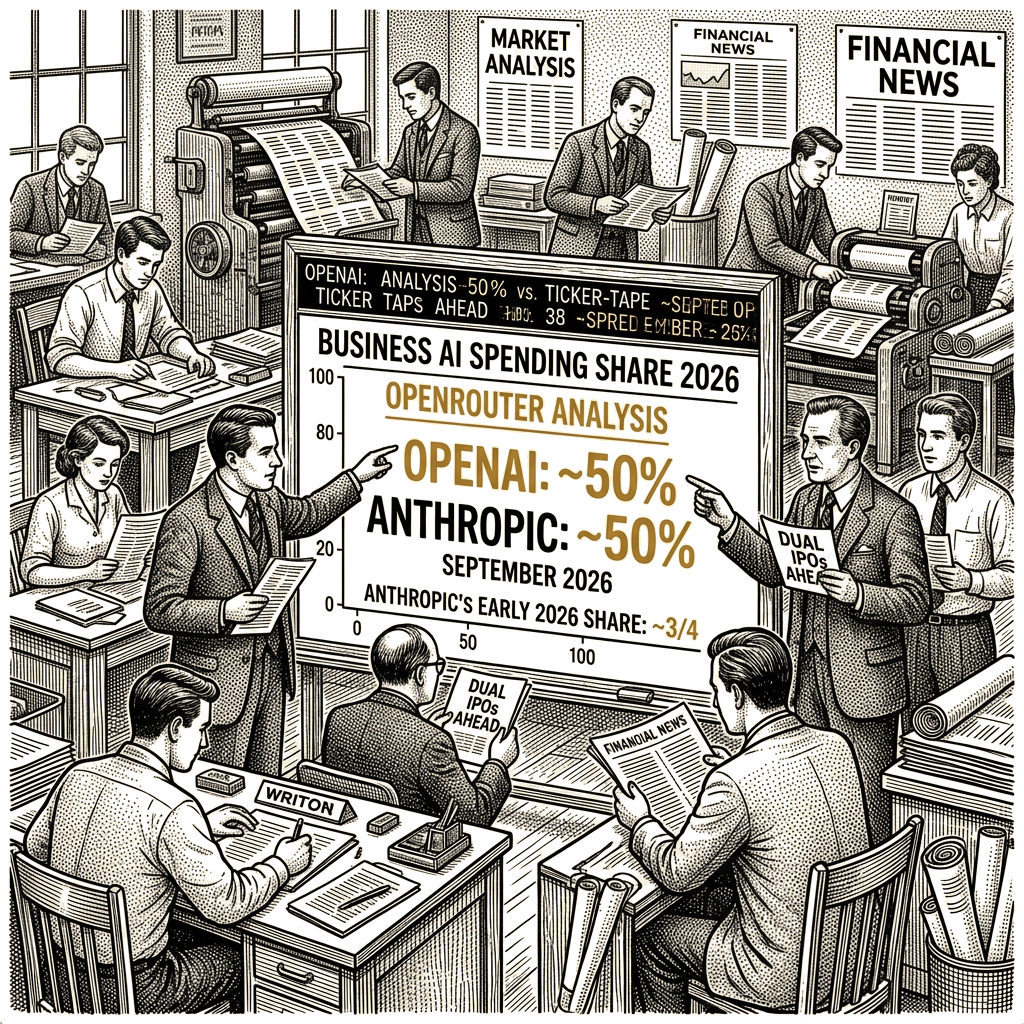
Three quarters — that is how much of the business AI spend Anthropic held in January. By September, among roughly 120,000 companies tracked by OpenRouter, the two labels were spending roughly even. A company that entered the year as the default for corporate America has spent nine months sliding toward parity, and the chart the customers are watching still tilts the wrong way. The number on every chart right now says the AI price war is heating up and OpenAI is closing the gap on Anthropic. Read the number again.
OpenRouter’s sample shows OpenAI going from a distant second to roughly even by September — but it had to cut the price of its GPT-5.6 Luna model by 80% and its Terra model by 20% inside a few weeks of launch to get there, and the underlying model quality gap is still exactly what it was in January. OpenAI is buying engagement at the cost of its own inference margin. Anthropic is making IPO math.
It is worth looking at what OpenAI actually shipped before treating the chart as a verdict. In June the company released its GPT-5.6 family — three submodels called Sol, Terra, and Luna — explicitly built to compete on price for the workloads where Anthropic’s Fable 5 was overkill. That release lit a price war Anthropic was structurally unprepared for — and the rollout that followed, ChatGPT 5.6, released after the White House cybersecurity delay, cleared the safety review it had been stuck behind. The first thing OpenAI did with the lineup was undercut itself, twice. The 80% Luna cut is not a customer win. It is a confession that the discount was the only thing getting through enterprise doors. Customers did not have to be sold. They were already shopping.
That isn’t a story about a winner and a loser. It is a story about what happens when customers stop assuming there will always be a “best” model for every task. Main Street Independent wrote about companies ditching pricey models for cheaper alternatives earlier this summer, and the reporting sketched that exact rupture: as more employees inside more companies experimented, more of those companies concluded that the most advanced models were not always needed. Some of those tasks migrated to cheaper, open-weight models. Some migrated to whichever label happened to be running a promotion that quarter. The premium-pricing thesis, which had underwritten Anthropic’s entire valuation story, started to unravel in the open — and OpenAI has now built a product line shaped for that buyer, and is selling it at a loss to prove it can.
The cohort did the damage. The data did not come from hobbyists — it came from AI-native startups and large enterprises, the kind of customers whose contract signatures are the actual bedrock of billion-dollar revenue lines. In the same window, Anthropic was watching Claude Code crash under corporate demand — the problem you have when your enterprise product is too popular for your own data center. That is not the signature of a company in retreat.
It is true that the discount worked. David Hsu, the founder and CEO of Retool, calls GPT-5.6 “the main catalyst” for shifting most of his company onto OpenAI models, because his revenue climbs as the cost of inputs falls. He estimates OpenAI runs him about 20% cheaper than Anthropic. Not better. Cheaper. That is the sentence that explains the whole chart: the OpenRouter sample is a price-tracker, not a quality-tracker, and OpenAI is winning the price-tracker because finance teams asked it to. The trouble is that a customer who switched on price is a customer who will switch again on price — which is exactly what a sales-platform co-founder meant in a single sentence: the “honeymoon phase of being tied to one model maker is gone.”
Ara Kharazian, the economist at Ramp, looked across 70,000 business customers in mid-September and watched OpenAI’s spending tick above Anthropic’s for the first time since December. By the end of the week Anthropic was back on top by a sliver. The “lead” was a half-week flicker on a sample that skews toward growth-stage tech. That is not gaining ground. That is running out of giveaways.
Anthropic’s response to the price war, when it came, accelerated the slide. Instead of matching the discount, it layered a 30-day data-retention policy onto its flagship model — Fable 5 — for “trust and safety” reasons. Retool could not use Fable 5 at all, because the retention window clashed with contracts that default to data being deleted, and customers in regulated industries discovered the same clash: they could not honor the deletion clauses in their own contracts if their vendor was keeping inputs for a month. Hsu put it bluntly: “We could not attest to that if we had used it, so we just never used it.” That is a vendor disqualifying itself from the most lucrative contracts in the economy on the eve of the largest capital-markets event in its history — a data-retention policy that knocked Anthropic out of regulated-industry contracts before its IPO roadshow began. It is true that the friction was narrow, and that Anthropic has since moved to fix it with enterprise controls. The trouble is that narrow friction is what kills a regulated contract, and the fix arrived after the contracts had already routed elsewhere.
Michael Szklarski of ReadyM waited in line for hours outside Anthropic’s Claude Founder House in San Francisco — the line wrapped the block, and people were getting turned away at the door like it was a Coachella gate — for a chance to talk to the company’s engineers. What he wanted to ask about was not the leading model’s capabilities but how to bring down the cost. Even the loyal customers are negotiating on price. He is still routing his workloads to Fable 5.1 — which matters, because OpenAI now claims two and a half million businesses use its products, and the unit-of-count there is sign-up, not workhorse workload, and the workhorses are what Anthropic has been collecting. A discount bin buys the customer the buyer-account manager was told to keep. It does not buy the customer whose engineers wrote the workload for a specific model. Anthropic’s product history is product launches. OpenAI’s product history is post-launch price cuts.
That capital-markets event is the reason this matters beyond a single product line. Anthropic is targeting a November window, and both companies are carrying trillion-dollar valuations and capital-expenditure curves that resemble hockey sticks. OpenAI, after months of publicly deliberating whether to delay, is waiting until next year — carrying a trillion-dollar valuation to defend, capital expenditures that are still skyrocketing, and a market-share chart that only bends when the cheapest model in the stack gets cheaper. In late September Anthropic began releasing its Claude 5.5 family, touting lower cost and better efficiency — the same lane OpenAI tried to claim, and, at this point, the language every company reaches for when its previous pricing story has ended. It is true that the counterattack landed in the lane OpenAI carved; whether it moved the line is exactly what the next filings will have to show. What Anthropic brings to the print is the cleaner story: a market-leading enterprise product, a customer base that did not switch off when Claude Code crashed under demand, and a new model family timed to undercut OpenAI’s price war in the quarter that matters. What OpenAI brings is the busier story — a valuation to defend and a chart that only moves on discounts. Neither company can afford to be the model that customers quietly retire when their compliance teams get involved.
Three quarters of the business AI spend was Anthropic’s in January. By September it was roughly even — and the even was bought with an 80% discount. A 30-day data-retention policy knocked it out of regulated-industry contracts before its IPO roadshow began. A loyal-customer base is publicly asking for cheaper models. This is what an inflection looks like from the inside — not a victory lap for OpenAI, but the moment the customers stopped assuming there would always be a permanent winner.
Anthropic gets the print. The Street will read the same chart the customers read. It just won’t read it out loud until the IPO filings do.