
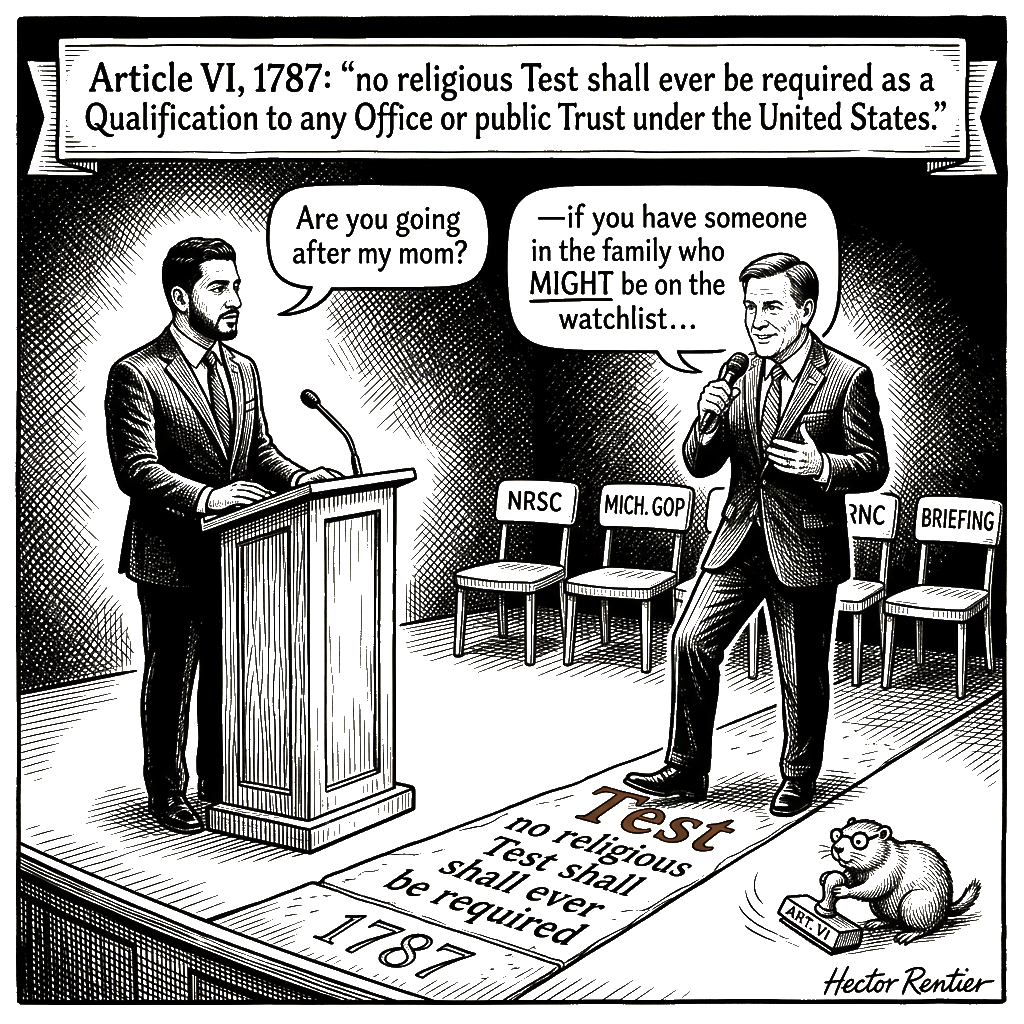
Mike Rogers and Donald Trump made Abdul El‑Sayed’s Muslim faith the case against him.
Rogers did it first, on a debate stage in Michigan on Thursday night, while the two men were arguing about Flock surveillance cameras. Rogers asked why federally regulating AI‑powered cameras “would bother” El‑Sayed, and then answered his own question: “Well, if you have someone in your family that might be on the watchlist.” El‑Sayed, a physician and former state health director who would be the first Muslim member of the United States Senate, asked him to say it plainly. “Are you going after my mom?” The moderator, Rick Albin, said the exchange continued off camera through the commercial break — something Albin said he had never seen in thirty years of doing debates. You can read the full exchange here.
The next morning Trump posted on social media: “Mohammad is a Jihadist lunatic who hates our Country.” El‑Sayed has been known as Abdul since kindergarten, per the Detroit News. Choosing “Mohammad” was not an error of informality. It was the point.
The rule they broke is written down
For three days now the coverage has called this “normalization,” which is a description of a temperature, not a name for a wrong. The wrong has a name and it has a citation. Article VI of the Constitution states that “no religious Test shall ever be required as a Qualification to any Office or public Trust under the United States.” That is not a value the founders expressed. It is a prohibition they enacted, in the original text, in 1787, before the First Amendment existed — because men who had watched religious tests disqualify and persecute across an ocean wrote the ban into the frame of the government itself.
A suggestion that a candidate’s mother “might be on the watchlist” is a religious test performed in the subjunctive. It requires no evidence, admits no rebuttal, and does its work in the sentence where it is spoken. So does calling a Senate candidate a “Jihadist lunatic” the morning after he survives a debate. Rogers and Trump are free to say these things. Article VI does not criminalize stupidity. What it does is establish that no honest institution of the party they represent may treat these things as a qualification — and that is the sentence the Republican Party of Michigan and the Republican National Committee now owe the public.
What the text actually says
I was raised to believe this was a Christian nation, and I believed it for thirty years. That belief carried a corollary I was never taught to test: that a Muslim candidate is a foreign body in the body politic, and that noticing so is not prejudice but prudence. It is the corollary that Rogers’s watchlist line and Trump’s post both assume, and it is the corollary that the texts I was raised on refuse.
Leviticus 19:33–34: “When a foreigner resides among you in your land, do not mistreat them. The foreigner residing among you must be treated as your native‑born. Love them as yourself, for you were foreigners in Egypt.” Read it in plain English, without the interpretation machinery. The standard is not tolerance. Tolerance is what you extend to something you have decided to permit. The standard is native‑born — the same standing, the same access, the same presumption of belonging. And the stated reason is covenant memory: you were the stranger, therefore the stranger in your gate is owed what you were owed.
The Christian Nationalist reading of this passage treats the ger command as domesticated foreign policy for ancient Israel, inapplicable to a modern republic — and then turns around and treats a Muslim American’s citizenship as conditional on his religion. You cannot have it both ways. Either the covenant’s memory of Egypt binds the way this country treats the resident outsider, or it binds nothing, and every sermon about Christian nationhood is nostalgia wearing a flag. The same command’s logic is what Article VI enacted in secular form. When the covenant code and the Constitution converge on one rule and the Republican Senate campaign in Michigan breaks it, the failure is not theological disagreement. It is refusal to be bound by anything at all. The stranger passage is not decoration here: Jesus builds the same standard into the judgment scene of Matthew 25 — “I was a stranger and you invited me in” — and Exodus 22:21 states it without ornament: “Do not mistreat or oppress a foreigner, for you were foreigners in Egypt.”
I taught the domesticated version. I sat in women’s Bible studies where “we are a Christian nation” was said the way other people said the weather. I am not writing from outside that room. I am writing from the place where the plain text finally got loud enough to contradict it.
The insinuation was investigated and it came up empty — that is the method
Rogers’s watchlist line has a factual substrate, and the substrate has already been checked by his own side’s media. El‑Sayed’s mother, Fatten Elkomy, worked as a nurse practitioner for the Islamic American Relief Agency and left in 2004 — the same year the Treasury Department designated the organization. She was never among those indicted by the Justice Department in 2007. Bridge Michigan, a state outlet, has found no evidence connecting El‑Sayed personally to the Muslim Brotherhood. Every verifiable element of the insinuation resolves to nothing, and it was resolved to nothing before Rogers said it on stage.
That is what makes it a technique rather than an error. The conservative press dug up the mother’s employment; the fact‑checkers cleared the candidate; and the campaign said it anyway, because the sentence does the work before the correction arrives and never retracts. Quardricos Driskell of George Washington University put the distinction precisely: Islamophobia “has long existed … across American political society from both parties. What distinguishes the current moment is that the explicit use of Muslim identity as a political attack is by prominent Republican leaders.” After 9/11, George W. Bush stood in front of a mosque and said, “Islam is peace.” That was a Republican president enforcing a norm inside his own party. The current norm is enforced by nobody: Andy Ogles posted that “Muslim’s don’t belong in American society”; Nancy Mace wrote that “After 9/11 we said ‘Never Forget.’ I think we sadly have forgotten” after Zohran Mamdani became New York City’s first Muslim mayor; Trump posted about El‑Sayed. Haris Tarin of the Muslim Public Affairs Council reports an eight‑fold increase in anti‑Muslim speech tracked over the past year. Pew’s number moved from 25% of American adults saying in 2002 that Islam is “more likely” to encourage violence, to 51% in 2026. The audience for this rhetoric was built, not found.
Gregg Nunziata, a Republican policy adviser, called the remarks “extremely destructive and deeply alarming” and said it is “the responsibility of leaders to tamp down that type of rhetoric and police their own side and that’s not happening today.” Nunziata is right, and he should not have to be a lone voice in his own coalition.
The demands, by name
Because the rule is written down, the remedy is not a national conversation. It is four specific statements from four specific addresses.
Steve Daines, chairman of the National Republican Senatorial Committee, must say on the record whether the watchlist insinuation is NRSC strategy in Michigan, and must make a public apology from Mike Rogers a condition of further committee support. The NRSC exists to elect this candidate. Silence is endorsement; the committee’s own branding rides on the ticket.
Pete Hoekstra, chairman of the Michigan Republican Party, must disavow the watchlist line by name and state that a candidate’s faith is not a qualification question in his state party. He chairs a party that will spend the next four weeks asking Michigan voters to trust it with Senate control. Trust is the issue; he can answer it in one sentence.
Michael Whatley, chairman of the Republican National Committee, must put the party’s position on Article VI in writing: does the no‑religious‑test clause of the United States Constitution bind Republican candidates, or does it not? This is not a question for the courts. Article VI is already law. The question is whether the party that claims this country’s founding still assents to its founding rule — and the RNC chair can answer it without a lawyer.
The White House press secretary, at the next briefing, must answer whether the president stands by calling a United States Senate candidate “a Jihadist lunatic who hates our Country,” and the post must be retracted if he does not. A president who has decided that a candidate’s religion is news may not delegate the follow‑up to silence.
I apply the no‑religious‑test rule to my own coalition as cheerfully as to the other one. It is not partisan property. Article VI does not ask which party the disqualified candidate belongs to; it forbids the disqualification, and it has forbidden it since before either party existed.
November will decide whether Michigan sends a Republican or a Democrat to the Senate, and that is the voters’ business. What is not the voters’ business — what four institutions and four chairs must stop pretending is the voters’ business — is whether a Muslim American may run for office without his faith being entered as evidence. The rule against that is 239 years old and it is one sentence long. The men who broke it this week can be required to answer for it, and the people who can make them answer are currently saying nothing at all.