
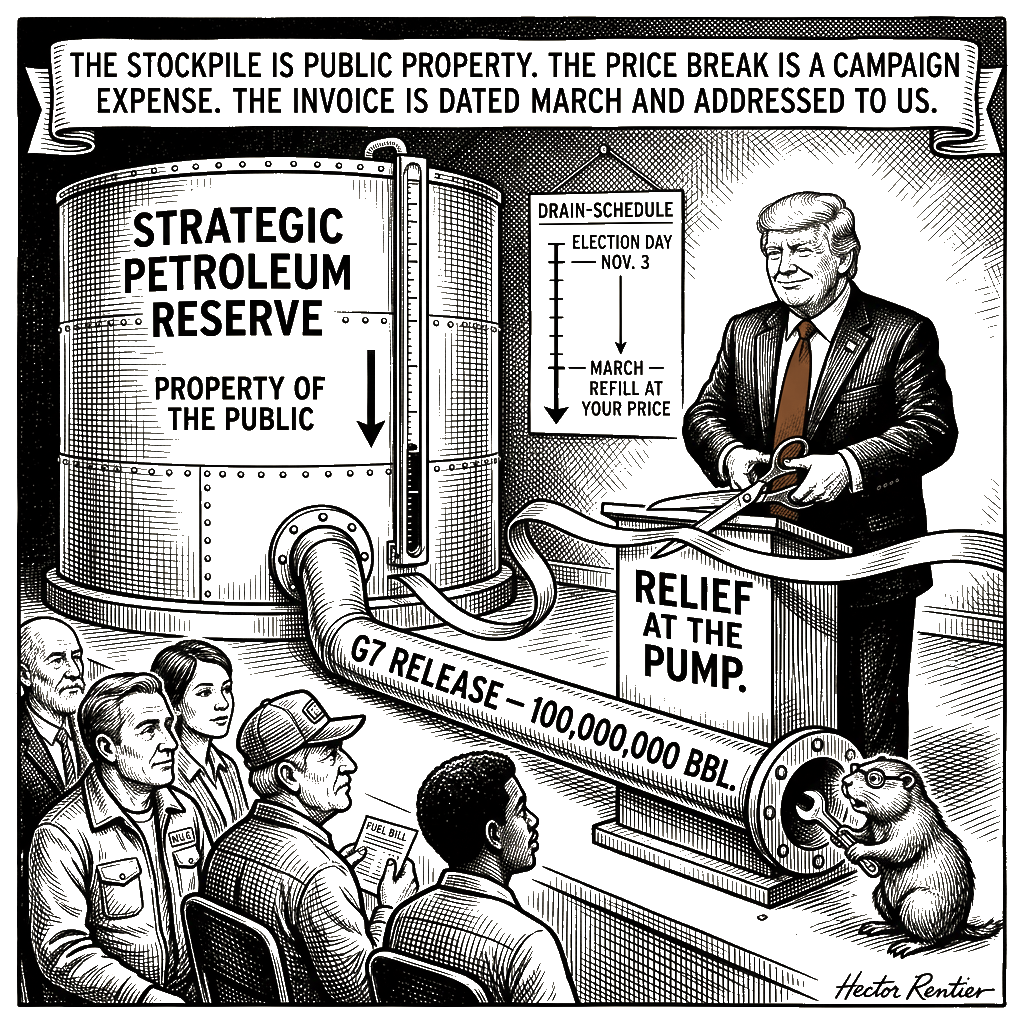
Trump is draining the public oil reserve to buy a cheaper pump price. The midterms are five weeks out, and the timing is not incidental to that. It is the plan.
The delivery that fills the tank behind the elevator off Highway 13 is the only honest price gauge I get all month, and it has been reading about three dollars a gallon one year and about six the next. David Ruisard, pricing manager for the commodities firm Argus, puts sixty percent of that move on the Strait of Hormuz and forty percent on the war in Ukraine. The president commands neither geography. He commands a dye in a fuel tank, a phone call to a statehouse, and a press conference next to a stockpile chart. That is the entire tool kit, and a county that has to run a milk truck, a grader and a school bus fleet off the same diesel doesn’t get to pretend the tool kit is a supply.
Every diesel dollar in Adams County now prices off two wars a farmer can’t see. The neighbor who hauls milk reads it twice a week at the bulk tank pickup: his hauling and feed costs come out of a milk check set in Chicago, and his diesel comes off a rack priced by a war in the Gulf. The potato growers on the Central Sands run trucks and equipment from June into September on the same rack. The school board signs a three-year bus contract and eats whatever the fuel does in year two. The town road crew grades sand roads every spring with a grader and two dump trucks burning the same gallon. None of those people is a price-setter. All of them are price-takers, and the difference between the two is the whole story.
Which is why the levers matter, and why the man pulling them says what he says about them. Patrick De Haan, head of petroleum analysis at GasBuddy, is blunt: Trump has “basically pulled all of the small levers that a president can pull, and we’re still seeing prices very elevated.”
Take the gas tax. Trump says he is “thinking about” suspending the federal levy, and he has been imploring state capitols to cut theirs; Ohio and Georgia have done so. Suspending the federal levy requires a Congress that will not deliver it before November. But look at where the state money goes, because this is the part that never makes the cable segments. Federal gas-tax revenue doesn’t go in a vault. It goes into the Highway Trust Fund, and it comes back out to the states as highway aid, and it shows up at a county board’s budget hearing as the line that buys gravel, salt and diesel for the county plow trucks. Wisconsin towns and counties lean on state highway purpose revenue sharing for the same thing. When a president leans on governors to cut gas taxes, the revenue that disappears is money the state was going to pass down to us. Indiana cut in May, and the cut has already cost that state government a billion dollars. A town that levies for road repair is funding that hole one mill at a time, and the people voting on the levy will never connect it to a campaign stop.
Then the red-dye diesel. At a campaign stop this week Trump announced he would allow tax-free red-dye diesel — fuel meant for off-road equipment — onto the highways. Ruisard notes that the only difference between the two products is the dye itself, and that the dye is deliberately hard to get back out of a tank, because running dyed fuel on the road is considered tax evasion and the fines are steep. So a trucking operator who takes this relief is borrowing against a fine that comes due the day the rule ends. And the dyed pool is finite: Ruisard warns that street consumption depletes the supply ordinarily reserved for off-road users, including rail operators. This is the small-operator version of the whole administration. A trick that works exactly once and bills you later — relief you have to flush out of your own tank on your own dime.
The one move with measurable effect is the G7 agreement, under Trump’s pressure, to release 100 million barrels of oil and diesel from strategic stockpiles. Michael Pearce, chief US economist at Oxford Economics, calls it “a temporary solution.” A hundred million barrels against a market that eats tens of millions a day is a rounding error that moved prices because it was announced, not because it was large. And the accounting closes behind us: as long as Gulf exports stay disrupted, those stocks drain further, and the need to refill them keeps prices elevated even after the Middle East clears. Our county highway department will still be buying diesel at a elevated price next spring because Washington sold its cushion to get through October.
Trump has also backed a ban on US diesel exports, which on its face sounds like it would help a fuel-short Midwest. Pearce’s read is that it gives partial relief in the Gulf and Midwest, “little benefit” to the Northeast and West Coast, and risks backfiring: stockpiling drains, refineries cut production, and gasoline prices rise to pay for the diesel discount. That is not a fix. It is a swap, and the swap runs through the same rack on Highway 13.
This is the chain our household budget actually lives in, and it does not have a lever on our end. Energy drove most of this year’s uptick in inflation. Inflation is what is holding interest rates up. Higher rates plus higher diesel is what a dairy operation feels when it refinances, what the elevator feels when it finances a custom-harvest crew, what a school district feels when the bus contract comes up for rebid, what a township feels when the road levy comes around. Wars drive oil. Oil drives diesel. Diesel drives the milk hauling bill, the bus contract and the gravel levy. The president can announce against every node in that chain. The chain does not move.
So the politics is plain, and it is aimed straight at us. Gasoline is the most visible price in American life, and a small decline at the rack in Friendship between now and Election Day is worth more to this White House than a settlement that only shows up in March. That is why every announcement is stagecraft — the dye, the stockpile, the calls to statehouses — and none of them is a market mechanism. Polls already show a majority of Americans disapprove of Trump’s handling of the economy and the war with Iran, and the analysts have already conceded what the announcements cannot fix: De Haan says the only way out “in a meaningful way” is solving one or both of the conflicts, and Pearce notes those are matters the White House does not control.
Even a deal would not be relief on our timeline. Ruisard says damage to Middle Eastern facilities from military strikes means production takes four to six months to come back to normal. The neighbor’s milk check will not get lighter in November no matter what gets announced in October. Wendell Berry’s argument in The Unsettling of America is that extraction takes the cost out of the ledger where you can see it and leaves it in the place where you cannot. That is what a stockpile release is: the public’s cushion, spent where the invoice can wait, on a calendar that ends at a ballot box.
Mike and Quinn will inherit whatever is left of a county that runs on diesel it does not control and announcements it cannot use. That is the verdict November will be asked to render, and it will be rendered at the co-op tank, the bulk pickup, the bus contract and the levy hearing — not at a podium.