
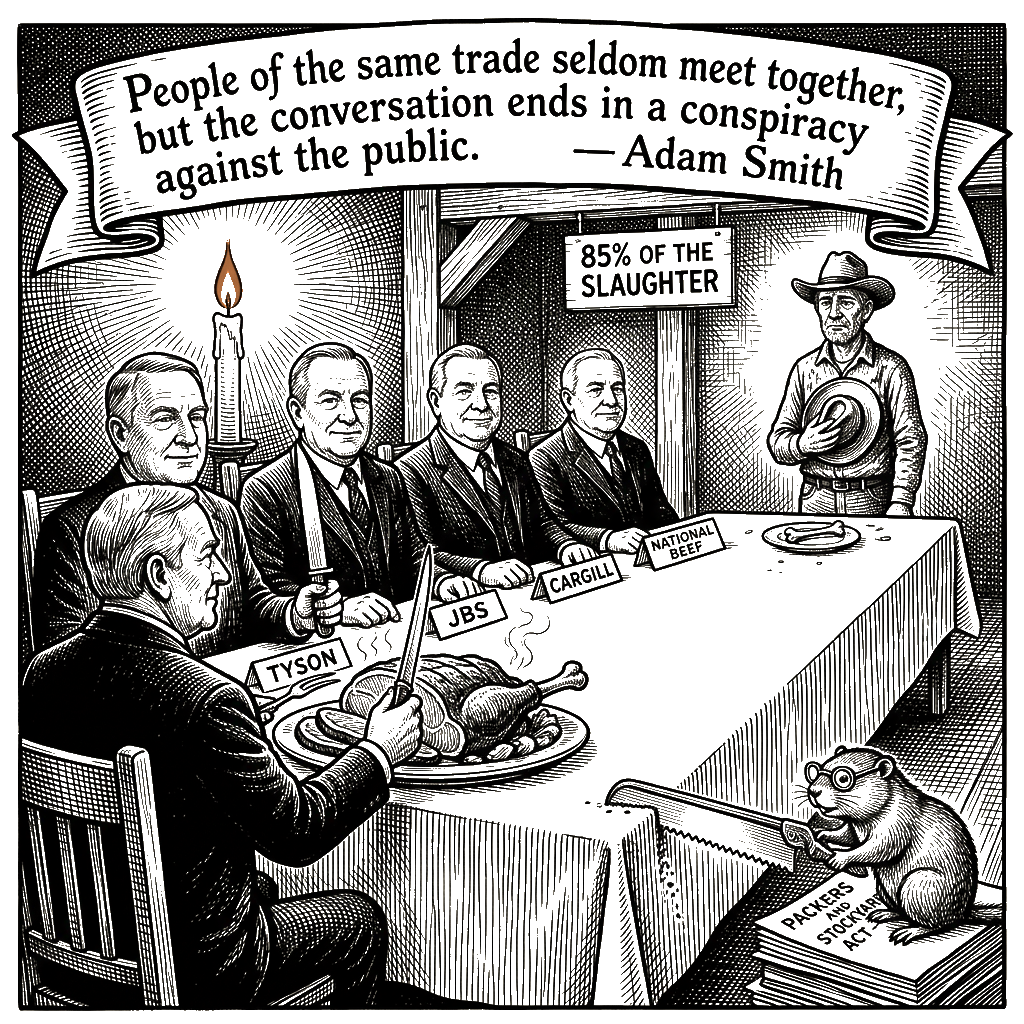
A rancher in the Sandhills sells a fat steer, and the buyer is an agent for one of four companies. That’s not a tariff. Rural Republicans aren’t defecting because of President Trump’s tariffs; they’re defecting because four firms control roughly 85 percent of beef slaughter and two generations of senators — his own party’s — let it happen. That’s the diagnosis The Editors of National Review sidestep when they pin the party’s polling collapse in Iowa, Kansas, and Nebraska on the trade war and the Iran conflict in “Why Are Republicans in Danger in Middle America?”. The editors want readers to believe a presidential policy tweak explains the worst rural collapse in a century. It doesn’t. The piece names the wrong villain — and it has to.
It has to, because the correct villain is the party itself. The Republican Party has spent years removing every idea, policy, and institutional check that would let it disagree with Donald Trump. There is no separate platform to fall back on. There is no senior Republican with the standing to say “the president is wrong about this” and be believed. So when the tariffs raise the cost of diesel in Iowa to six dollars a gallon, the party cannot say so. It has to defend him. It has to find another culprit. The editorial does exactly that. It blames the trade war and calls it a day.
Here is the mechanism the editorial skips. A senator who breaks with a sitting president of her own party pays a price in a primary. The senator who defends him pays a price at the ballot box. Republicans have decided, again and again, that the primary is the real election. So they swallow tariffs that hurt Iowa corn growers. They swallow retaliatory duties that crush Nebraska beef. They swallow fuel spikes that hit Kansas wheat farmers — because the alternative is a Trump-backed opponent in two years. The editorial describes this dynamic in the same breath as it blames the tariffs themselves. It does not notice the contradiction.
When a rancher sells that steer today, the buyer is almost certainly an agent for Tyson, JBS, Cargill, or National Beef. Those four control roughly 85 percent of the slaughter. They set the price they pay the rancher and the price they charge the grocery store. The rancher gets squeezed at both ends — by a buyer who is also his only buyer. That’s a monopoly, and you can trace what it does in the numbers. Wholesale beef prices hit record highs in 2024 and again this year. The price the rancher receives has not kept pace. The share of the retail dollar flowing back to the producer has been falling for thirty years, on the USDA’s own farm-share data. The packers didn’t need a tariff to do any of this. They needed a Congress unwilling to enforce the Packers and Stockyards Act of 1921, and a Justice Department that filed a price-fixing case in 2022 and settled for a wrist-slap.
There is a bipartisan scorecard on that, and the Republican side is the longer one. Both parties have waved through merger after merger. But Republicans are the rural party. They write the Farm Bill. They chair the agriculture committees. They could have revived packer competition any year they wanted. They chose, decade after decade, not to. And the structural dependence they chose is older than this president: American agriculture was built to ship raw product overseas and import finished goods back. That is not a Trump creation. That is forty years of Republican-backed farm policy — get big, get specialized, get export-dependent. Bush tried steel tariffs. Trump’s first term ended with tens of billions in farm bailout payments to make up for the damage his own trade war caused. Republicans who now profess surprise at the cost of tariffs are professing ignorance of their own history.
I’ll grant the editorial the facts it gets right. The polls aren’t flattering, and the conditions aren’t fake. The races in Iowa, Kansas, and Nebraska are genuinely tight. Retaliatory tariffs really do squeeze margins — China did slap retaliatory duties on corn and beef in 2025. Diesel really does cost six dollars in Iowa, and a Nebraska farmer running a combine burns through hundreds of dollars of it in a single day. Of course fuel and fertilizer cost more during a shooting war; that is what wars do, and if Republicans win in November fuel costs will not collapse, and if they lose they will not collapse either. None of that should be dismissed.
But there is a difference between a marginal harm and a structural one. Tariffs move prices at the dock and the pump. Monopoly moves prices at every transaction, every day, for decades — and it transfers that money, predictably, to four publicly traded firms. If you want to know why a Kansas wheat farmer’s kid is moving to Wichita or Denver, the answer isn’t in the White House trade office. It’s in the consolidated meat and grain industries that have swallowed his family’s margins.
Which is why the editors’ prescription — endangered Republicans putting rhetorical distance between themselves and the president’s economic agenda — won’t fix this, and may make it worse. Rhetorical distance is a communications tactic, and it will not work because there is nothing on the other side of the distance. Voters aren’t fooled by a senator denouncing a tariff while holding a committee chairmanship that refuses to mark up a single antitrust bill aimed at the packers. They see the votes. They see the contributors. They want the system broken up, not the description softened.
So what actually gets built. Enforce the Packers and Stockyards Act the way it was written. Block the next round of agribusiness mergers before they consolidate further. Let the Justice Department finish what it started on price-fixing. Pass a Farm Bill that puts market-structure reform in the title alongside subsidies — and pays for stewardship, not just for bushels of commodity. Build local processing for cattle and grain so a steer doesn’t have to leave the county to become a steak. None of this requires an Iran treaty or a permission slip from Beijing. And Republicans need a leadership bench that has disagreed with this president publicly and survived; the bench is empty, and both parties are short on it, but Republicans are shorter.
Rural America didn’t hollow out in twelve months, and it won’t be rebuilt in twelve months. The heartland is not angry about a tariff schedule. It is angry about a party that promises what it cannot deliver, defends what it cannot defend, and calls it the weather. Break up the packers — or keep working on a more flattering way to describe the failure. Rural voters can already tell the difference.