Are voters finally going to hear an honest debate on Medicare for All? Maine Democratic Senate candidate Troy Jackson has, and he has the answer: “prioritizing where we’re spending our money, not in forever wars, not in ICE.” That is not magical thinking. That is the only honest budgeting in American politics — and the only serious fiscal argument on offer. Abdul El-Sayed, running in Michigan, is now doing voters the further favor of clarifying that the rallying cry of “Medicare for All” really does mean Medicare for all, and that getting there does not require lying to the 160 million Americans currently locked into employer plans.
Yes, Medicare for All costs money. Mr. Jackson laid out the funding logic at Maine’s first Senate debate on Tuesday: the way to pay for universal healthcare is to reorder national priorities away from endless war and away from mass-deportation enforcement. The budget of ICE, which Mr. Jackson and his fellow Democrats have called to disband, is a rounding error against what the country already devotes to a fragmented private system. Medicare for All, by replacing that apparatus with a single public payer, redirects spending that is already happening toward actual care.
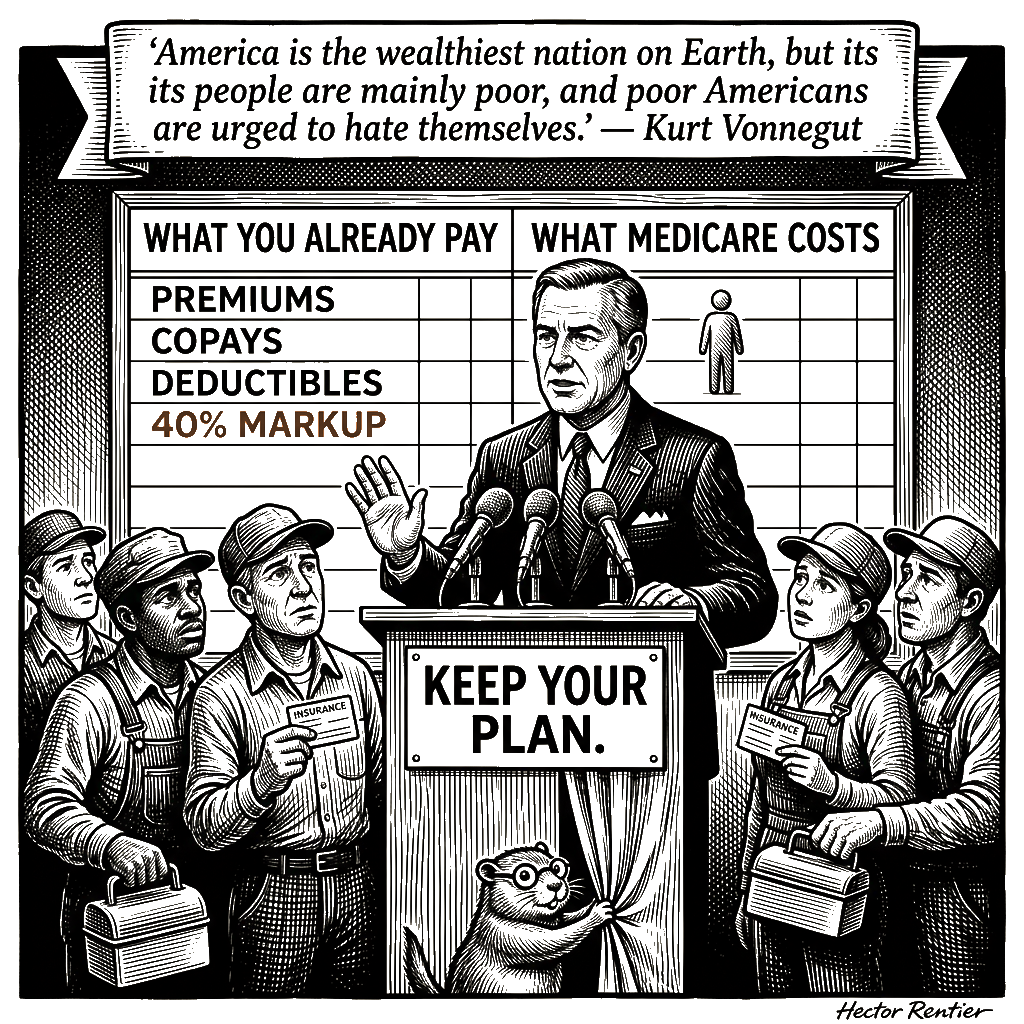
A 2018 analysis of Sen. Bernie Sanders’s bill put the price at $32.6 trillion over a decade — produced, it should be said, by Charles Blahous, a conservative analyst with a long record of finding reasons to say no to public programs. Even that figure assumed all provider payments could be cut to Medicare rates, “more than 40% lower than private insurance rates.” That is not a buried assumption. That is the plan working. Americans currently pay private insurance rates roughly 40% higher than the public Medicare rate for the same services. Lowering those payments is not a hidden cost. It is the savings. And they are available to fund the zero premiums, zero copays and zero deductibles that Mr. El-Sayed is promising voters. The honest reading of Mr. Blahous’s own math is not that universal coverage is unaffordable. It is that Medicare is dramatically more efficient than the private-insurance status quo. While proponents of Mr. Sanders’s plan note that new public spending would simply replace today’s premiums, copays, deductibles and out-of-network bills, there is still a gap to close — and Mr. El-Sayed has chosen the honest path of telling voters how it will be closed.
Medicare for All also means liberating Americans from a system millions never chose. Mr. Jackson did not flinch from saying so, even after Republican Sen. Susan Collins attacked him at the same debate for wanting “big government to take over healthcare, to abolish private insurance that people, such as the workers at Bath Iron Works, are happy with.” That is a strong position for Mr. Jackson, since 47.5% of Mainers had employer health coverage in 2024, per the Kaiser Family Foundation — a near-majority of the electorate tied to a job-lock arrangement that ties coverage to a job and lets the boss decide, year to year, what plan the family gets to keep. In Michigan it was 50.3%. The critics read those numbers as proof Americans love their private plans. They prove nothing of the kind. They prove that some 160 million Americans are afraid of losing what they have — and that fear is exactly what the critics exploit. Bath Iron Works builds the warships that fuel the “forever wars” Mr. Jackson wants reprioritized. The man defending the work and the man defending the wars should not be on the same side of this debate.
In Michigan it was Mr. El-Sayed who told the truth at a Thursday debate. “If families want to keep their private health insurance,” he said, “that’s fine by me.” He has since been accused of trying to “deceive voters” by clarifying what the legislation actually does. His campaign says plainly: “Medicare should be automatic, for everyone,” and “Medicare for All does not have to ban additional private insurance through unions or employers, although Medicare for All should make those choices redundant and unnecessary.” That is not deception. That is the most honest thing any candidate in either party has said about healthcare in this cycle. Here is a line from the version Mr. Sanders introduced last year: “It shall be unlawful,” the legislation says, “to sell health insurance coverage that duplicates the benefits provided under the Medicare for All Program.” The House bill, sponsored by Rep. Pramila Jayapal, carries similar language. This is what universal coverage looks like in statute.
Mr. El-Sayed’s good-faith effort proposes to delete that provision, and the result his campaign concedes hardly differs. Instead of making private plans illegal, universal coverage renders them obsolete — because nobody chooses to pay for a private duplicate of coverage Medicare already provides automatically, for free. That is the point. The private market does not need to be outlawed. It simply ceases to be competitive when the public plan covers everyone. A refinement, not a retreat — and exactly the kind of evolution the working-class progressive coalition behind these campaigns has every right to make.
Recall President Obama’s line on ObamaCare: “If you like your healthcare plan, you can keep it.” After millions of cancellations, PolitiFact labeled that the “lie of the year.” That sentence is the standing confession of the political class: they knew the incremental system could not deliver universal coverage, and they sold it anyway. Now the same class campaigns outright on giving that same treatment to some 160 million Americans with employer coverage — recycling the slur every time a Democrat promises universal coverage, and never finishing the sentence. They never tell voters the rest of it: you will not need to keep your plan, because you will have something better, paid for by the money we have been spending on the wars Mr. Jackson wants ended and the deportation machine Mr. Jackson wants disbanded.
Troy Jackson is not running on a slogan. He is running on a reordering of national priorities — away from the military interventions and detention bureaucracies that drain the treasury, toward healthcare every American can actually use. His critics are running on fear. If you like your plan, you will not need it anymore, because you will already be covered. Voters in 2026 can tell the difference.