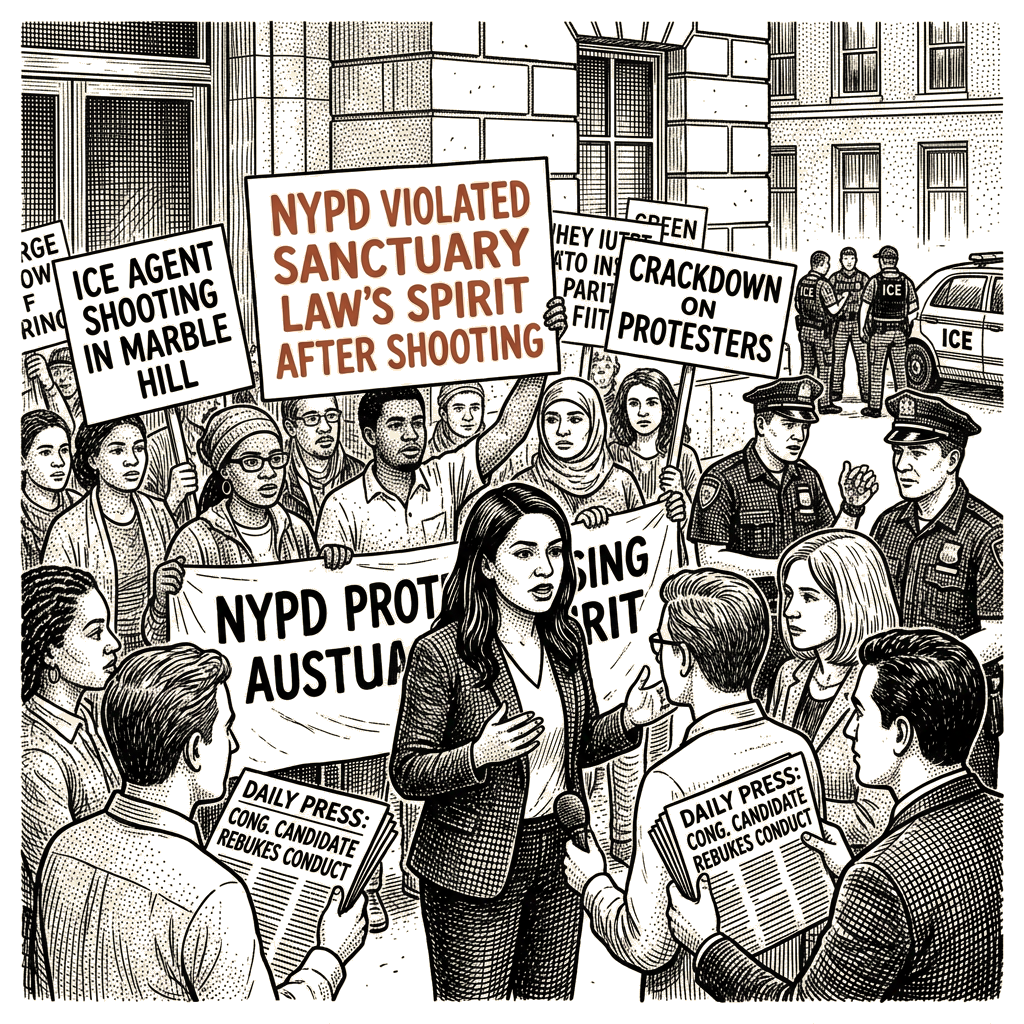
On 8 October, an ICE agent shot Oscar Belgal, a 28-year-old Dominican man, in the neck while he sat in his car in Manhattan’s Marble Hill with a five-year-old in the backseat. The child was physically unharmed. Belgal was hospitalized in stable condition, and then — by the account his own lawyers could not verify — back into federal custody, because federal custody was always the destination. The Department of Homeland Security’s first move after one of its agents shot a man in front of a child was to announce that the man was undocumented, as if that settled anything. New York got its answer in writing when Mullin said ICE would not pause city operations. There was never a question about whether the federal government would change course. The question was always about New York.
Here is what New York did. A neighborhood under occupation answered like one: a few hundred residents took the streets on Thursday night and demanded ICE leave. The NYPD sided with the occupiers. It put up barricades against the residents. It clashed with them. It carried Belgal — still handcuffed — to an unmarked car. Five people were arrested. Commissioner Jessica Tisch told reporters her officers arrived to preserve evidence, that they were not part of the immigration operation, and, unprompted by any question that required it, that Belgal had a criminal record.
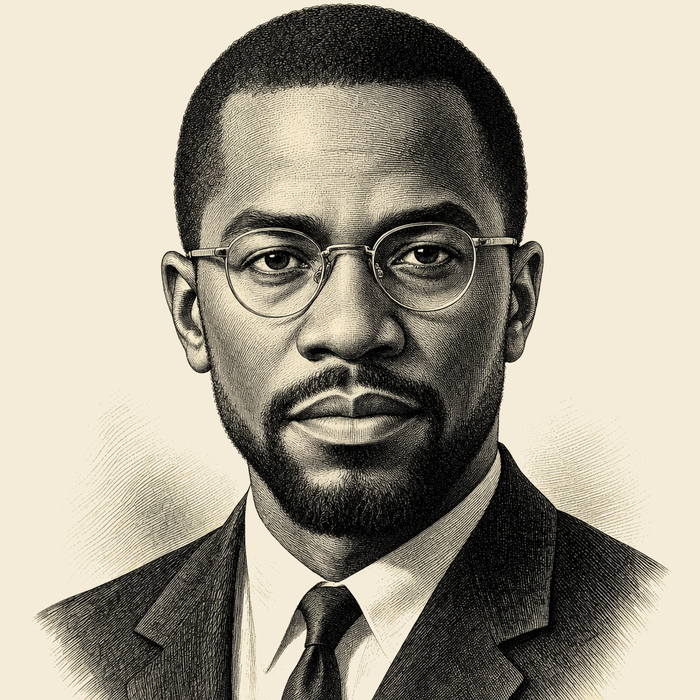
That last detail is the tell. You do not volunteer a shooting victim’s arrest history at a press conference unless you have decided which story you are telling, and it is not the city’s. When critics objected to the smearing, the NYPD’s defense was that they always provide such information. Always. That is exactly the point. Darializa Avila Chevalier — the congresswoman-elect for this district, a longtime organizer who stood in Columbia University’s pro-Palestine encampments, present at the scene on Thursday night — put it plainly: Tisch was “more interested in peddling the narrative of the Trump administration than in upholding sanctuary policies.” Her summary of the evening fits on one line: “The NYPD spent more time protecting a militia that just shot someone than protecting New Yorkers.” No statement from the department has contradicted it, because the sequence of events contradicts nothing.
Avila Chevalier tried to tell police the barricades were escalating the situation, that people were being hurt and pushed back. Then officers knocked her to the ground. “At some point, I felt like my feet were not touching the ground. I felt like I flew,” she said. She is thankfully OK, though still in pain. The NYPD’s explanation for throwing a congresswoman-elect to the pavement? That she was pushed to prevent the crowd from trampling the captain. The captain. In the same city where the police commissioner used a press conference to catalog the criminal record of a man shot in front of a five-year-old, the injury that mattered was to the captain’s dignity.
And the man himself? By Friday, Belgal’s lawyers could not locate him. “That is deeply concerning to me,” Avila Chevalier said. It should be deeply concerning to everyone. A man was shot in this city, in front of a child, by a federal agent, and the institutions of that city — the police who carried him away handcuffed, the commissioner who smeared him, the mayor who kept her on — have turned him into a legal abstraction with an immigration status. That is what sanctuary looks like when it is run by people who do not believe in it.
Sanctuary law in this city is written as a prohibition: local police do not help federal agents carry out civil immigration enforcement. Watch what that prohibition permitted on Thursday. An evidence-preservation detail. A perimeter. Barricades facing outward, at the people, not the agents. A perp walk to an unmarked vehicle. A commissioner’s briefing that pre-blamed the man in the ambulance. Every one of those acts is defensible in isolation as routine police work, and in sum they are a federal immigration operation escorted, secured, and publicized by the NYPD. Avila Chevalier’s phrase — that the conduct violated “the spirit, if not the letter” of sanctuary law — is being treated as a soft criticism. It is the opposite. It is an indictment of a law whose letter can be satisfied while its purpose is executed around it.
Mayor Zohran Mamdani called the shooting “unconscionable,” reiterated calls to abolish ICE, and said throwing anyone to the ground in this city is unacceptable. Then he confirmed that Tisch keeps her job and that the strategic response group — the rapid-response unit that has made its name cracking down on protesters, and that he promised, repeatedly, to disband — stays in place. DHS has already rejected a pause in New York enforcement, even as Mamdani and AOC made the abolition argument. Avila Chevalier was characteristically generous about the gap between them: it is her duty, she said, to echo the demands of her district, and she would be a poor partner to the mayor if she did otherwise. Duty is the wrong word for what the moment requires. The mayor already has the demands. He has had them since the campaign.
“Unconscionable” is a word. Abolition is a policy. One of them costs nothing; the other requires removing the commissioner who smears shooting victims and disbanding the unit that brutalized the demonstrators. Condemn the shove, keep the squad. That is the whole settlement, offered within 48 hours of the shooting, before the organizers who elected him had finished counting their bruises. The mayor’s office did not respond to a request for comment. Of course it didn’t.
And the demands are not complicated. Avila Chevalier stated the only coherent one: “We wouldn’t need sanctuary policies if ICE didn’t exist.” The whole arrangement — local cops who merely keep their distance while federal agents operate in the neighborhood — is a room in a burning house. Sanctuary is a tourniquet. It slows the bleeding at the edges of a city while the wound is federal and stays open. Every week produces another demonstration that the tourniquet can be tied around a shooting and a handcuffed man in an unmarked car and called effective.
The organizers in Marble Hill understood the arithmetic better than the press conferences did: a few hundred people, barricades, five arrests, and a congresswoman-elect knocked to the ground are what it costs to make the tourniquet visible. Avila Chevalier still believes in the protest that built the power she now holds: “So much of the power given to our electeds comes from the space that constituents and organizers give us to be bold.” Marble Hill gave that space. Sanctuary as a consolation prize is over. Abolish ICE, disband the SRG, remove Tisch. The bold demand is the only honest one — the only one that closes the wound. Everything else on the table in New York this week is a debate about the angle of the wrap.