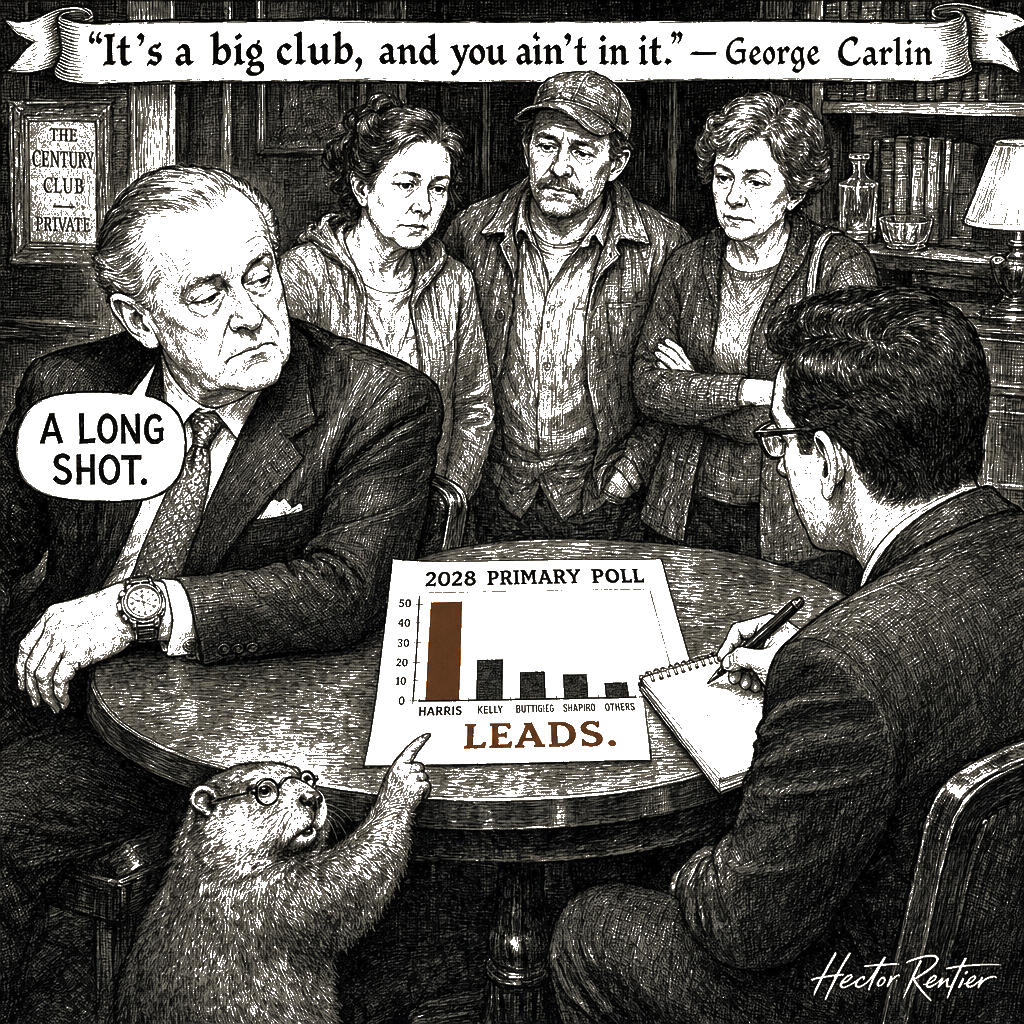
The Wall Street Journal reported this week that Kamala Harris’s husband has privately signaled to people close to the couple that he would prefer she sit out another presidential campaign, and that major Democratic donors are now telling her directly that a third White House bid would be a long shot. The full apparatus is in motion: a spouse’s private reservations aired to friendly reporters, the bundlers delivering private counsel to retire, the named-sources-only leaks planted in advance of her decision. It is a familiar Washington maneuver, and a poisonous one.
Consider who is whispering. The same donor class that funded the 2024 race — the race Harris inherited after Joe Biden’s abrupt withdrawal, the race the donor class itself pressured him to exit, the race she then lost in both the Electoral College and the popular vote to Donald Trump. They have spent the eighteen months since then diagnosing the loss as a candidate problem rather than a coalition problem. They have decided, in private, that Harris is the wrong messenger for the next cycle. Their case has the ring of strategic wisdom. It also has the ring of investors trying to fire the worker they have not yet employed.
There is a particular ugliness to the way this particular benching is being attempted, and it starts at the kitchen table. Harris’s 2024 campaign memoir, “107 Days,” describes her husband as fiercely protective and emphatically supportive. She writes that when she was tapped as Biden’s running mate in 2020, “he made a huge sacrifice, gladly and without bitterness” by leaving his law firm, and that during the brutal final weeks of the campaign she heard him say, “We can’t turn on each other.” He has since returned to private practice in Los Angeles, and the couple have settled back into ordinary married life far from the capital. That is the posture of a household that has gone home — not the posture of a household bracing for another campaign. And now that private skepticism is the lead item in a story that ran as his wife spent the week campaigning for other Democrats.
The voters are not on board. Harris still leads nearly every hypothetical 2028 Democratic primary poll. She took the stage at an NAACP event in Michigan last month and received a lengthy standing ovation. She has appeared at half a dozen private California fundraisers in recent weeks, including events in Santa Monica for Milwaukee County Executive David Crowley and for Nevada Attorney General Aaron Ford. She traveled to Michigan to campaign with Senate hopeful Abdul El-Sayed, turning out Black voters in a demographic group he had struggled with during the Democratic primary. She is expected to campaign next for Ford in Nevada, for Senator Jon Ossoff in Georgia, and to keynote the Fulton County Democratic Party’s annual fundraiser in Atlanta. She joined a DNC get-out-the-vote call last week with more than 2,000 volunteers across a dozen states and told them to knock on doors. “Hard work is good work,” she told them. That is the cadence of someone building the infrastructure for a run, not someone tiptoeing away from one.
Donna Brazile, the longtime Democratic strategist who stays in close touch with Harris, put it flatly: “She is going where she is needed and she is willing to do what it takes to help Democratic candidates on the ballot this year.” Harris has hired staff: former U.S. Ambassador to Trinidad and Tobago Candace Bond as chief of staff, strategist Brian Fallon from her last presidential campaign, Eduardo Negrón as communications director. None of that is the posture of a woman leaning toward the exit.
It is, instead, the posture of a woman who has decided to run and is being told not to.
The Democratic bench is real, and a robust primary would do the party some good. Gavin Newsom told CNN in September that he would not enter the race if Harris does, calling two Californians in a primary “a gift from God for everybody else” with “no upside whatsoever” — which is deference, but also a calculation that an open field where Harris sits out is the only field Newsom can win. Pennsylvania Governor Josh Shapiro, Michigan’s Abdul El-Sayed, the rising stars from the state legislatures — all of them become plausible 2028 contenders in a Harris-less race. None of them becomes plausible by beating her in a primary she could plausibly lose.
If a younger, fresher face is what the party needs, then let that face beat Harris in a primary. That is how the nominating process is supposed to work. Rob Sand of Iowa said publicly last summer that Harris should not run again — an honest position, taken in the open, on the record. That is what debate looks like. It is what the whisper campaign is not.
Harris has said repeatedly that she has not decided whether to run. As she told the NAACP in Michigan, “I have not decided if I’m going to run again. I do sincerely believe ‘28 won’t matter if we don’t get through ‘26.” That is the only legitimate ambiguity in this story. Everyone else has already decided, and most of them are not voters — most of them are bundlers, gossip-column surrogates, and a spouse who has earned the right to his own opinion and apparently no one else’s privacy.
Let her not decide. Let the field assemble. Let the donors cut their checks to whoever they please. But stop the whisper campaign. Stop planting stories. Stop pretending that a candidate who leads every poll is somehow too wounded to compete.
An entire establishment has substituted itself for the voter, and is now trying to substitute itself for the primary. The 2028 race should be decided in primaries and on ballots, not in the back channels of a nervous donor class.