
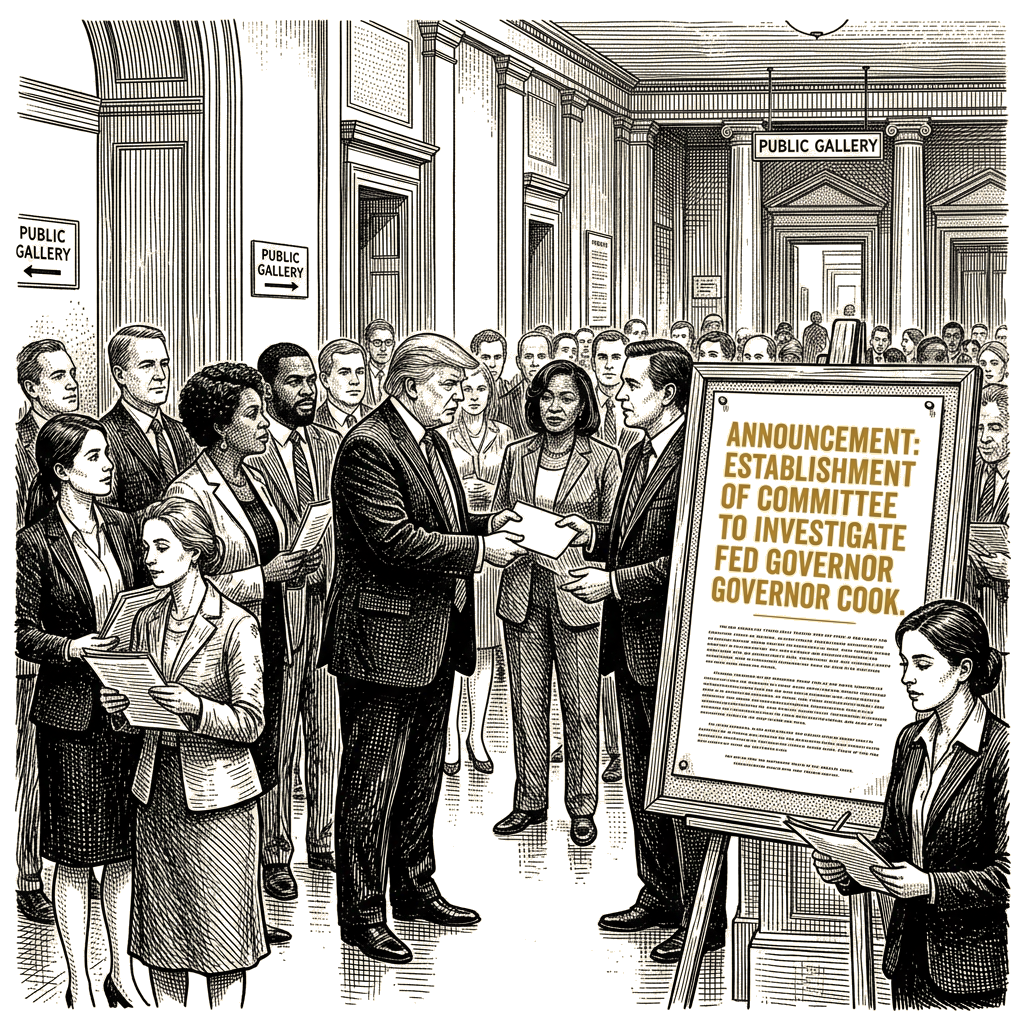
The president is trying again to remove a Federal Reserve governor, this time through a White House committee, after the Supreme Court struck his first attempt down as unconstitutional.
Here is the procedure, as the White House announced it. A committee will consult Justice Department officials to decide whether there is “cause” for Lisa Cook’s removal. An in-person hearing sits on 5 November at the White House, closed to the public but transcribed and published. Cook may submit a written statement with her own evidence. She may be examined by White House counsel and by her own counsel. Those are precisely the protections the Court found missing in August 2025. They are also the second attempt at the same result.
The first attempt was fiat. In August 2025 the president fired Cook abruptly, saying she had committed mortgage fraud by listing two properties, one in Georgia and one in Michigan, as her primary residence, and by failing to report rental income on her Atlanta property. She sued. The Supreme Court, 5–4, let her keep her seat while the allegations were litigated. In June the Court held the firing unconstitutional because the president had not followed proper procedure and had not given her an opportunity to dispute the allegations before removing her. The Court did not clear her of anything. It held that he could not remove her without a hearing. The committee is the hearing.
The president’s own statement, posted to the White House website, reads: “As President, it is my job to ensure the laws are faithfully executed, including by firing subordinates who cannot be trusted to tell the truth and follow the law.” One of those laws is the one the Court held he had broken. Faithful execution of it would have meant the August 2025 firing never happened.
The pattern is the reason a mortgage form has reached the White House. Cook was fired in August 2025 just as the president launched attacks on the Federal Reserve’s chair, Jerome Powell, in his push to get the central bank to lower interest rates. The Justice Department opened an investigation into Powell. It was dropped in April. Kevin Warsh, who succeeded Powell, had echoed the president’s calls for cutting rates before he was picked to lead the central bank; when the board met with inflation running hot off the war in the Middle East, it voted to raise rates instead, and the White House was displeased, roughly a month before the midterms. Each of those is a separate documented event. Strung together they describe fourteen months in which a president attacked a chair, opened and closed a probe of the chair, fired a governor, lost in court, and has now convened a committee that will sit on that governor’s mortgage file two days after a midterm election in which the price of money is on the ballot.
That is the stake. Congress created the Federal Reserve as an independent institution, and its governors — seven of them — vote on interest rates. Interest rates are the price of a mortgage, a car loan, a business line of credit. A president who has publicly demanded lower rates for more than a year will choose Cook’s successor if she leaves, and he has made clear what he wants the central bank to do. This is not an allegation about what he privately intends. It is a description of the structure, and the structure answers the question of who benefits before anyone opens a mortgage form.
Cook’s attorneys say the White House is “cherrypicking” and that any fraud claim rests on unrelated clerical errors. That is a defense, and it may be right or wrong. The committee is the venue where that gets decided on a record, and a column is not. What can be said now is what the standard is. The White House’s own announcement supplies the statutory word: “cause.” Cause is a finding about her conduct. It is not a finding about the calendar, and it is not a finding about the interest-rate votes of the other six governors.
The standard does not change with the party of the president. A president of either party who moves against a sitting central banker owes a record that will still read as cause two years later, when the next administration inherits the board. A record built to survive a change of power is the only record worth building.
The test of the committee is not whether it sits. The Court said the president needed a process, and he is running one. The test is whether “cause” is established in a mortgage file or found in a midterm. One of those is the rule of law. The other is the rule of law with a deadline.