
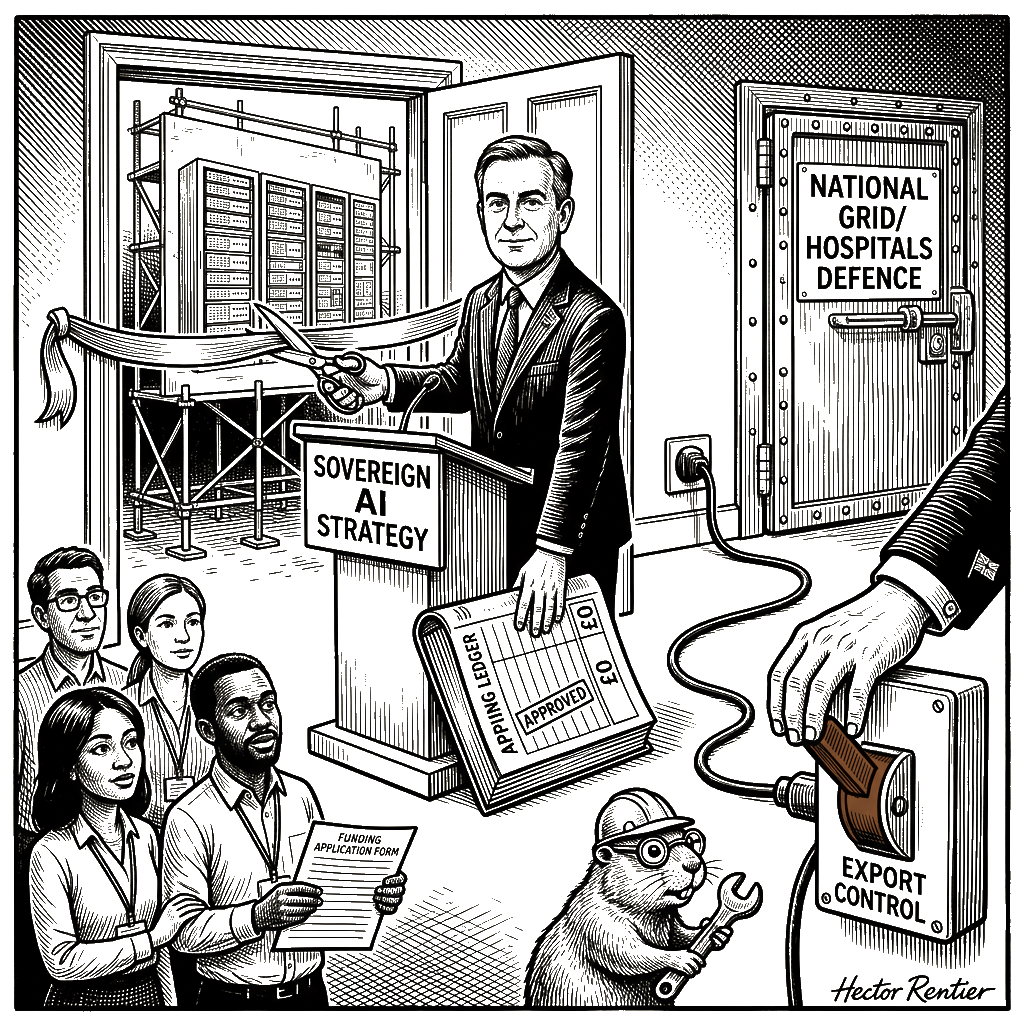
Britain keeps demanding sovereign AI, and the funding that would make it real has never materialized.
George Williamson, the new chief executive of the Alan Turing Institute, has put the argument in its bluntest form yet: a country that cannot inspect the systems running its hospitals, its grid and its defence apparatus is not a country in control of them. He is right. And the most damning evidence for his position is not what America has done to Britain. It is what the British state has already done to his own institute — under the previous government, with the funding relationship that governs the current one left entirely unchanged.
Start with the American evidence, because it is not hypothetical. In June, Washington temporarily blocked the release outside the United States of Anthropic’s latest models. It has reportedly gone further, asking leading AI laboratories to withhold their models from the UK’s AI Security Institute until the American counterpart has examined them first. Read that again. The transatlantic partner is not merely controlling what Britain can use. It is reportedly controlling what Britain is permitted to test. A sovereign testing capability that has to queue for a foreign permission slip is a testing capability in name. Williamson, who spent his previous career inside His Majesty’s Government Communications Centre, building the instruments of national independence rather than announcing them, is not describing security theatre when he says “we shouldn’t depend solely on systems we can’t inspect or control, or that could be restricted or even switched off.” He is describing an operational dependency in the vocabulary of a man who knows exactly what “switched off” costs.
He is on equally firm ground about the arithmetic, and to his credit he does not pretend otherwise. The United States and China are not ahead by a margin. They are ahead by an order of financial magnitude, and no British announcement closes that gap. The genuinely useful move Williamson makes is refusing to cosplay as a frontier laboratory: “We can be ambitious here without trying to copy what frontier labs are doing.” Smaller, nationally owned models handed to startups is a credible industrial policy precisely because it is not trying to be a British Anthropic. That is also the weakest clause of his pitch. The sovereign intellectual property he describes is real, and it is thin, and thin intellectual property does not survive contact with a state that treats its national institute as an instrument.
Which is the part of this story that bears directly on whether any of the rest means anything. In 2025, under Keir Starmer’s government, the then technology secretary Peter Kyle wrote to the Turing’s chair demanding the institute switch its principal focus to defence and security. Williamson’s predecessor, Jean Innes, resigned soon afterwards. That episode was the last time a British government actually tested what it would do to a national research institute whose independent judgement diverged from ministerial preference, and the answer is on the record. Andy Burnham’s government is not Starmer’s government. But it inherits the same funding relationship, the same departmental apparatus, and a precedent: the institute’s independence lasted exactly as long as it was convenient. Sovereignty is not a speech. It is a multi-year funding commitment that survives a change of minister’s mind, and Burnham’s government has inherited a demonstration — two changes of minister’s mind in three years — of what happens to commitments that are not funded. Nothing in the public record suggests the funding has changed.
You can see the gap between announcement and apparatus in how Europe is talking about the same exposure. Christine Lagarde, the president of the European Central Bank, and Ursula von der Leyen, the president of the European Commission, have spent recent weeks warning that Europe must become more self-sufficient, with Lagarde speaking about the threat of being “cut off” from US and Chinese technology. Lagarde’s word is the useful one. “Cut off” is the vocabulary of an exposure being measured. Williamson’s is the vocabulary of a capability being announced. Measuring an exposure produces an inventory: what do we depend on, who can revoke it, what would it cost to replace. Announcing a capability produces a press release. Only one of those is an apparatus, and Britain has so far supplied the second.
Two contradictions in Williamson’s own case deserve pressing, because he is far too serious to be spared them. He reaches for the alarm he then disowns. He cites Anthropic’s prediction of a greater than 10 per cent chance of the technology wiping out humanity by 2030 as part of the concerns justifying the institute’s resilience pivot, and in the same breath says “I’m not sure it’s helpful trying to assign particular percentages to it because I have not seen anyone show me a convincing evidence of how they’ve arrived at the number.” Both cannot be load-bearing. Ten per cent of what, exactly, and measured against what? If the percentage is ungrounded, drop it from the case for funding. If the threat is real enough to justify a national programme, the honest version of the argument does not need a number borrowed from a laboratory with a commercial interest in its own mystique. What Britain actually needs from the Turing is an institution that can say both things at once — that the doomsday percentages are numerology, and that the danger is not. Scepticism of the number is not scepticism of the risk, and an institute worth funding has to hold the two apart.
His second contradiction is smaller and more revealing. He declares climate “as much a national security issue as defence,” which conveniently lets the Turing keep doing work the Starmer government wanted sidelined. That may well be correct on the merits. A country whose grid, food supply and cities are buckling under extreme weather is not resilient, however many models it can run. It is also an institutional survival manoeuvre wearing the language of threat assessment, and renaming is what institutes do when the funding is going elsewhere. The previous government did not sideline climate work because of national security. It sidelined it because of ideology. “Resilience” must not become the word that lets the same retreat happen again under a friendlier flag.
On China, Williamson is right, and not for the abstract reason usually offered. His test is the best line in the interview: “Try asking some of these models about some events in the recent past in China and you’re not going to get an answer that’s particularly helpful if you’re doing GCSE history.” It is worth being precise about what that demonstrates, because the point is architectural rather than diplomatic. A system whose memory has a censor built into the weights is a system whose memory can be amended by a foreign authority. Not argued with. Amended. Britain can live with that inside a consumer chatbot. It cannot live with it inside the national grid, and there is no version of “resilience” in which it can.
But let us not pretend that American models arrive with no thumb on the scale of their own. Every country’s AI carries its country’s assumptions, and the American ones carry export controls, licence conditions and — as June demonstrated — a switch. The useful conclusion is not that China’s censor is uniquely sinister. It is that neutrality was never on offer, and that a country pretending to be a neutral consumer of two rival systems has decided, by default rather than by choice, to accept whichever censorship arrives attached to the better funding round. Britain should stop pretending it can be neutral and start deciding what its own values actually are.
And there is a plain arithmetic of refusal here that requires no British frontier laboratory to be true: the more countries that refuse to be switched off, the harder it is for any single power to switch anyone off. Coordination with Europe is not a sentimental option. It is the cheapest sovereign capability on the table, and Britain is drifting out of it because the procurement habit is comfortable.
There is an older version of this argument, and it does not come from a policy institute. My father spent thirty years as a journeyman millwright on the bar mill at Manitoba Rolling Mills. In 1995, Gerdau of Porto Alegre bought the place. He kept his job. Several of my uncles did not, and the pension he eventually retired on was a fraction of what the 1995 bargain had promised. Being employed inside a plant the new owner controls is not the same as owning the plant. It is, however, considerably more comfortable than being told so — which is roughly where Britain has settled: employed in someone else’s plant, and calling the employment an industrial strategy.
So the commitment worth holding Williamson to is the one he made almost in passing: securing critical systems against disruption, countering threats from AI itself, and shaping strategic capability for the UK. Three things that are all verification, inspection and control, and none of which require a British model to beat the frontier. That means public compute, open-weight models, a legal right for the state to audit and intervene in the systems running critical infrastructure, climate work retained on the merits rather than relabelled, and a real alliance with Europe rather than a drift back into a US-first procurement habit. It also means the resilience framing has to name the people on the receiving end of automation, or the word means nothing.
The Turing does not need to outspend Anthropic or DeepMind. It needs to be the one body in Britain that can tell the government, without asking Washington or Beijing for permission, what a given system actually does. That is the whole of national resilience, and it costs money the Exchequer has not yet agreed to spend — money it will be spending anyway, in the form of dependence, whether or not anyone announces a sovereignty strategy. If the only thing that changes is that Britain buys its models from a domestic champion instead of an American one, the dependency remains. It just has better branding, and a British accent.
Everything else in this interview is framing. The budget is the position.