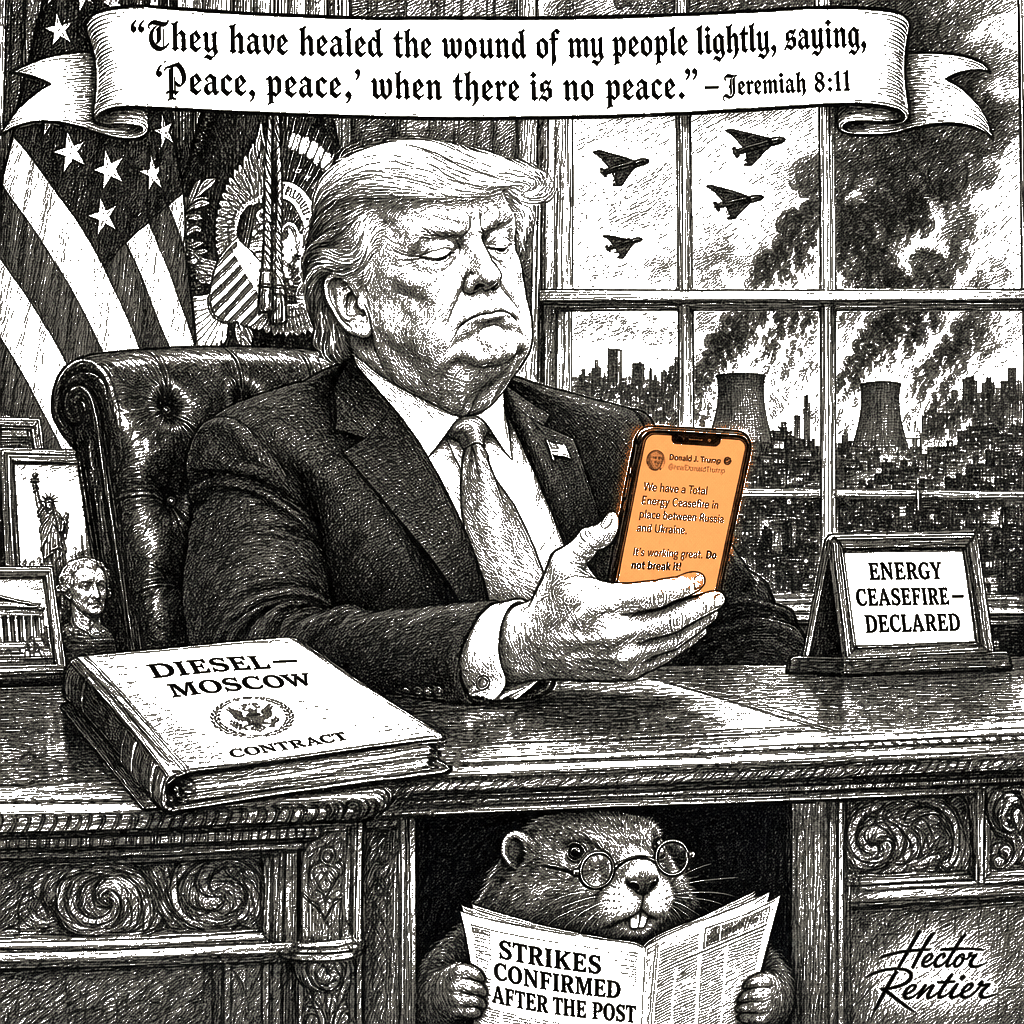
President Trump announced a ceasefire on Sunday. Russian drones struck a Ukrainian power plant the same evening.
The announcement itself was two sentences on social media: the energy ceasefire had taken effect immediately, and — this was the whole of the architecture offered to a four-and-a-half-year war — “Do not break it!” Moscow did not comment. Not a denial. A silence. And inside that silence the Russian army hit a power plant in Kharkiv. Ukraine’s presidential office confirmed the timing: after the post. All day, President Zelenskyy said, the Ukrainian skies were full of Russian shaheds, glide bombs, strikes on energy infrastructure. The ceasefire, in other words, exists the way a promise exists when only one person has heard it. The prophet Jeremiah named this exact thing: “They have healed the wound of my people lightly, saying, ‘Peace, peace,’ when there is no peace.” Announcing a truce over a country still under bombardment is not peace. It is the word. And the people who will pay if the word is empty are not in the room where it was spoken.
They have names and addresses. In Zaporizhzhia on Saturday, a Russian bomb killed twenty-three people. Four of them were children. More than thirty were wounded; eight are still in the hospital. In Kharkiv, men and women went to work the night shift at a power plant — the people who keep the heat and the running water moving while the missiles fly — and a missile found the building. Russia’s deliberate campaign against Ukrainian power, heat, and water, designed to freeze a civilian population into submission, is not strategy. It is cruelty aimed at the body of a people, and Vladimir Putin is responsible for every kilowatt-hour it has darkened. I say that without flinching. And I say it knowing that a Russian man is dead tonight in the Bryansk border region from a Ukrainian drone, and that the word for his body is also body, and the grief over him is also grief.
Which is the confession this column owes before it names anything else: my own country is inside this. On Friday, the United States struck a deal to buy diesel from Moscow. Ukrainian and European officials said plainly what such a deal does — it helps pay for the war effort. The same administration that announced the ceasefire has spent weeks pressuring Ukraine to stop striking the Russian refineries that fund that war effort, and has blamed Ukraine for record diesel prices at American pumps rather than the American-led war in Iran that drove world energy prices up. We are not neutral parties delivering a truce from above. We are buying fuel from one army, telling the other army to stop hitting the refineries, and calling the arrangement peace. That entanglement does not disqualify American diplomacy. It does mean the first honest step is to stop pretending we stand outside the ledger. The diesel money is a thread, and it runs from American gas stations to the budget that buys the shaheds. The claim was made public two days ago; the thread has not been cut.
The just-war discipline applies to my own sympathies here too, and I will not skip it. Over the past four days Ukrainian drones took three Yandex data centers off the grid — Ryazan, Kaluga, Vladimir — and the outages reached into Kazakhstan, Belarus, and Armenia. A taxi driver in Moscow canceled rides he could not complete. A shopper’s screen went blank. One resident said it affected healthcare and everything else, that this was not about convenience. I understand the pressure that produces those strikes. I also know what the tradition I write from asks when a drone disables the digital backbone a hospital runs on: whom does this kill, and is that whom a combatant? A glide bomb on a Kharkiv power plant and a strike that blacks out Moscow’s pharmacies are not morally identical — the scale and the intent differ, and they differ in Ukraine’s favor. But neither one passes as clean. I will not call the second one leverage. It is more war, extended to more people’s kitchens, and the Catholic just-war inheritance requires more scrutiny when the target is civilian-linked infrastructure, not less. Zelenskyy himself has catalogued what continued — including his own country’s strikes — with a candor some of his admirers lack.
A ceasefire that deserves the name would stop on both sides. It would be verified rather than announced. It would leave Ukrainian and Russian civilians able to keep their heat, their water, their children, their pharmacy shelves. Zelenskyy has put Ukraine’s half on the record — readiness to refrain from striking Russian energy infrastructure, waiting on the same from Russia. That offer costs Ukraine something, since those refinery strikes are working, and it was made anyway. Vladimir Putin, you have answered every de-escalatory proposal with one word. You still have a different word available, and the people standing outside your decisions are as much yours as the ones standing outside Kyiv’s. Mr. President, a ceasefire you declare is worth exactly what the other party’s compliance makes it worth; pressure applied only to the army that is losing civilians is not pressure for peace, and diesel contracts signed in the same week are not the tools of it. Both of you can still put the weapons down. That door has not closed, and I will not write as though it has.
Pope Francis said what every person of good will already knows and no communique can improve on: war is a defeat. Every war is a defeat. This week added twenty-three dead in Zaporizhzhia, four of them children, a power plant burning in Kharkiv, a man dead in Bryansk, and an announcement with no agreement behind it. The Kharkiv plant will be repaired. The four children will not come back. That is the arithmetic, and no ceasefire declared over their graves changes it. Say the word if you mean it, and then hold it on both sides. If you cannot hold it, stop saying it — because the wound of a people is not healed lightly, and the peace that is only a word leaves the dead exactly where they are.