
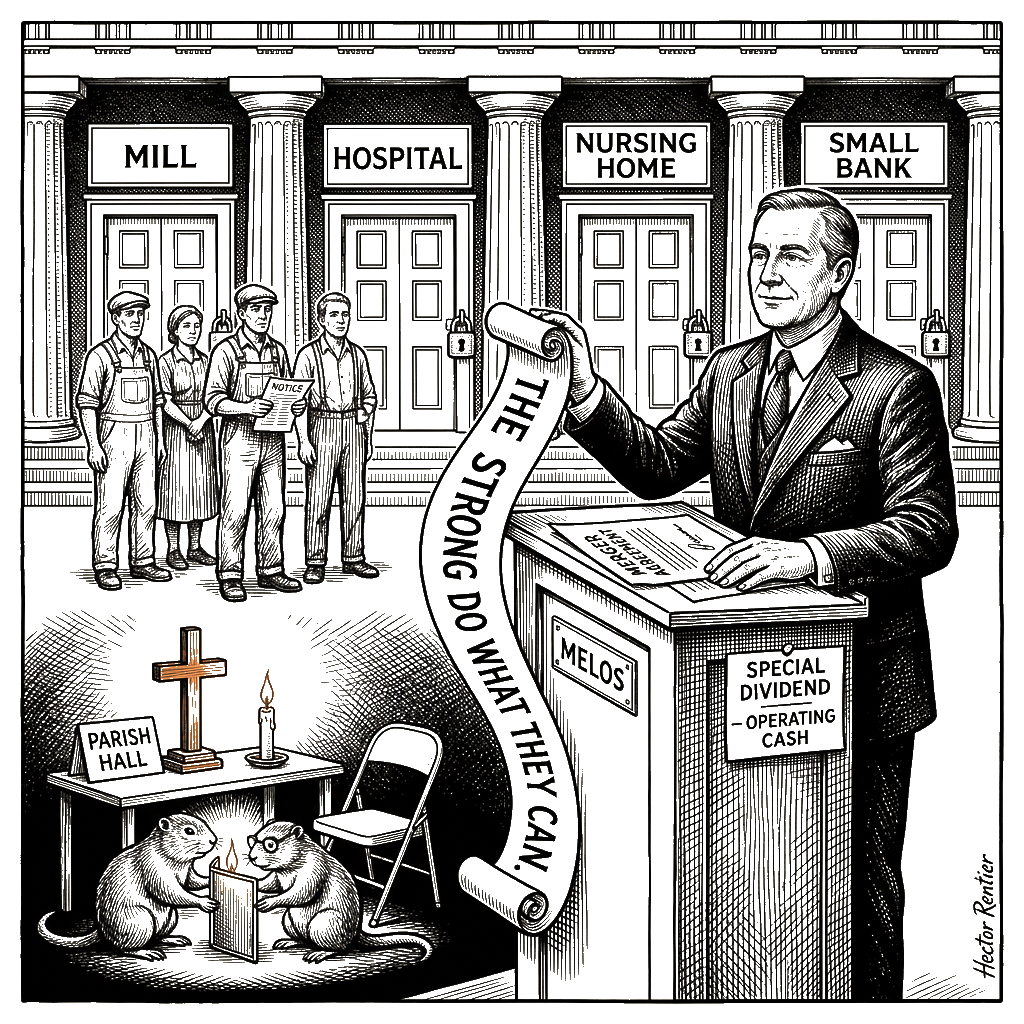
The country that built the mill on the bend of the river, and the parish that buried four generations in the same plot, did not teach the virtues the Secretary of State glorified from the Acropolis last week. The right once said it stood for those virtues. In a column this month, William Galston of The Wall Street Journal argues that Marco Rubio’s Athens speech was missing its necessary Hebrew counterweight — the humility of Moses, the Sermon on the Mount, the religious virtues that curb Athenian fire — and that without them what remains is a pagan nationalism the West cannot long survive. The Republican Party that built its modern identity on the defense of Judeo-Christian civilization has, in the hour of its ascendancy, laid that civilization down and enthroned in its place what the Greeks called thumos: the fire of passion, pride, and unapologetic national assertion. Galston is right about the religious absence. He is wrong that it is new. This is the honest confession of a politics that has always worshipped thumos and only lately stopped pretending to worship anything else — a politics whose fierce individuality closed your mill, bought your hospital, and sold your town’s name to a buyer who will never set foot there.
Concede him the central point, since it is the only point worth conceding. Galston takes Rubio to Athens and notices that he stops the history at the Melian Dialogue. Fifteen years after Pericles’ funeral oration, Athens demanded the neutral island’s submission, mocked its appeal to justice, and told it that the strong do what they can and the weak suffer what they must. Hubris is the Greek name for the disease the Athenians eventually died of in Sicily — drunk on the funeral oration, forgetting that daring is not prudence and that pride has a shelf life. Proverbs knew it before Thucydides finished: pride goeth before destruction, and a haughty spirit before a fall. The religious instinct that named hubris a sin was not, contra the secular university, a sentimental attachment to humility. It was the long memory of civilizations that burned themselves up. The lesson is not obsolete. It has never been more on display.
But here is the conservative objection to Galston’s diagnosis: Rubio is not breaking with the Republican tradition. He is finishing a break the party began when it traded its inheritance for power. The religious right of the late twentieth century — the coalition of Moral Majorities and Christian Coalitions that claimed to defend the family, the parish, and the altar — held its ground, when it held it at all, by recruiting Jerusalem as a restraint on thumos. The tables of the law, the humble Moses, the Sermon on the Mount: these were the counterweights to the unfettered will. To know them was to know that greatness includes the capacity to be answered, to be held to account, to kneel. The party that built itself on that coalition has now dispensed with the counterweight. What remains is the funeral oration — and the Melians — and the Treasury Secretary telling Canada, “I don’t think you can be in a tit-for-tat with someone who’s 13 times larger than you are.” The strong do what they can. In form if not in vocabulary, it is the Melian Dialogue. It is also, in form if not in vocabulary, the operating manual of the leveraged-buyout shop that descends on a county seat and extracts what can be extracted. Rubio honored the god of the trade. Galston heard only the speech.
There is a more honest version of Galston’s case, and he flinches from it. The same fierce individuality Rubio celebrated in Athens is the fierce individuality that bought the regional hospital, sold the nursing home, and dissolved the small bank — and called the wreckage creative destruction. I used to trade corn futures on a Chicago desk in the spring before the crop was planted. The Greeks would have understood the position. Thumos on the buy side: the conviction that you can see what the next man cannot, the willingness to lever on the conviction, the readiness to bankrupt the position if the conviction fails. The trade works for the man at the desk. The trade does not work for the farmer who planted the seed before the price was set, and it does not work for the town whose hospital was levered the same way. The private-equity fund that buys a hospital, levers it to the hilt, and pays itself a dividend out of the operating cash is acting in the spirit of the Athenian envoy at Melos. The chain that buys a regional grocer and strips the inventory is acting in the same spirit. The family that cannot afford to live in the county where three generations are buried is what the weak look like when they suffer what they must. Athens is not a foreign country. It is a desk upstairs. It always has been. The Acropolis speech was not a departure from this conservatism; it was its long-suppressed honest utterance.
The conservative suspicion must extend both ways. The thumos that hunts the Melians is the same thumos that writes the merger agreement, and both dissolve the local. The state that centralizes is the mirror-image failure: the consolidated hospital system, the federal mandate that bypasses the parish and the town, the uniform administered from a distance that has never seen the place — these are thumos too, dressed in universalism. Galston’s liberal pluralism is not the corrective; it is another abstraction owned by people who will never set foot in the place. Concentrated capital and concentrated state power are the same species under different vestments, and the conservative instinct is to suspect both and to defend the local institution against either.
A word on Christian nationalism, because the temptation will arise. Rubio’s speech is not the Christian nationalism the secular mind fears; it is the alternative to it, and a worse one. But the alternative to pagan nationalism is not Christian nationalism either. It is the religious ground held in persons and parishes, not in nations. A nation cannot be Christian; only a person can, and only with difficulty. The altar belongs to the parish, not the Capitol. The restraint of thumos must be local, voluntary, and rooted — and when the state imposes it, what was religious becomes ideological and dies.
Let Galston have what is his. He is right that the religious inflection has drained from the right. The ministers of the country congregations know it. When Rubio quotes Thucydides with no Proverbs to balance him, something genuinely has been lost — and not only the religion. Jerusalem, in a serious reading, is not a Sunday-morning affiliation. It is the binding obligation of the steward to the place he has been given, the refusal to extract what cannot be replenished, the rule that the strong owe something to the weak not as charity but as a constitutive limit on the strong’s power. Without that, the right’s talk of family and community is what it has always been when stripped of the binding obligation: a campaign garment. The family-values movement that immiserates families. The local-control party that hands every Main Street to a rollup fund. The Judeo-Christian civilization that closed the mill and called it progress.
What survives, then, is not a program. It is a posture — and a few stubborn things. The credit union that knows its members by name. The cooperative elevator that buys the harvest at a margin the family can live with. The mutual that insures the barn. The parish that buries the fourth generation and the first, and asks restraint of them in life. The county hospital owned by the county. These are not metaphors; they are slow, unglamorous, and they do not photograph well against the Parthenon. They are the thing that centralizes nothing, and the thing that roots a person in a place and asks him to be answerable to his neighbor, because his neighbor is the one he will see on Sunday. They are what is left of a country when the Athens-only program finishes what it has already begun in the rural counties and small cities the right once claimed, in its better moments, to speak for.
Nate Hochman saw it in 2022, and Galston sees it now. They are right that the religious right declined. What they miss is that the local institution — the small thing that holds a place — was the thing the religious right was supposed to be defending, and was, in fact, the thing it sold. The work of an age that has stopped believing the strong owe anything to the place they take from. The Acropolis is loud. The altar in the parish basement is small. The small thing was always the point.