
Hoskins backed down. That is the story.
When Missouri Secretary of State Denny Hoskins tried to override the state Supreme Court’s order to restore the old congressional map, Chief Justice Brent Powell did what the Missouri Plan was built to do. He made the elected official show up, explain himself, and submit. Fourteen Republican legislators answered by threatening to impeach “responsible members of this Court” for “willful neglect of duty, incompetency and misconduct.” The court held Hoskins in contempt anyway. Hoskins folded. The ballots went out under the map the law required.
That is not a system in crisis. That is a system doing the job.
The Missouri Plan has been here for eighty-six years. Missouri voters enshrined it in 1940 to take judicial selection out of the hands of party bosses who had been trading judgeships for patronage. Within two years those bosses put a repeal on the 1942 ballot, and voters defeated it decisively. In 2007, the conservative activist Leonard Leo tried to talk Republican Gov. Matt Blunt into rejecting a Supreme Court slate the commission had produced; Blunt refused and picked one of the three. In 2012, GOP lawmakers put a governor-pick overhaul on the ballot that would have given the governor more control; it lost by a three-to-one margin. The system has become a model for some two dozen other states.
Now the third assault is on, and the attackers have made the same mistake every prior attacker has made. They have confused being outvoted with being outflanked.
The new grievance is the redistricting map. Republicans redrew Missouri’s congressional districts mid-decade at President Donald Trump’s urging to give the GOP a shot at seven of the state’s eight seats instead of the six it holds. Voters gathered enough signatures to force a referendum, and that put the new map on hold. Hoskins tried to keep the referendum off the ballot. The Supreme Court overruled him and ordered the old map restored until voters decided on the new one. Hoskins, citing a federal court ruling that contradicted the state’s highest court, directed officials to use the new map anyway. That is when Powell summoned him to show cause. The summons was the court’s answer to an official who had decided that a federal district judge’s ruling outranked his own state’s highest court. The court held him in contempt. Hoskins reversed course and the old map went out. The system held exactly where it was forced. Our prior reporting followed the contempt summons from its issuance through the district confusion that the eventual reversal left behind.
The Hoskins episode triggered the loudest round of repeal talk the system has ever heard. U.S. Rep. Jason Smith called for popular elections. Republican Party executive director Miles Ross declared on X that “The Missouri Plan is done.” Dan Seitz, chief of staff to Sen. Brad Hudson, called for replacing the system with a structure in which the governor could nominate judges directly, subject to Senate confirmation. State Rep. Cathy Jo Loy of Carthage — who has introduced such a bill in each of the past two sessions — said she intends to file a new one on Dec. 1, the first day lawmakers can file bills for next year’s session. Senate President Pro Tem Cindy O’Laughlin proposed replacing the system with a nonpartisan election; her bill stalled in committee. Gov. Mike Kehoe complained on X about “unelected judges,” then admitted on a radio show the next day that changing judicial selection “hadn’t even been on my radar” before the court’s ruling; he has now decided it is something “a lot of people are going to start asking about.”
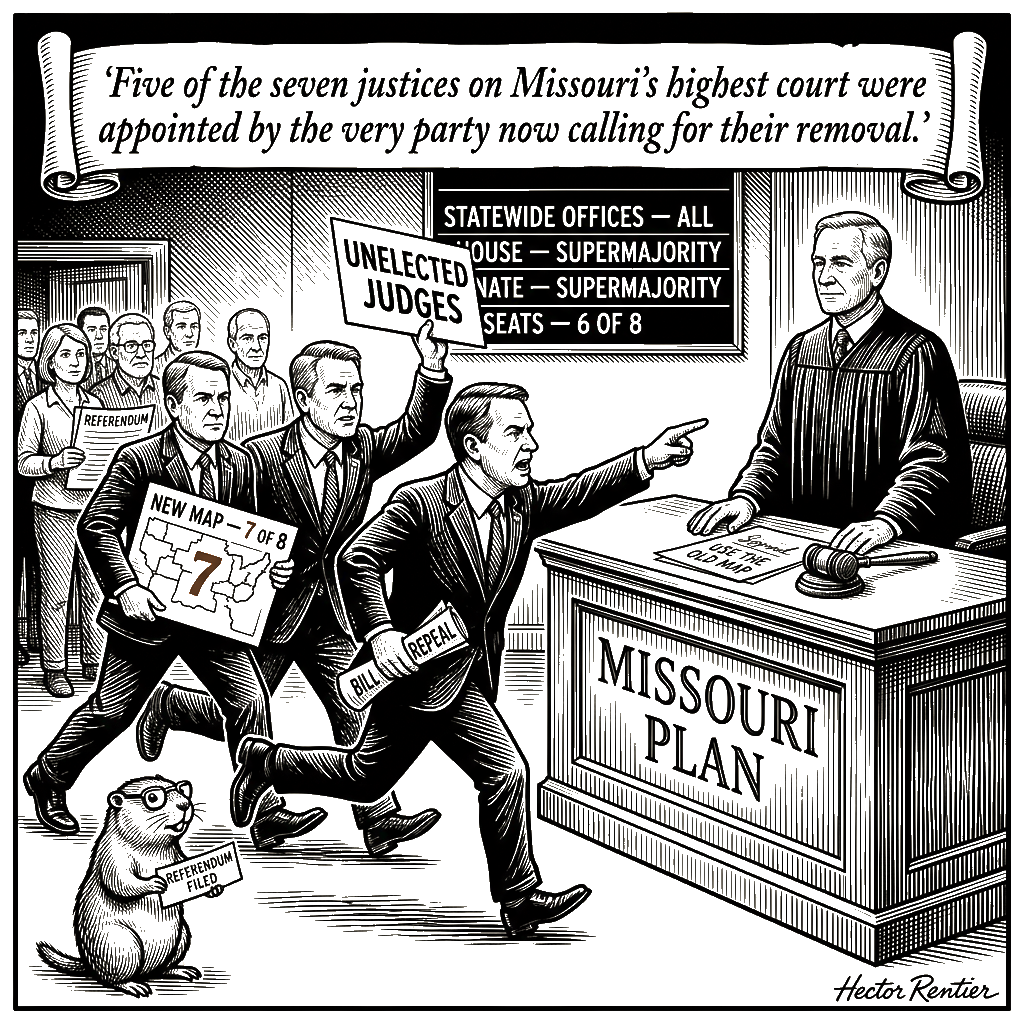
Read those quotes. The party writing them holds every statewide elected office in Missouri, supermajorities in both chambers of the legislature, and six of the state’s eight congressional seats. They tried to gerrymander a seventh seat, and voters forced a referendum, and the courts said use the old map. Now they want to fire the umpires.
And here is where the attack turns into an indictment of the attackers. Five of the Missouri Supreme Court’s seven justices were appointed by Republican governors. Powell himself — the man now defending the commission’s independence — was hailed by the then-chair of the state party as a “good conservative” before Republican Gov. Eric Greitens selected him in 2017. The “unelected judges” Kehoe complains of are, by the count that matters, his own party’s appointees.
The design is the defense. Three lawyers elected by lawyers in each appellate district. Three non-lawyers appointed by the governor. One Supreme Court judge chosen by the court. The governor picks from a three-name slate. Then judges face retention votes every twelve years. The commission was tilted toward the governor’s preferences by design, and the governor appoints three of its seven members outright.
This is not a liberal court defying a conservative state. It is a court majority appointed by the same party now demanding its scalp, ruling that the law still applies when the law inconveniences the ruling party’s map. The system cannot be indicted as captured without indicting the Republican Party’s own nominations.
The tragedy of these attacks, from the attackers’ perspective, is that they are exposing the strength of what they want to destroy.
But the threat is not nothing, and the defenders know it. Ed Dowd, the former U.S. attorney who for two decades has helped lead the Citizens for Missouri Courts, said the group “becomes most active when the system is under threat.” His St. Louis-based firm, Dowd Bennett, recently contributed $100,000 to the campaign. That is what defenders look like when they smell a real fight. Powell, on Sept. 17 at the joint annual meeting of the Missouri Bar and the Judicial Conference of Missouri, made the case explicit: “It is incumbent on all of us as lawyers and judges to rise up and defend our constitutions and the rule of law.”
The opponents are reading the room badly. Peverill Squire, a professor emeritus of political science at the University of Missouri, doubts the votes exist to put a repeal on the ballot in the first place; some bills might get hearings, he said, “but my guess is there probably won’t be enough appetite among enough Republicans to really want to put it on the ballot.” Loy herself acknowledged how hard it would be after the party’s recent losses at the ballot box. That is the catch the attackers keep forgetting. The Missouri Plan is not a statute. It is a constitutional choice made by the people, and the people have already made it three times in 86 years. The system’s structural advantage is the voters’ memory, and the voters’ memory is longer than any legislative session.
So the opportunity is not to treat this as a defensive holding action in committee rooms and ballot-question campaigns. The court’s ruling on the map did two things at once: it preserved the 2026 election under fair district lines, and it handed the system’s defenders a campaign issue that has nothing to do with judges and everything to do with whether the people who lost get to redraw the lines. Missouri voters confronted district confusion this fall precisely because powerful people tried to redraw the lines after losing. That confusion is now a story with a villain, and the villain is on record trying to fire the court that stopped him.
Treat this round, then, as the public’s introduction to what the Missouri Plan actually does — a recruiting year, not a rear-guard action. The Missouri Plan takes the selection of judges out of the hands of party bosses and gives it to a commission of lawyers and laypeople appointed through both branches. It makes retention elections the only direct check voters have on appellate judges. And time and again, when lawmakers tried to limit voters’ ballot-initiative power, the courts rewrote ballot summaries they found unfair or misleading and forced the measures back on the ballot — including the initiative that ultimately established abortion rights in 2024. The system has been doing its job in plain view.
The attackers, meanwhile, keep doing the defenders’ work for them. Hoskins revealed himself. The fourteen lawmakers revealed themselves. Kehoe revealed himself. Smith, Ross, Seitz, O’Laughlin, and Loy revealed themselves. They did the work the Missouri Plan’s defenders have never been able to do on their own: they showed Missouri voters, in real time, exactly why the plan exists. Hoskins did not need to be summarized. He needed to be shown doing what he did.
The defenders’ job is now bigger than a $100,000 donation and a hearing schedule. They need to make sure every voter who watched this fall’s redistricting chaos knows whose signature is on the gerrymander the courts had to overturn. They need to make every repeal hearing a referendum on the people writing the repeal bills, not just the bills themselves. And they need to found a coalition that carries the Missouri Plan’s logic of judicial independence out past the courthouse — to the ballot initiatives and the other instruments of direct democracy the courts have defended all year.
The Missouri Plan is not under attack because it is failing. It is under attack because it just stopped the most powerful people in the state from doing what they wanted to do. That is what it was built for. Now make every Missourian know it, and build something larger than what the attackers are trying to tear down.
The Missouri Plan was never popular with the people who momentarily run things. It was built so it would not have to be.