
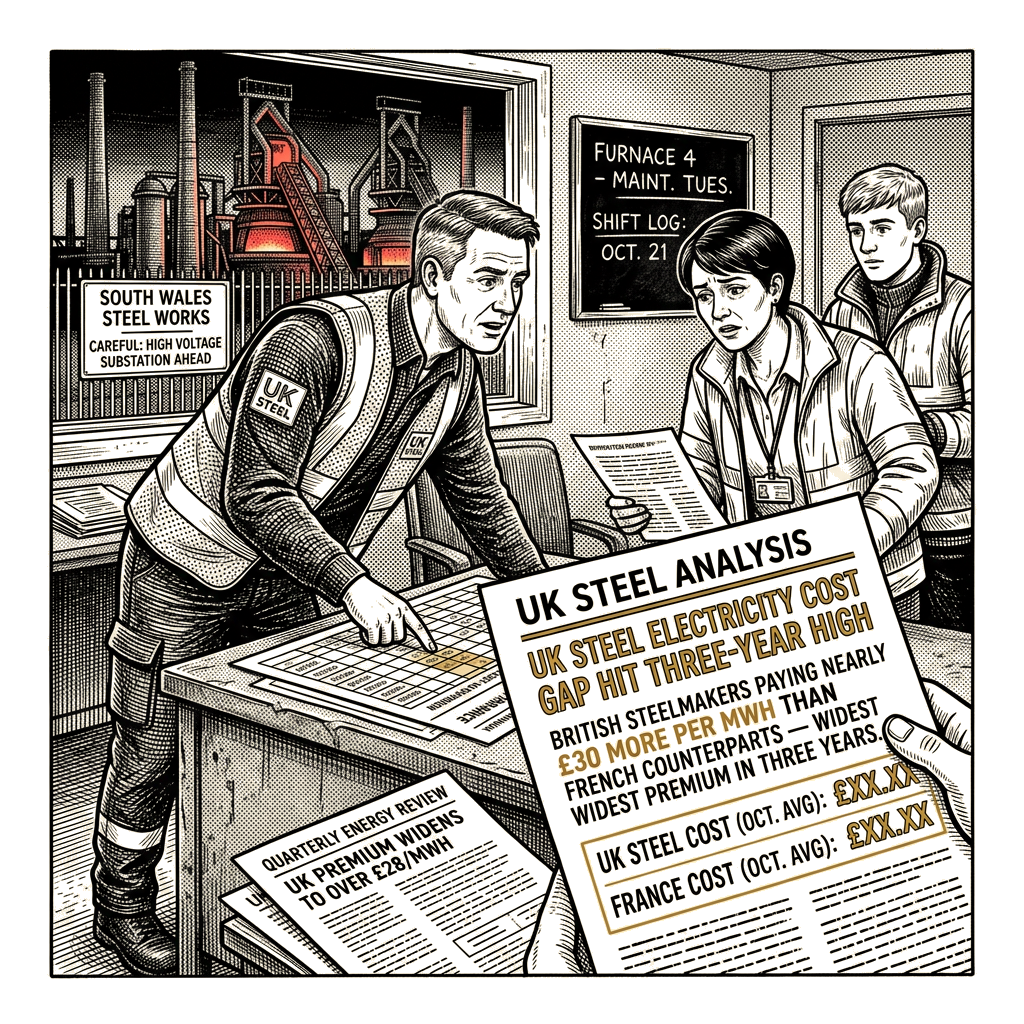
I write this from a steel town. From Scunthorpe, where the blast furnaces still smoke and the night shift still walks in. We are watching the last of it priced off the map, and the killer has a number: £30 a megawatt hour. That is what our mills now pay over their French rivals — the widest gap in three years, and widening fast.
The arithmetic is obscene. That premium, multiplied across what a basic oxygen furnace and an electric arc furnace consume, is the difference between a steel plant operating and a steel plant idling. This is not a market. It’s a punishment.
The mechanism is not mysterious. Britain prices its grid on the marginal-cost rule: the most expensive generator sets the price for every electron delivered — including the wind and solar that cost almost nothing to generate. France runs on reactors. Germany still leans on coal. Britain chose gas. When wholesale gas spikes, the British price spikes with it, even when British wind is generating freely. France’s grid is insulated. Britain’s grid is exposed. And it spiked: Iran’s closure of the Strait of Hormuz, in response to America’s bombing campaign, sent gas higher still. Cornwall Insight projected a 16% rise in the energy price cap earlier this month, and every furnace in the country ate that forecast as a cost increase. The mills are paying more. The French are paying the same as last month.
The premium is a history lesson. It hit £153 per MWh in 2022, when Russia invaded Ukraine and gas went thermonuclear. That was the moment the country should have acted. Last year the gap fell to £18 — the narrowest in years — and ministers ran a victory lap. It is now almost £30 against France, and roughly £12 against Germany. Three years on from the last gas shock, with the same exposure and no new shield, Britain is repricing its own manufacturing out of Europe.
Three-quarters of British steel crosses the Channel on the way out of the country. £3bn a year. The customers are French, German, Italian, Spanish fabricators who buy British slab because — until recently — British mills could compete on cost. They cannot now. Lost tenders first. Then closures. Then imports. Then no domestic supply chain for the wind turbines, the rail, the bridges, the cars, the white goods, the defence platforms the government keeps claiming it wants to build in Britain. We lose a customer to ourselves.
The lobby has put a number on the answer: £51m a year for a price cap that triggers above a threshold and claws back when prices fall below. £51m. Less than one consultancy contract to design the scheme that would not be needed if ministers simply wrote the cheque. A rounding error against anything else the Treasury has touched this fiscal year. The reason the cap is not in place is not money. It is political will.
The government will say it has done something, and it will be partly right. Ministers have stripped policy costs out of heavy industry’s electricity bills, announced a 25% reduction for more than 10,000 manufacturing businesses, and put roughly £1bn a year in cuts toward the most electricity-intensive users. Those are real. They are also visibly not enough. The £30 premium persists. The three-year high persists. Andy Burnham, who has been warning about exactly this bill for weeks, is right: reindustrialisation without an industrial electricity price is a slogan. This week’s 100,000-workforce “jobs plans” for eight growth sectors are a poster. Which of those sectors uses electricity? Every one. Which of them gets powered by gas? Too many. This problem does not go away by being announced elsewhere.
There are two answers, and only two. Build cheap renewables at scale. Or directly subsidise industrial electricity. Britain has the wind resource. Britain has the offshore shelf. Britain does not have the planning and grid-connection regime capable of delivering the gigawatts required in the timeframe required. That is a choice. It is a choice to keep the gas exposure. It is a choice to keep the £30 premium. Renewables are the right answer for 2031, 2032, 2035. Subsidies are the right answer for next quarter. We are out of next quarter.
The mills are running. The lads are on shift. We are still here. But the price of the choice already made is paid in Scunthorpe, in Port Talbot, in Teesside, in every furnace running on a grid that was rigged, by design and by default, against them. The premium widens. The export book shrinks. The workforce thins. The ministers speak of reindustrialisation. The grid sets the price of every promise they make.
Build the renewables, do the nuclear, sign the CfDs till your fingers cramp. But do it now — before there is no British steel left to power when the turbines spin up.