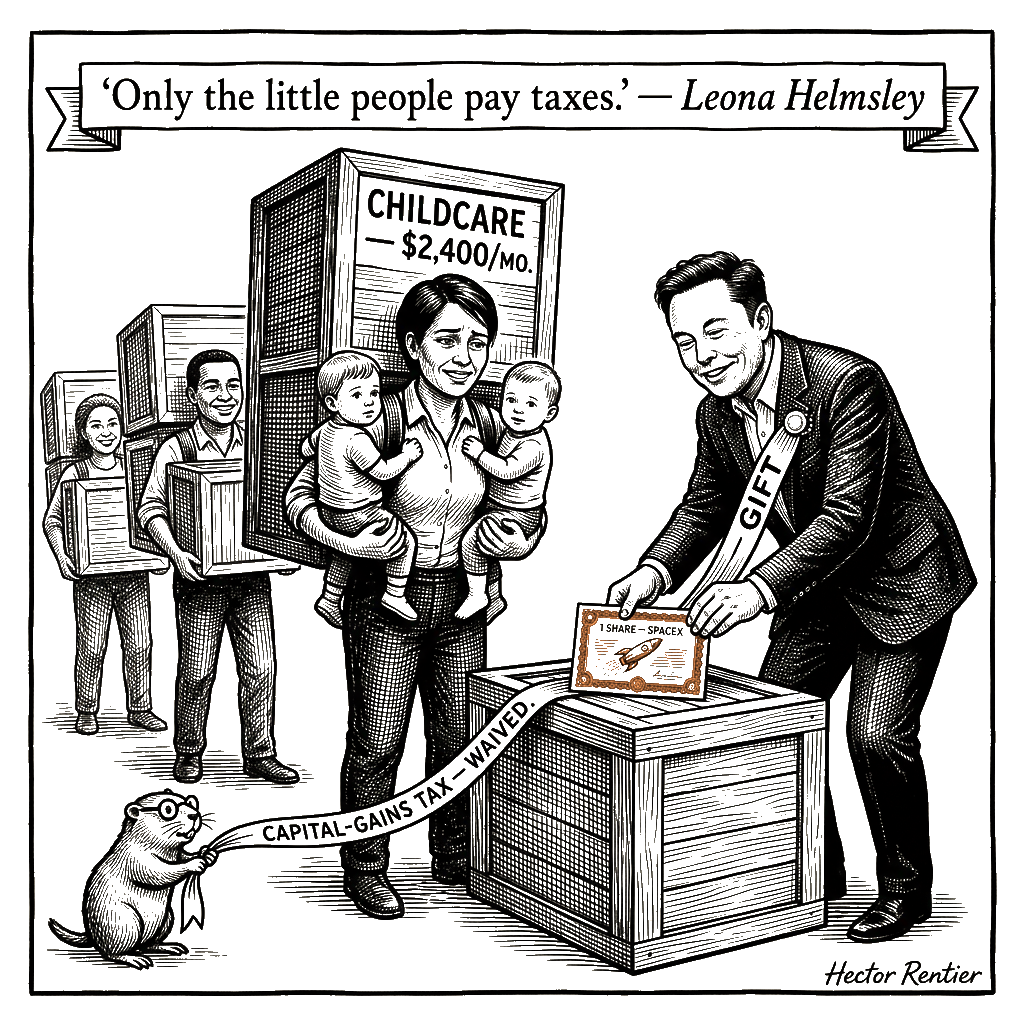
Elon Musk is using America’s children as a tax shelter and calling it a gift. The announcement came Monday morning: one SpaceX share for every child in the country — seventy-three million of them, about $10 billion at Friday’s $146.03 close. I will concede the number is real, and a share of SpaceX could be worth more someday; my own two children might even benefit. But the design around it — the capital-gains waiver, the five-year lockup, the rule that families cannot refuse — tells you whose interest it serves. It is not the children’s. The donor gets the tax break, the story, and the legacy. The public gets the foregone revenue. The family gets the risk. And the only approved response is gratitude.
Here is the kitchen-table version. If the pledge comes through, my four-year-old and my one-year-old each get a share worth something like Friday’s $146.03. Put that next to the childcare bill — $2,400 a month for the two of them — and one share is about a day and a half of daycare. It is not a college fund. It is one share of one private company, chosen by a donor nobody in this house picked, that I cannot sell for five years and cannot refuse. My children are being made captive shareholders in a company they did not choose. An inheritance is something you can accept or walk away from. This is a compulsory bet on a rocket company, written on my children’s names, in an account I cannot touch — and the gratitude is owed in advance.
Then ask who built the rails. The Treasury is auto-enrolling tens of millions of children in the government’s Trump Accounts program. Last month it set rules enabling wealthy donors to contribute stock while skipping capital-gains taxes, in a form families cannot refuse, locked for five years. The Treasury has said, on the record, that donors were more interested in giving if the children were invested in a particular company rather than a broad index fund. Read that sentence again. The children’s portfolios are being designed to suit the preferences of the people writing the checks. Whose children, whose risk, whose escape hatch? The child gets one share of one company she did not choose. The parent gets the obligation to smile. The billionaire gets the tax break, the story, and roughly ninety-nine percent of the fortune — more than $900 billion by the Journal’s count, the fortune that made him the world’s first trillionaire when SpaceX went public last June — stays right where it was.
If the goal were to give every child a stake in the country, there is a democratic way to build it. Tax the concentration — a real wealth tax, an estate tax that functions, a capital-gains regime that does not evaporate when a donor’s name lands on a child’s account — and fund every child’s account from general revenue, in a broad index fund, managed as a public trust, with the same rules for every child. No billionaire’s signature required. No single company’s stock. No donor choosing the portfolio. That would be a baby bond. This is a tax shelter wearing a children’s face, and the giveaway’s whole job is to make the shelter look like generosity.
Here is the same man in 2021. David Beasley, who then ran the World Food Program, made a public case for $6 billion to keep 42 million people from dying of hunger — not complicated, he said. Musk answered that he would need a demonstration first, proof of how the money would resolve the crisis. The record does not show the check landing. Six billion for the starving: prove it. Ten billion in stock for children’s accounts: the Treasury wrote the rules, waived the capital-gains tax, made the donation unrefusable, and the message to families is thank you. The difference between those two responses is not generosity. It is structure. The first would-be gift needed an audit. This one needed a Treasury rule.
The religious teaching I grew up with had a test for charity, and it was not whether the giver felt generous. Feed the hungry. Clothe the naked. Shelter the homeless. Visit the sick. Almsgiving costs the giver; that is what makes it almsgiving. A stock donation that skips the capital-gains tax, locks the child in for five years, and leaves the family holding the risk of a single private company does not cost the giver. It costs the wrong people.
There is a song for this, and its title is the most honest sentence in American child policy: “You’re On Your Own, Kid.” The line is not a lyric; it is the mission statement of our care infrastructure. Musk read it the way the tax code reads it: fine — you’re on your own, so here is one share of a rocket company, locked for five years, be grateful.
Seventy-three million children holding one share each while one man holds the other $890 billion is not wealth changing hands. It is wealth being staged — the government built the stage, the billionaire brought the stock, the children supplied the names, and the rest of us are the audience, expected to clap. I would rather my children inherit a country that taxes what it cannot justify than one that hands them a locked share of someone else’s fortune and calls it a future.