
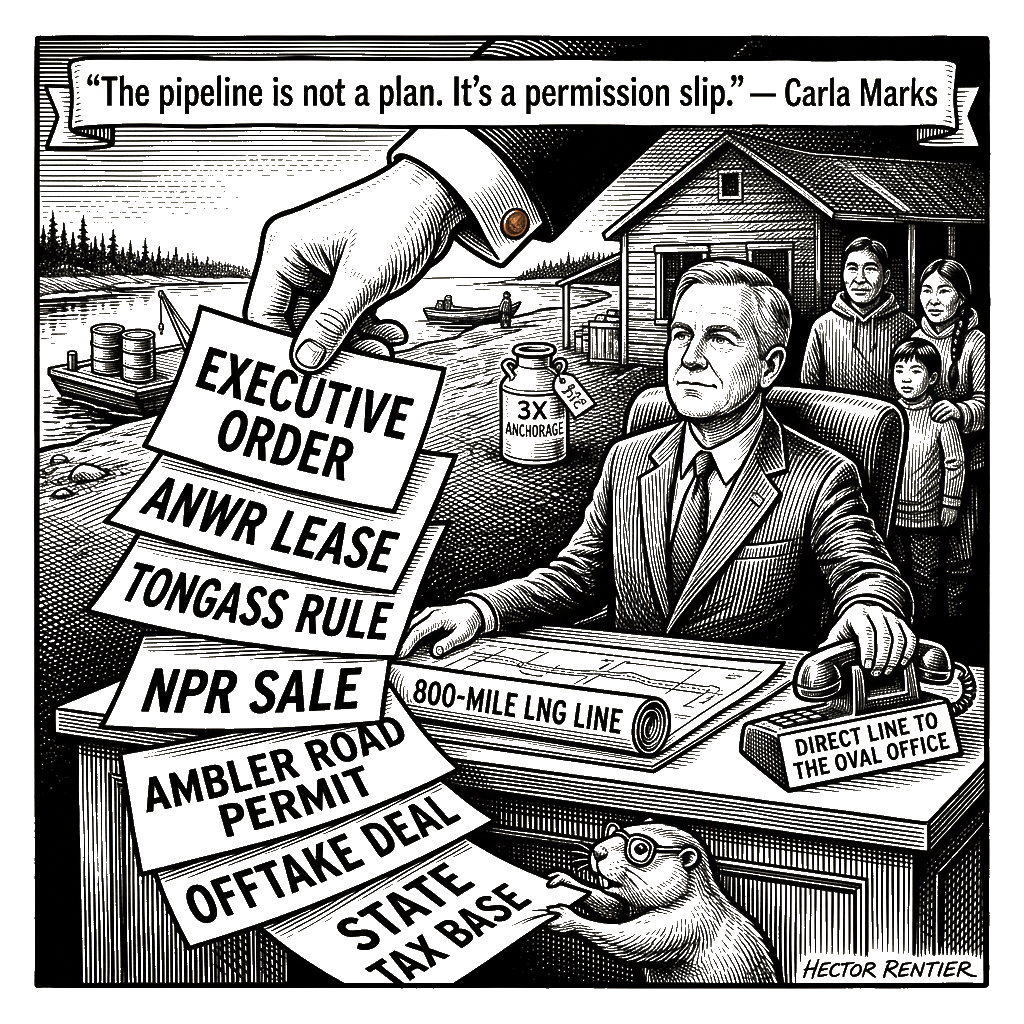
Last week at a rally in Alaska, President Trump made the pitch plain: vote Democrat Mary Peltola on November 3, and the 49th state loses its only senator with a line to the Oval Office. That is the load-bearing claim of Kimberley Strassel’s Wall Street Journal column, “Alaska Considers Economic Suicide”, which frames the Sullivan-Peltola race as a referendum on whether the state keeps its “special relationship” with the White House. Alaska’s economy, she argues, was strangled by seventy-plus Biden executive actions, saved by Trump’s reversals on Inauguration Day, and now hangs on a $50 billion Korean investment in a long-stalled LNG pipeline — a line run through Sullivan, the only Republican senator Trump trusts, since Lisa Murkowski voted to convict him in 2021. Peltola, meanwhile, voted with her party 90 percent of the time and missed 17 percent of her House votes. Lose Sullivan, lose Alaska’s line. That’s the argument. It has misidentified both the stakes and the lever.
Start with what Strassel’s column proves by its own facts. Biden issued more than seventy executive actions restricting oil and gas leases, mining, timber, fisheries, road-building, and military spending in Alaska. Trump rescinded or reversed nearly all of them — reopening the Arctic National Wildlife Refuge, holding a record lease sale in the National Petroleum Reserve, approving the Ambler Road mining access project, repealing the roadless rule on the Tongass, and pushing a real chance at an 800-mile liquefied-natural-gas pipeline. The column treats that reversal as proof Alaska’s economy works fine when Republicans are in charge. It actually proves the opposite.
If your state’s economic future rises and falls on whether the current president personally likes your senator, you do not have an economy. You have a favor. Trump can rescind every order Strassel celebrates the day he leaves. The next Democratic president can lock the same acreage back up. ANWR will be locked up again. The Tongass will be roadless again. Alaska’s treasury, payroll, and tax base will swing with every change of administration. The cycle repeats every four to eight years until Alaska decides that prosperity built on executive action is no prosperity at all.
This is why the pipeline illustrates the fragility rather than the fix. Strassel calls it “tantalizingly close.” It has been tantalizingly close for decades, and the reason is not that the state keeps electing the wrong senator. An 800-mile line through Alaska requires capital, global LNG prices, roads and skilled labor along the route, federal permits, federal land access, federal lease sales, federal regulatory streamlining — and an offtake deal from Asian buyers who can purchase Australian or Qatari gas more cheaply than most American projects. That is a single tube balanced on half a dozen decisions, any one of which can kill it, none of which a senator controls. No Sullivan phone call changes that arithmetic. The pipeline is not a plan. It’s a permission slip.
Strassel is right about real things. Biden’s restrictions were a genuine headwind, and they cost Alaska jobs, revenue, and time. Peltola voted with her party most of the time. Sullivan has used his seat to push the federal apparatus back, and the ANWR reopening, the NPR lease sale, and the Ambler Road approval are concrete decisions that materially help specific Alaska projects. Executive action has moved. That is a true point, and it deserves conceding.
But the column mistakes a temporary tailwind for an economy. And it treats Sullivan’s status as Alaska’s “line to the presidency” as the state’s asset when it is the state’s vulnerability. A state whose prosperity depends on one senator’s personal relationship with one president is not a partner. It’s a client. Meanwhile the problems Alaskans actually live with don’t move on that line at all. Strassel notes prices “even higher” than in the lower 48. A gallon of milk in a roadless Interior or Western village often runs two or three times the Anchorage price, because the village has no road to anywhere and supplies arrive by barge twice a year. Sullivan can’t fix that with a phone call. Peltola couldn’t fix it with a vote either. Alaska’s high-cost problem comes from scale and supply chains, not from which party holds the Senate gavel. It is structural, and no ranked-choice “skullduggery,” no decoy candidate, and no senator’s standing with Trump touches it.
So what should Alaska build instead? An economy that doesn’t need a permission slip.
That means value-added industries that don’t depend on raw export through one pipeline: refineries processing Alaska’s own crude for in-state and Pacific marine markets, fish processing plants that capture value before the catch leaves state waters instead of shipping frozen fillets south. It means hydroelectric and geothermal power exports through the Panhandle to the Pacific Northwest, and data centers running on natural gas that would otherwise be flared off at oil wells. It means ports, rail, road, and broadband that serve multiple industries rather than a single extraction chain — infrastructure that drops the cost of moving a pallet from Bethel to anywhere. It means tourism marketed around what Alaska actually is — wilderness, fishing, dark skies — rather than subsidized by which party holds the White House. And it means a tax base that doesn’t require oil at ninety dollars a barrel to balance the budget, so the state can fund its own schools and services through whoever occupies the White House next.
The LNG project can be part of that future. The point is not to kill the pipeline. The point is to make Alaska’s prosperity clear the bar on its merits and its contracts — not because it sits at the intersection of one president’s pen and one senator’s phone.
Alaska’s choice in November isn’t really between Sullivan and Peltola. It’s between two versions of the same dependency: prosperity as a federal favor, or prosperity as a thing you build. Peltola will not fix that. Sullivan will not fix that. The first version feels easier. It isn’t durable. The only fix is a state economy designed to survive any of them losing.