A crown slipped down Ulises Hernandez’s throat during a dental procedure.
He was forty-one. He had Medicaid.
He waited eight hours in an emergency room and went more than two days without food.
David Valadao says there are no actual cuts.
That contradiction is not a communications problem. It is the election.
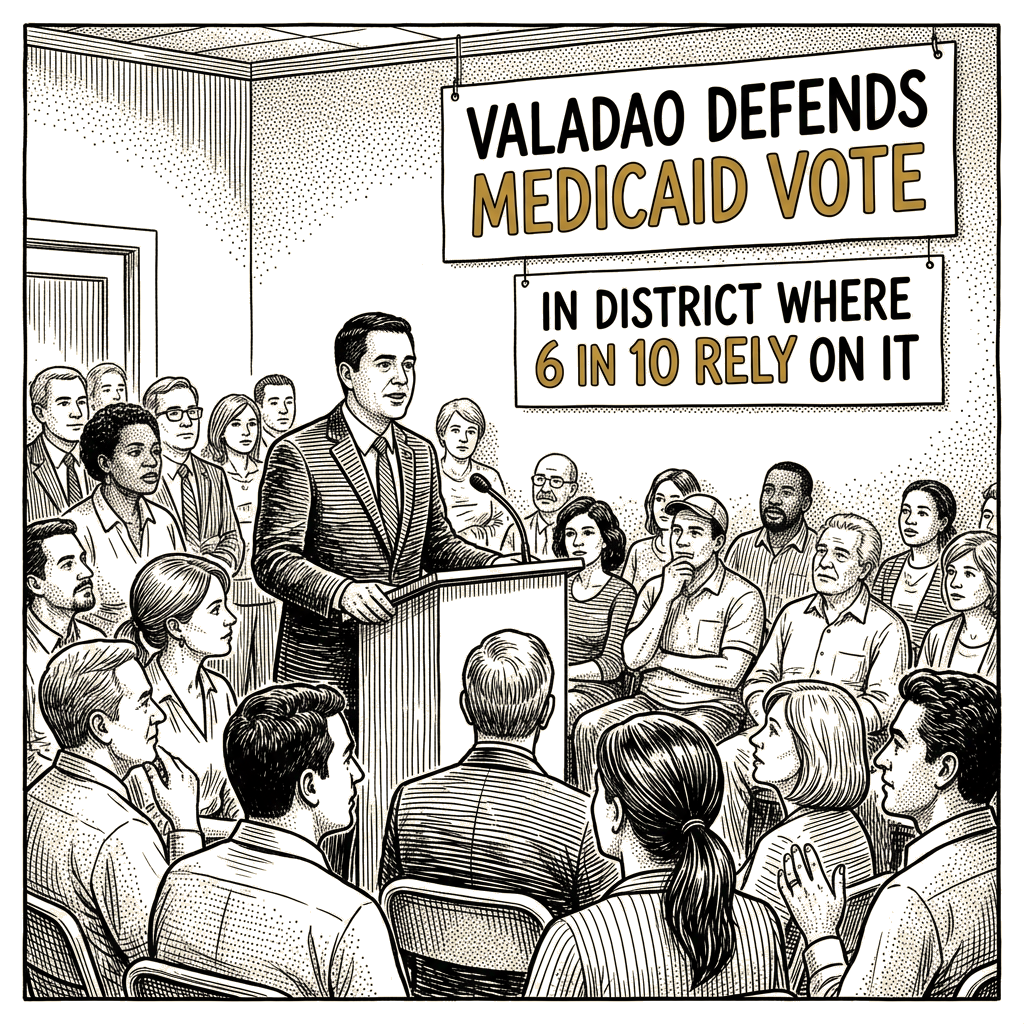
On October 6, Valadao defended his vote on the tax-and-spending law known as the One Big Beautiful Bill Act, declaring that “there are no actual cuts.” The law is expected to reduce Medicaid spending by more than $900 billion through 2034 through stricter eligibility rules, work requirements, twice-a-year eligibility checks and reduced federal funding to states.
Valadao says certain working-age adults on Medicaid will have to work, attend job training or perform community service. He calls this a way for adults to “put in and make a fair effort to try to cover their expenses and be a part of their community.”
Medicaid covers 62 percent of the residents of Valadao’s Central California district. The Center for American Progress estimates that another 60,000 district residents could be uninsured by 2034, factoring in both the tax-and-spending law and the expiration of enhanced Affordable Care Act premium tax credits. Researchers cited in the reporting estimate that the new rules will push more than 2 million Californians off their coverage while leaving the state short about $30 billion a year.
Those distinctions do not look the same from an examination room. They look like coverage disappearing because a patient failed a paperwork test, a state ran out of money, or an insurer found a technical reason not to pay.
Hernandez knew the difference before Valadao cast his vote. He had had Medicaid coverage for as long as he could remember. After the dental crown slipped down his throat, he spent eight hours in an emergency room waiting for care and more than two days without food. His wait came before the new requirements took effect. That distinction does not weaken his warning. He called the wait “a foreshadowing of what’s ahead.”
He arrived outside Valadao’s Bakersfield office in a wheelchair. He called the congressman’s vote shameful and said the new rules would only make waits longer. He plans to vote for Randy Villegas. He wants Valadao defeated and Congress to change hands.
Villegas is a political science professor, a former schoolboard member, and a candidate backed by Sen. Bernie Sanders. His campaign centers on Medicare for All and a single-payer universal healthcare system. During the October 6 debate, he argued that the United States pays twice as much as other countries while producing worse health outcomes.
Whether voters agree with him is beside the point. He has put an alternative before the voters. Valadao has offered a narrower defense: his vote did not cut coverage, and its work requirements represent a fair effort for adults to receive it.
Valadao has won six of his seven congressional elections. He has repeatedly turned a double-digit voter-registration advantage for his opponent into victory through his support for agricultural issues, water infrastructure, oil and a reputation for distancing himself from Donald Trump. He has done so since first taking office in 2012. He lost in 2018 after his Affordable Care Act repeal votes and his alliance with Trump became ballot-box problems.
California redrew its congressional map last year. The new Central Valley seat is considered more favorable to his challenger. Valadao is also the last House incumbent still running for reelection who voted to impeach Donald Trump after the January 6, 2021, attack on the Capitol.
Healthcare costs are already a leading affordability concern for voters nationwide. A September KFF poll found that Americans trusted Democrats over Republicans on healthcare by a two-to-one margin.
David, the political danger facing you is arithmetic.
You won six of seven elections by making the contest local. Water. Oil. Agriculture. Distance from Trump. You made those issues carry your name while Washington did the harsher work.
This time, the national decision has become local because 62 percent of your district depends on the program you voted to restrict. Washington can treat Medicaid restrictions as housekeeping. Bakersfield cannot.
You have said “there are no actual cuts” until the sentence has worn smooth. A metallic taste gathers under your tongue when you say it. Your throat tightens around the lie before it reaches the room.
You knew the mechanics. You knew the district. You knew the twice-a-year checks would not arrive until after the midterms. You chose the sentence that made you sound innocent and made 60,000 future uninsured residents disappear into policy language.
David, “make a fair effort” is not an abstraction. It is the test that decides whether someone keeps a doctor.
Your fingers stiffen when you turn a prescription into proof of labor. Your stomach turns when eligibility becomes a matter of whether a sick person can satisfy a rule before the bill comes due.
The work requirements and twice-a-year checks begin after the midterms. By political design, Valadao’s challenger says.
The timing is convenient. The hunger will not be.
On September 30, before the October 6 debate, you held a $1,000-a-ticket fundraiser in Bakersfield. House Speaker Mike Johnson hosted the event while campaigning through 22 states in six weeks to help you hold the chamber. Afterward, reporters were allowed into an invitation-only reelection event.
Neither you nor Johnson mentioned Medicaid or the rising cost of healthcare. You repeatedly refused to answer questions about your vote and its effect on constituents’ coverage, saying, “I think you are distorting the truth.”
David, your jaw locks when the question reaches coverage. Your breath shortens before you can turn it into another claim about fairness. Your refusal is the answer.
If there are no actual cuts, the question is harmless. If there is a real risk to 62 percent of the district, your refusal to answer is the answer.
David, Hernandez came to your office in a wheelchair, but he did not come as a prop. He named the wait. He called your vote shameful. He said the new rules would lengthen the waits. He told you what the paper requirements would mean for people already too sick to wait.
Your chest tightens when you hear his eight hours repeated. The pressure does not leave because the room is quiet.
He wants to vote against you. He is not promising revenge. He is telling you what his body already knows. Eight hours in an emergency room. More than two days without food. A crown gone down the wrong path. A wait long enough to make a person understand what a paperwork test means when medicine hangs on the answer.
You want the friendly room to carry you. It will not carry the whole district.
A reporter approached six of the roughly fifty people at the invitation-only event. None lived in your district. Charlotte Brandt, a retired nurse from a neighboring district Valadao does not represent, called you “a hero for the Central Valley,” citing your work on water, oil and agriculture. Her daughter supports stricter eligibility rules.
Even the friendly terrain is split.
Your palms go cold when the base calls you a hero. Seslie Maese, an undecided registered voter from Bakersfield, heard that you broke your pledge not to cut Medicaid for vulnerable people. For her, a politician who says one thing and does another is a deal-breaker.
“He just hasn’t come through with anything he said,” Maese said, “especially since he cut off a lot of Medicaid.”
Data compiled by AdImpact show that the two campaigns have each booked more than $16 million in advertising through Election Day, more than $32 million combined. An opposing attack ad tells voters that you are “going on vacation again.”
David, the ballot will not grade your vocabulary. It will ask whether a man who says there are no actual cuts deserves to represent a district where Medicaid is the majority condition of life.
You cannot win on Medicaid by asserting that nothing is happening while 62 percent of your constituents depend on the program and your vote threatens to reduce their coverage.
Your old strategy was to put distance between yourself and the national power. This time, the national move is your own vote.
“Truly I tell you, whatever you did for one of the least of these brothers and sisters of mine, you did for me.” — Matthew 25:40
Valadao says there are no actual cuts.
Hernandez says there was no food and no care.
On November 3, the district chooses which voice sounds like government.