
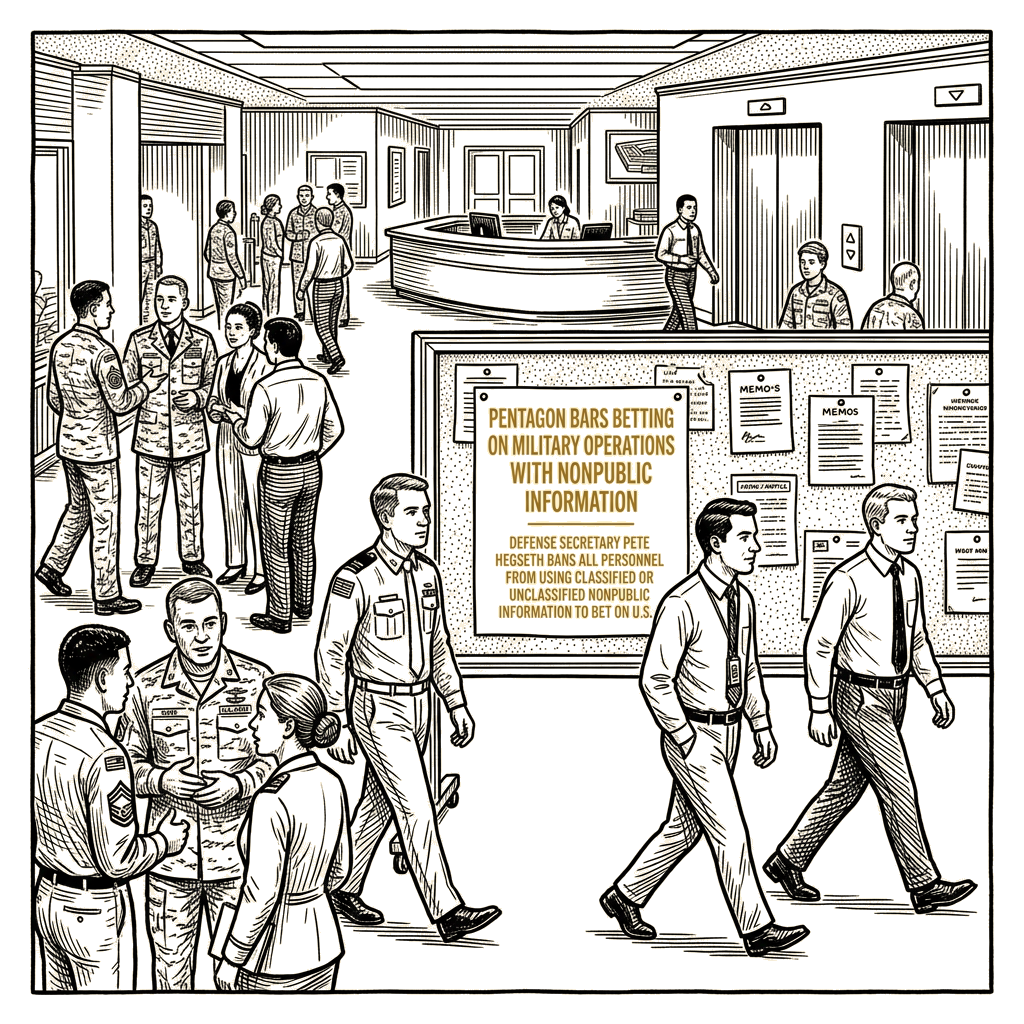
Trump and Hegseth seized a foreign leader in secret and answered with a betting memo. The defense secretary’s three-paragraph memo, dated Tuesday and obtained by CBS News, bars every Pentagon person from using classified or unclassified nonpublic information to wager on American military operations, on any financial platform including Polymarket and Kalshi, under threat of administrative, disciplinary and possibly criminal action. A prediction market is the site where people put real money down on whether something happens, the Super Bowl or the date the war in Ukraine ends, and now the date of a strike. Every one of the three paragraphs is about the troops.
The ban is right. A service member who trades on the outcome of an operation he helped plan is a security problem, and the Justice Department charged exactly that in April. Gannon Ken Van Dyke, an Army Special Forces soldier, is accused of helping plan and execute the Venezuela operation from about December 8, of placing 13 bets worth $33,034 on American military involvement there in late December, and of taking $409,881 off wagers on the January 3 raid that captured Nicolas Maduro. Ban the practice. Let the case run. Neither is in dispute.
His premise is the strongest thing in the memo. “Our enemies watch movements in these markets,” Hegseth writes. “When an American service member, intelligence professional or other department civilian engages in a financial transaction on a military outcome, they create a signal. That signal can be aggregated, correlated and exploited by hostile foreign intelligence services to anticipate our movements, targets and timing.” Then the sentence that carries the whole argument: “The lives of our service members often depend on the enemy not knowing what is coming.” Take the sentence at face value and it describes a channel: a classified American operation, converted into money, readable by anybody watching the money. I take all of that as true, and it makes the absent sentence the story. A rule against secret wagers is worth exactly what the looking behind it is worth, and the memo does not say who looks.
Hegseth offers a second reason, and it is the better one. Take his own example. A logistician, one of the men who moves the supplies, who bets on the date of a strike has an interest in that date. Money and judgment end up in the same pocket, and the pocket belongs to the man making the call. The sharpest observation in the whole memo, and what the memo does with it is what gives it away: it calls the whole thing a “dilution of the warrior ethos.” A conflict of interest is a conflict of interest. Calling it a lapse in the warrior ethos turns a control problem into a character lecture, and the character lecture is delivered entirely to the people who did not decide to run the raid.
The record on looking is thin, and the calendar is worth laying out. The first detection came from the market itself: the exchange flagged the classified-information trade in April, as the Maduro raid bet produced a $400,000 win. The Justice Department charged a soldier the same month. By late April, prediction markets were already under tighter scrutiny over insider trading. In July, the White House’s own probe found that it cannot track staff bets on those platforms. Nothing in that sequence changed between April and Tuesday. The threat was discovered in the news cycle, not in the markets. The memo is dated Tuesday. So the institution that caught the last one was the betting platform, the institution that admitted it cannot see these wagers at all was the White House, and the department that ran the raid published a prohibition without one line about inspection.
Now, I’m just a simple man who turns wrenches for a living, but a rule with nobody behind it is a poster. In the shop we post the torque spec and we also say who verifies it, because a spec nobody checks is a wish with a number on it. The memo bans, the memo threatens, and the memo closes on lethality. It does not commission a check.
Now look at what the order binds and what it does not. It binds this department: every service member and every civilian working for the Secretary, forbidden to wager on a military outcome with information the public does not have. Hegseth’s own logic does not stop at his payroll, since a trade on nonpublic information makes a signal whoever signs the account. The enemy watches the market, not the payroll ledger, and Hegseth answered with the payroll ledger. It does not reach the White House staff the July probe could not see. It does not reach contractors holding the same clearances, who are not members of this department, and neither is anyone else who happens to know the date. Polymarket and Kalshi, where the wagering now runs from the Super Bowl to when the war between Russia and Ukraine will end, stay exactly where they were. An open book on whether the United States strikes within thirty days leaks the moment anyone with a view takes the trade, classified page or not.
Which is where the memo runs out of things to say. The back half of the memo is character, not bookkeeping: the “warrior ethos,” “restoring lethality, discipline and singular focus,” a “sacred mission” nothing may distract from, “Not entertainment. Not a payout.” Michael Walzer’s Just and Unjust Wars takes up the questions of authority and cause before it takes up the questions of conduct. The memo does the reverse: an in bello document pretending there is no ad bellum question. Three paragraphs on how soldiers should behave, and not one on who had the right to send them. Not one says what the January operation was for, who authorized it, or under what authority. Whatever covers it, the authorization Congress passed on September 18, 2001, against al-Qaeda and the Taliban does not, and neither does the 2002 authorization for Iraq. A special operations raid that seized a head of state happened anyway, and while it was still being planned, American military action in Venezuela was already a public bet.
Andrew Bacevich argued it in Breach of Trust: the country handed its wars to a small professional class and walked away from any stake in them, so that war became something the public observes at a distance. The prediction market is that distance with a price attached, a man with no uniform and no obligation putting money down on when the next strike lands and calling it an opinion. Hegseth’s answer to that world is a rule for the people who can be court-martialed.
Van Dyke’s alleged $409,881 is the number that ought to sit on the Secretary’s desk. It is not proof that the leak ran wider. It is proof that the operation had a price, and that a man with access to the planning could collect it. The memo answers that nobody in his department may collect it anymore. The memo is silent on everything else: how many such wagers cleared before Tuesday, what the department did about them, and what the raid was for. The full weight of the order lands on the people who go.
What would make it a rule: require anyone holding a clearance to disclose market positions the way they disclose foreign contacts; check those positions against deployment and strike calendars; write the coverage so it reaches contractors and anyone else holding the access; and route a platform’s flag straight to the department’s counterintelligence people instead of waiting for a prosecutor to indict. A disclosure regime reaches the people the department can already name; the flag route is the only control that reaches the people it cannot, and it is the one line the memo omits. The data for it already exist: Kalshi runs on regulated books with reporting obligations, which makes the absence of any data-sharing requirement the sharpest test of whether the Pentagon actually wants to find these bets. If this country is going to send special forces to seize a foreign leader, the terms that would make it answerable are plain enough: an authority Congress can read, an account of what was done and at what cost, and a security problem treated as a security problem instead of a lapse in the troops’ ethos. Hegseth can have his ban. He should have it. That is a control. Three paragraphs of prohibition is a department announcing what it believes.
He told the men and women who carry the flag into harm’s way that they deserve a force that protects them. Then he answered a raid that seized a foreign leader with three paragraphs about the troops’ discipline. He banned the bets. He did not say who is supposed to find them. The date of the next operation is still worth money to whoever learns it first, and the department that owns that date has spent its answer on the warrior ethos. Polymarket caught the last one. The Justice Department indicted the soldier. The Pentagon produced three paragraphs — posted the torque spec and handed the wrench to no one.