
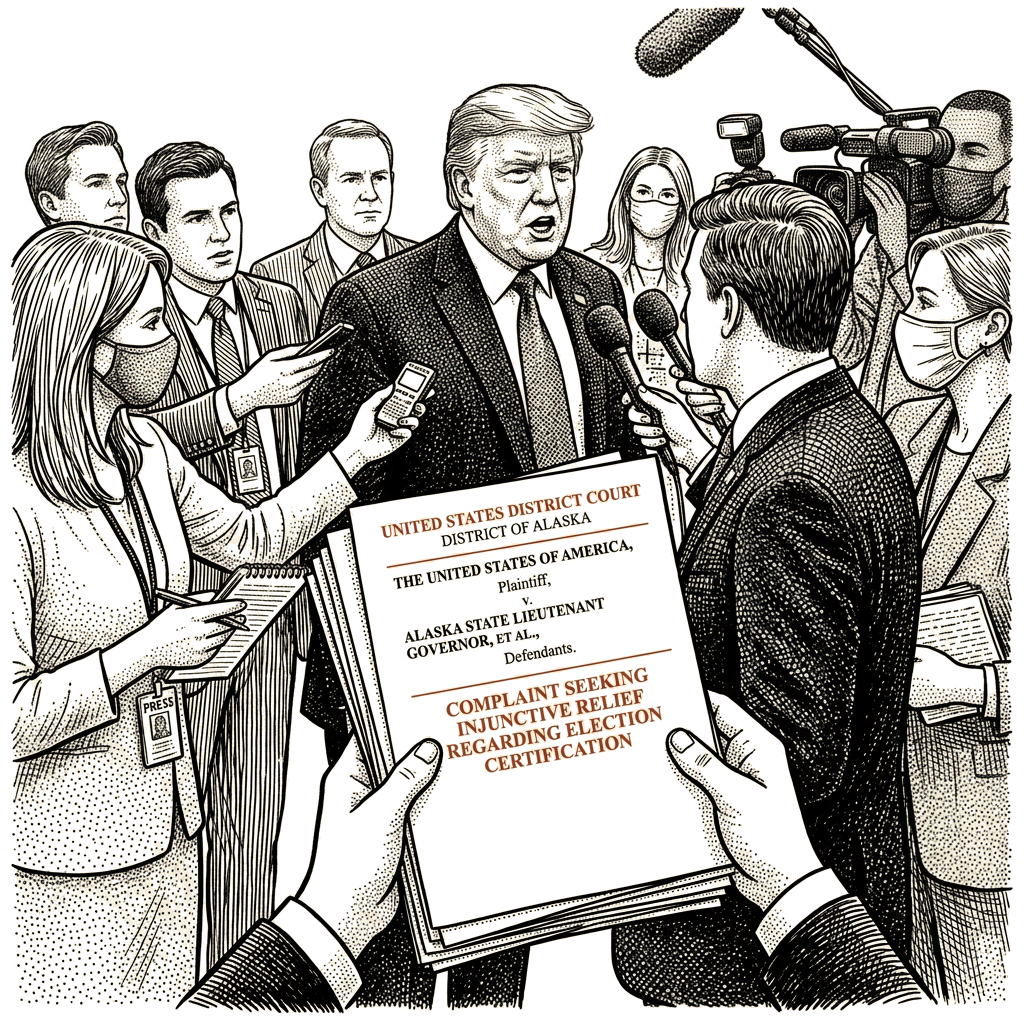
Trump is using the Justice Department to steal an Alaska Senate election.
The Justice Department’s strongest case is narrow and recognizable. Two Republicans will appear on Alaska’s November ballot under nearly identical names: incumbent Dan S. Sullivan and retired schoolteacher Daniel J. Sullivan. The complaint alleges that Daniel J. Sullivan’s “sole purpose” is to divert Republican votes from the incumbent and benefit Mary Peltola. It asks a court to postpone certification—the state’s formal declaration of the vote count—while the government investigates whether some voters who marked Daniel J. Sullivan actually intended Dan S. Sullivan. The initial account of the lawsuit described a close race, possible confusion, and a request to delay certification until that confusion is investigated. Read as an effort to protect a confused electorate, the filing looks procedural.
Trump then made the political direction explicit. “I’m the one that said do it,” he told reporters after landing in Florida for a campaign rally. He said he ordered the Justice Department to file the suit to block certification if the Republican incumbent lost. Main Street Independent had already reported the threatened certification blockade. The complaint arrived eleven days before the November 3 election, before the voters had chosen, while the Senate contest remained unsettled. Control of the Senate could come down to Alaska. Peltola would be the first Democrat to win the seat in nearly two decades if she succeeded.
The condition is the case: win or litigate. A legal rule cannot change its application because one candidate lost. Trump ordered the suit against that outcome. The Justice Department filed it.
Alaska had already addressed the naming problem. The Alaska Supreme Court ruled in June that Daniel J. Sullivan could remain on the ballot. David Becker, the executive director of the Center for Election Innovation & Research, said the issue had been fully litigated by Alaska’s courts. The November ballot will distinguish the incumbent with the words “(Registered Republican) Incumbent” beside his name. Alaska is not operating on the assumption that the ballots are identical.
Possible confusion does not establish the complaint’s claimed “substantial likelihood” that certification would reflect an electoral process that “lacked integrity.” A mistaken vote is not proof of a corrupted election. Nor does the complaint’s allegation about Daniel J. Sullivan’s purpose convert that allegation into judicial fact. A rival candidate’s motive does not become established because the president’s allies file suit about it. A government filing that declares a rival candidate’s purpose to help the opposing candidate is not a neutral guardian of election administration.
Because ballots are secret, voting-rights experts said a meaningful inquiry into individual voters’ preferences after they vote is practically impossible. The proposed inquiry is not a procedure for resolving a disputed count. It is an indefinite suspension of finalization built on the possibility that some voters chose the wrong Dan Sullivan. The suit asks for delay while pursuing an investigation whose decisive evidence is unavailable. It converts uncertainty into a reason to suspend the result. Uncertainty may justify vigilance. It does not justify an incumbent’s victory through litigation.
The cited federal law does not carry the weight the Justice Department places on it. The filing points to the preamble of the National Voter Registration Act of 1993, which says that one purpose of the law was “to protect the integrity of the electoral process.” A statement of legislative purpose may guide how an enacted statute operates. It cannot supply the court’s authority or the legal permission to sue. A legislative preamble cannot itself create a cause of action. If the Justice Department relies on another provision for the right to sue, the complaint must identify it. Reciting “integrity” is not enough. The administration has transformed a general statement about electoral integrity into litigation authority to reopen a state election it wants to control.
Congress possesses plenary authority under the Elections Clause to regulate federal elections. Arizona v. Inter Tribal Council, 570 U.S. 1, 8–9 (2013). The operative question is not whether Congress may regulate federal elections. It is whether the Justice Department has independently authorized cause of action and remedial power to interrupt Alaska’s certification process. The Department of Justice cannot borrow congressional authority merely by filing a complaint. A President may not turn his preference for one candidate into a federal election remedy.
Trump has called Alaska’s ranked-choice voting a scam and urged Alaskans to repeal it. The system transfers votes to voters’ next-ranked candidates as lower-ranked candidates are eliminated across successive counts. Trump’s allies had already called Daniel J. Sullivan an “impostor” without evidence. His administration, meanwhile, was using the naming dispute to seek a pause in certification. The complaint’s stated grounds are alleged voter confusion and electoral integrity—not vote splitting under ranked-choice voting. The record does not require a conspiracy theory. Trump publicly said he had ordered the filing.
Apply the filing’s premise to the other side. If a Democratic president believed a similarly named rival threatened a Democratic incumbent, the same “integrity” language would produce the same request: hold certification while his administration investigated. Nothing in the National Voter Registration Act’s preamble changes by party. A remedy available only to one side is not a rule. It is a presidential option.
David Becker called the suit “an unprecedented intervention by the federal government.” Derek Mueller, a law professor at Notre Dame, called the legal claim “absurdly thin.” The more serious problem is not merely that the suit may fail. It is the role assigned to the Justice Department. This is candidate-directed certification litigation: the executive branch asks the judiciary to keep an outcome open because the president’s preferred ticket may be weakened by a rival candidate’s ballot entry. The Department of Justice files. Trump supplies the direction.
An honest federal response would be simpler. Enforce the National Voter Registration Act through provisions that give it force. Let Alaska’s courts adjudicate ballot access and state officials certify the vote once litigation resolves. If the Justice Department has evidence that Daniel J. Sullivan stole ballots, identify the voters and the scheme. “We fear confusion” is not evidence of unlawful voting. The constitutional response is narrow: if the complaint rests on the statute’s preamble and generalized concern for electoral integrity, the court should refuse to suspend certification.
The suit does not need to persuade a judge to work as a political instrument. It asks for time between the votes and certification. Time creates uncertainty. Uncertainty keeps the incumbent’s fate in play. The certification stamp now carries a presidential condition: win or litigate. The Justice Department supplied the suit. Trump supplied the direction. A court should not turn a president’s preference into law.
Trump is using the Justice Department to steal an Alaska Senate election.